Web cookies (also called HTTP cookies, browser cookies, or simply cookies) are small pieces of data that websites store on your device (computer, phone, etc.) through your web browser. They are used to remember information about you and your interactions with the site.
Purpose of Cookies:
Session Management:
Keeping you logged in
Remembering items in a shopping cart
Saving language or theme preferences
Personalization:
Tailoring content or ads based on your previous activity
Tracking & Analytics:
Monitoring browsing behavior for analytics or marketing purposes
Types of Cookies:
Session Cookies:
Temporary; deleted when you close your browser
Used for things like keeping you logged in during a single session
Persistent Cookies:
Stored on your device until they expire or are manually deleted
Used for remembering login credentials, settings, etc.
First-Party Cookies:
Set by the website you're visiting directly
Third-Party Cookies:
Set by other domains (usually advertisers) embedded in the website
Commonly used for tracking across multiple sites
Authentication cookies are a special type of web cookie used to identify and verify a user after they log in to a website or web application.
What They Do:
Once you log in to a site, the server creates an authentication cookie and sends it to your browser. This cookie:
Proves to the website that you're logged in
Prevents you from having to log in again on every page you visit
Can persist across sessions if you select "Remember me"
What's Inside an Authentication Cookie?
Typically, it contains:
A unique session ID (not your actual password)
Optional metadata (e.g., expiration time, security flags)
Analytics cookies are cookies used to collect data about how visitors interact with a website. Their primary purpose is to help website owners understand and improve user experience by analyzing things like:
How users navigate the site
Which pages are most/least visited
How long users stay on each page
What device, browser, or location the user is from
What They Track:
Some examples of data analytics cookies may collect:
Page views and time spent on pages
Click paths (how users move from page to page)
Bounce rate (users who leave without interacting)
User demographics (location, language, device)
Referring websites (how users arrived at the site)
Here’s how you can disable cookies in common browsers:
1. Google Chrome
Open Chrome and click the three vertical dots in the top-right corner.
Go to Settings > Privacy and security > Cookies and other site data.
Choose your preferred option:
Block all cookies (not recommended, can break most websites).
Block third-party cookies (can block ads and tracking cookies).
2. Mozilla Firefox
Open Firefox and click the three horizontal lines in the top-right corner.
Go to Settings > Privacy & Security.
Under the Enhanced Tracking Protection section, choose Strict to block most cookies or Custom to manually choose which cookies to block.
3. Safari
Open Safari and click Safari in the top-left corner of the screen.
Go to Preferences > Privacy.
Check Block all cookies to stop all cookies, or select options to block third-party cookies.
4. Microsoft Edge
Open Edge and click the three horizontal dots in the top-right corner.
Go to Settings > Privacy, search, and services > Cookies and site permissions.
Select your cookie settings from there, including blocking all cookies or blocking third-party cookies.
5. On Mobile (iOS/Android)
For Safari on iOS: Go to Settings > Safari > Privacy & Security > Block All Cookies.
For Chrome on Android: Open the app, tap the three dots, go to Settings > Privacy and security > Cookies.
Be Aware:
Disabling cookies can make your online experience more difficult. Some websites may not load properly, or you may be logged out frequently. Also, certain features may not work as expected.
It comes as no surprise to senior Brandon Hermoza-Ricci that his peers are extremely invested in sustainability, particularly in the wellbeing of the planet.
“We’ve seen what the world used to be, and what it is becoming, and we want to keep it the way it should be,” said Hermoza-Ricci. “That’s what inspires us.”Continue Reading
UConn Today – The School of Business is hosting a Global Business Leadership in Sustainability Summit, featuring professionals and faculty discussing key initiatives that are shaping sustainability in business, both locally and around the world.
The Friday, March 25 summit will provide students the opportunity to speak with professionals who share their passion for “business for good,” and encourage students to explore the potential of incorporating sustainability within their careers.
I Nengah Dana (left) and Komang Mandi(right), employees from the Rinjani Mountain Coffee growers, harvesting coffee beans. UConn’s International Business Case Competition was focused on providing solutions to the business challenges of several international companies. (Contributed Photo)
For every 300 kilograms of rich, flavorful coffee beans Rinjani Mountain Coffee growers pick on their farm in Indonesia, about 100 kilograms are unusable husks, suitable only for composting.
Or so co-owner Brett Tagrin thought.
That was before he saw the myriad opportunities to repurpose the waste byproducts dreamed up by resourceful students in the 2021 UConn International Business Case Challenge. Hosted by the School of Business for the eleventh year, the competition brought teams of undergrads from around the world to compete virtually by solving real-life business issues, and boosted their global expertise in the process.Continue Reading
Management major Duygu Ozcan at COP26 in Glasgow, Scotland (Contributed Photo)
Management major Duygu Ozcan was among 14 UConn students selected to attend the United Nations’ Climate Change Conference, nicknamed COP26, in Glasgow, Scotland, last month.
With access to the conference’s prestigious Blue Zone, where key negotiations between world leaders take place, Ozcan said the experience heightened her professional and personal interests in the intersection of business and sustainability.Continue Reading
David Noble (left) and Peter Barkman (Right) during a recent installment of the Global Entrepreneurship Speaker Series at UConn. (Arminda Kamphausen / UConn School of Business)Four prominent entrepreneurs came to campus this semester to talk about their companies, their visions, and ways in which students can embrace industry disruption.Continue Reading
CIBER is expanding its professional development program in exporting and compliance (istockphoto.com)
The Center for International Business Education &Research (CIBER) is creating a new, professional development program in exporting for students in the part-time MBA program in Hartford.Continue Reading
Students from eight universities, two of them international, participated in an ice-breaker at the Makerspace experimental lab at the Werth Tower, as a prelude to the Annual UConn CIBER Case Challenge. (Nathan Oldham/UConn School of Business)
The UConn Center for International Business and Education Research (CIBER) held its 15th annual case competition this month, hosting global-minded business students during a four-day event.Continue Reading
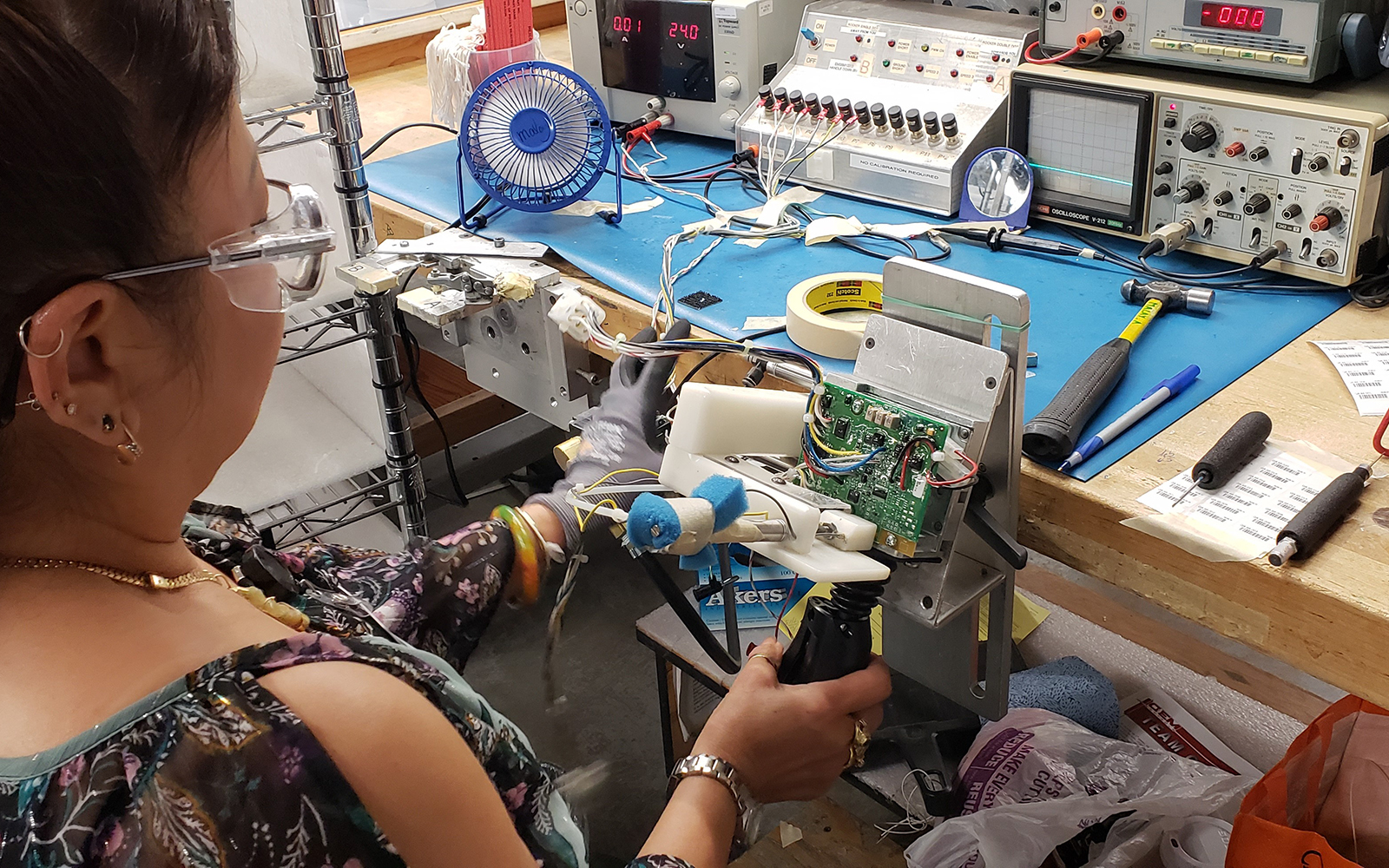
An electrohydraulic controller being created at OEM Controls in Shelton, Conn. (Sulin Ba/UConn School of Business)
Associate Dean Sulin Ba and Arminda Kamphausen, associate director of UConn’s Center for International Business Education and Research (CIBER), recently visited Samuel R.N. Simons ’95 EMBA at his company, OEM Controls in Shelton, Conn. Simons is the newest member of CIBER’s Advisory Council. Continue Reading
CIBER Case Challenge participants gather around the Husky statue on the UConn Storrs campus for a quick photo. (Arminda Kamphausen/UConn School of Business)
Unique Competition Requires Strong Knowledge; Fosters Quick Team Bonding, Personal Growth