Web cookies (also called HTTP cookies, browser cookies, or simply cookies) are small pieces of data that websites store on your device (computer, phone, etc.) through your web browser. They are used to remember information about you and your interactions with the site.
Purpose of Cookies:
Session Management:
Keeping you logged in
Remembering items in a shopping cart
Saving language or theme preferences
Personalization:
Tailoring content or ads based on your previous activity
Tracking & Analytics:
Monitoring browsing behavior for analytics or marketing purposes
Types of Cookies:
Session Cookies:
Temporary; deleted when you close your browser
Used for things like keeping you logged in during a single session
Persistent Cookies:
Stored on your device until they expire or are manually deleted
Used for remembering login credentials, settings, etc.
First-Party Cookies:
Set by the website you're visiting directly
Third-Party Cookies:
Set by other domains (usually advertisers) embedded in the website
Commonly used for tracking across multiple sites
Authentication cookies are a special type of web cookie used to identify and verify a user after they log in to a website or web application.
What They Do:
Once you log in to a site, the server creates an authentication cookie and sends it to your browser. This cookie:
Proves to the website that you're logged in
Prevents you from having to log in again on every page you visit
Can persist across sessions if you select "Remember me"
What's Inside an Authentication Cookie?
Typically, it contains:
A unique session ID (not your actual password)
Optional metadata (e.g., expiration time, security flags)
Analytics cookies are cookies used to collect data about how visitors interact with a website. Their primary purpose is to help website owners understand and improve user experience by analyzing things like:
How users navigate the site
Which pages are most/least visited
How long users stay on each page
What device, browser, or location the user is from
What They Track:
Some examples of data analytics cookies may collect:
Page views and time spent on pages
Click paths (how users move from page to page)
Bounce rate (users who leave without interacting)
User demographics (location, language, device)
Referring websites (how users arrived at the site)
Here’s how you can disable cookies in common browsers:
1. Google Chrome
Open Chrome and click the three vertical dots in the top-right corner.
Go to Settings > Privacy and security > Cookies and other site data.
Choose your preferred option:
Block all cookies (not recommended, can break most websites).
Block third-party cookies (can block ads and tracking cookies).
2. Mozilla Firefox
Open Firefox and click the three horizontal lines in the top-right corner.
Go to Settings > Privacy & Security.
Under the Enhanced Tracking Protection section, choose Strict to block most cookies or Custom to manually choose which cookies to block.
3. Safari
Open Safari and click Safari in the top-left corner of the screen.
Go to Preferences > Privacy.
Check Block all cookies to stop all cookies, or select options to block third-party cookies.
4. Microsoft Edge
Open Edge and click the three horizontal dots in the top-right corner.
Go to Settings > Privacy, search, and services > Cookies and site permissions.
Select your cookie settings from there, including blocking all cookies or blocking third-party cookies.
5. On Mobile (iOS/Android)
For Safari on iOS: Go to Settings > Safari > Privacy & Security > Block All Cookies.
For Chrome on Android: Open the app, tap the three dots, go to Settings > Privacy and security > Cookies.
Be Aware:
Disabling cookies can make your online experience more difficult. Some websites may not load properly, or you may be logged out frequently. Also, certain features may not work as expected.
As we approach the final weeks of 2017, the School of Business is growing, thriving and delivering its best to our students, wherever they may be.
Excitement has been at fever pitch in the last few months. We have celebrated phenomenal growth in our campuses, our programs and our student enrollment. Continue Reading
iSixSigma – The Lean Six Sigma (LSS) Green Belt and Black Belt curriculum needs an overhaul. The original operational excellence (OpEx) Lean Six Sigma methodology developed by Motorola in the 1980s and made famous by Jack Welch at General Electric (GE) in the early 1990s is finding itself a bit long in the tooth in comparison to the digital transformation activity going on around it. Practitioners of Lean Six Sigma who learned their craft more than 10 years ago need on-the-job training or CE (continuing education) classes to remain valuable to their client companies. The digital transformation has overtaken this quaint methodology, and unless continuous improvement teams embrace the new paradigm, their ability to affect the world will get smaller and smaller.
UConn Net Impact Graduate Chapter – On October 13th, 2017, UConn’s Graduate Net Impact Chapter hosted a volunteer day for Riverfront Recapture, a non-profit organization that manages downtown Hartford’s riverfront park system.
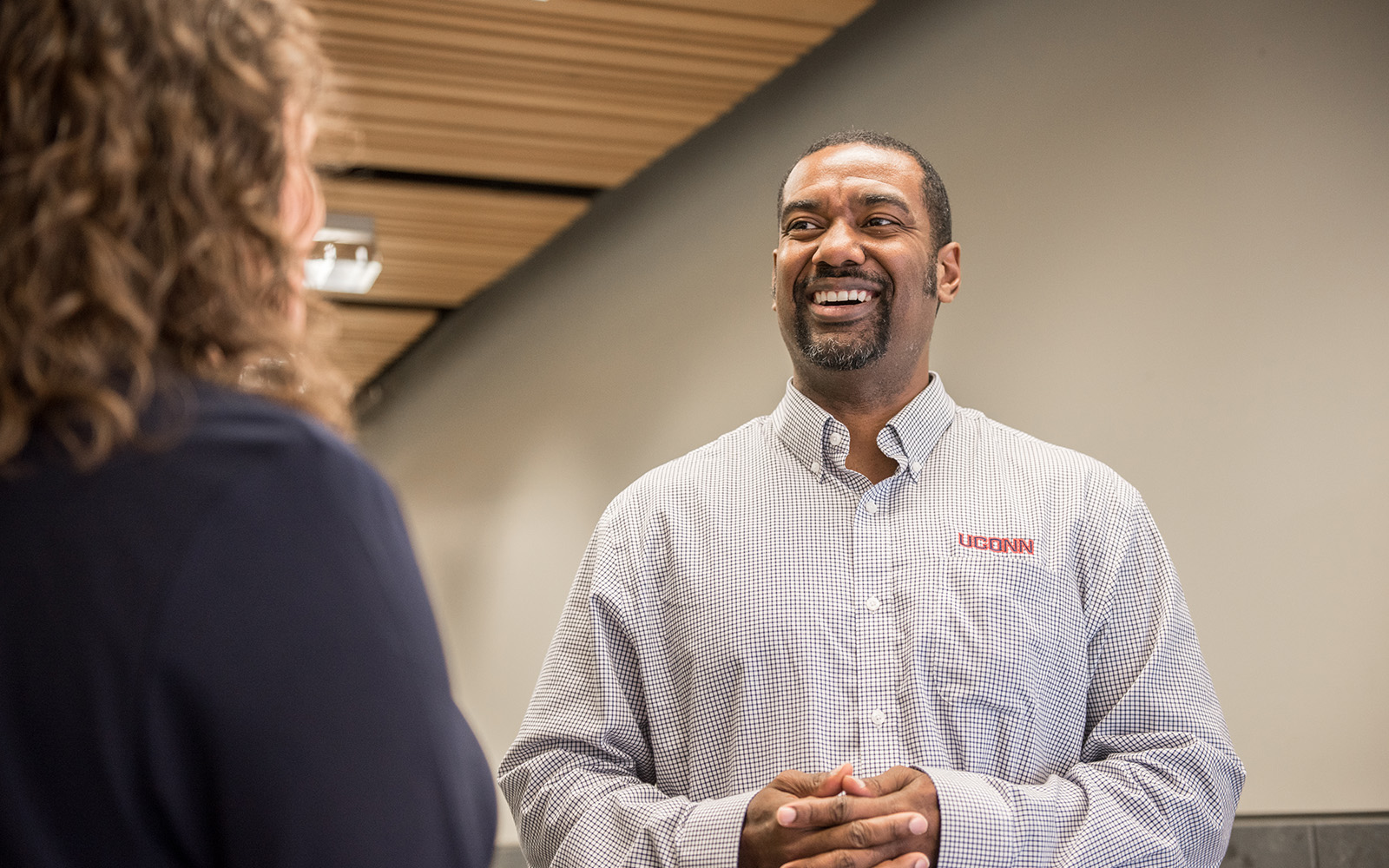
Leanne Adams speaks with Christopher Miller after the first faculty meeting in September. Both Adams and Miller are new instructors-in-residence in the accounting department. (Nathan Oldham/UConn School of Business)
Impressive Professors Bring Strong Credentials, Added Zeal to School of Business Ranks
An expert in terror analytics, a marketer who worked for NBC, Pepsi and Disney, and a champion of the volunteer income tax program at UConn are among the newest faculty at the School of Business. Continue Reading
LIMRA – LIMRA today announced it has established a Center of Excellence for Predictive Modeling and Data Analytics. LIMRA has hired Vikram Kamath to be the Center’s director.
With one new campus and one expansion, there is little doubt that Hartford is “Husky territory.” Here are some of the other milestones in our Hartford history: Continue Reading
John Elliott, dean, greets School of Business alumni gathered at a rooftop reception celebrating the opening of the first residence hall to serve the Stamford campus. (Nathan Oldham/UConn School of Business)
Business Alumni Overjoyed with Direction of Stamford Campus; Opening of New Residence Hall
Pengfei Yang ’15 MSBAPM is several years into a great career as a senior business analyst at Charter Communications, but on Aug. 17 he longed to be a UConn student again.
Yang was among 75 School of Business alumni gathered at a rooftop reception celebrating the opening of the first residence hall to serve the Stamford campus, located at 900 Washington Boulevard in the heart of downtown. Continue Reading
A dozen colleges and universities were represented at the 2017 UConn Analytics Roundtable on July 18 at the Graduate Business Learning Center (GBLC) in downtown Hartford.
The goal of the event was to form alliances between career coaches from Northeast business schools with analytics/data science graduate programs.
In addition to UConn, participating universities included: Clark, Syracuse, Merrimack College, NYU, Quinnipiac, Fordham, Brandeis, SUNY Buffalo, Rutgers, Boston University and the University of New Hampshire.
Professor John Wilson from the OPIM department was the keynote speaker and addressed the audience about the trends and future of analytics.
The 2017 UConn Analytics Roundtable was held on July 18 in Hartford, Conn. (Katherine Duncan/UConn School of Business)
“From the moment guests arrived there was chatter and energy in the room,” said Katherine Duncan, a UConn MSBAPM career adviser, who organized and moderated the event. “It was clear that all invited had passion for helping students and enthusiasm to share.”
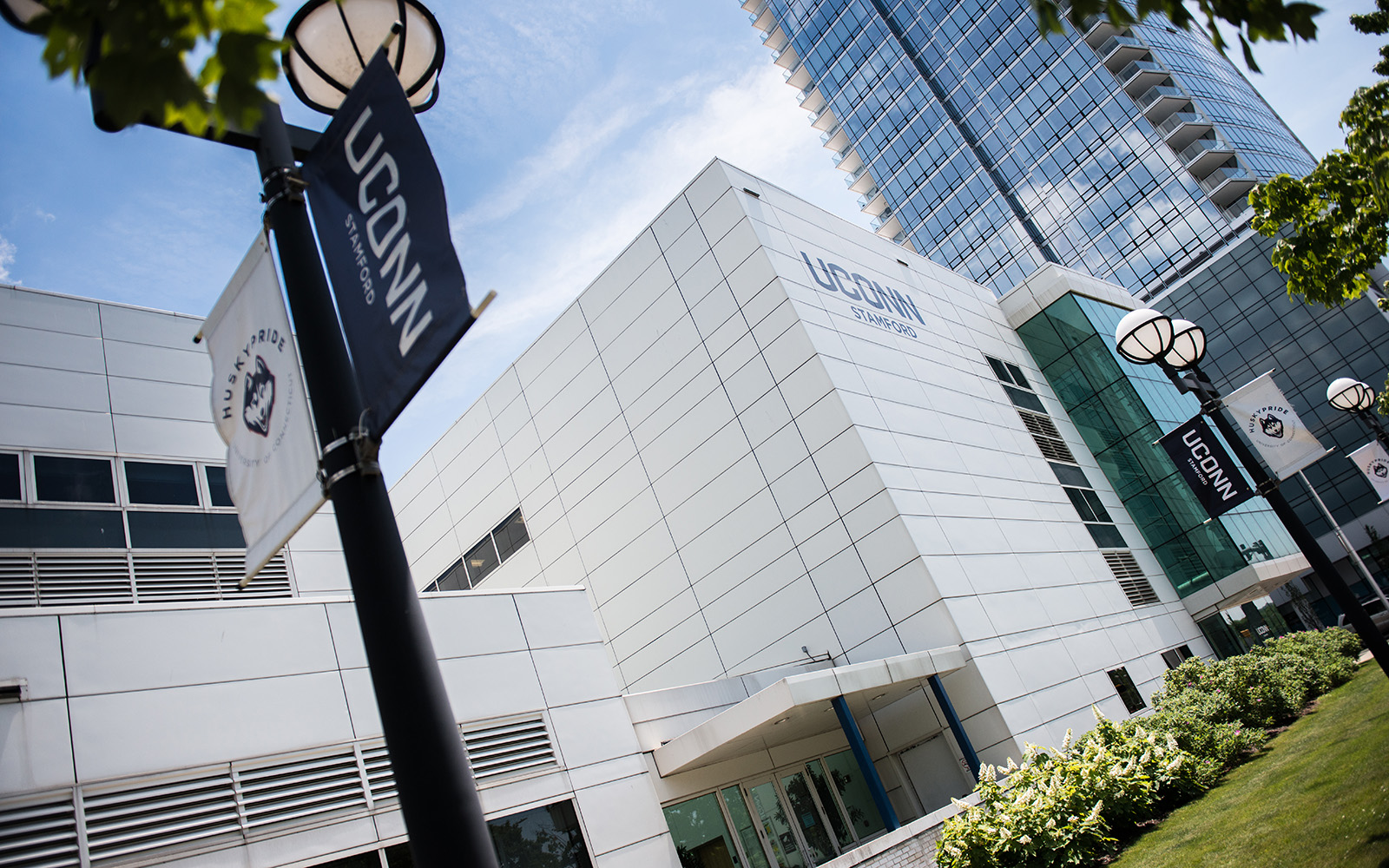
University of Connecticut, Stamford (Nathan Oldham/UConn School of Business)
The University of Connecticut’s downtown hub stands about 100 miles from its main campus. But it is no distant outpost.
UConn’s business school exemplifies the increasing prominence of the university in Stamford. Enrollment is growing and a major conference held last week reflects university officials’ view of the Stamford campus as an equal to the one in Storrs. Continue Reading
Stamford Advocate – The University of Connecticut’s downtown hub stands about 100 miles from its main campus. But it is no distant outpost.
UConn’s business school exemplifies the increasing prominence of the university in Stamford. Enrollment is growing and a major conference held last week reflects university officials’ view of the Stamford campus as an equal to the one in Storrs.