Web cookies (also called HTTP cookies, browser cookies, or simply cookies) are small pieces of data that websites store on your device (computer, phone, etc.) through your web browser. They are used to remember information about you and your interactions with the site.
Purpose of Cookies:
Session Management:
Keeping you logged in
Remembering items in a shopping cart
Saving language or theme preferences
Personalization:
Tailoring content or ads based on your previous activity
Tracking & Analytics:
Monitoring browsing behavior for analytics or marketing purposes
Types of Cookies:
Session Cookies:
Temporary; deleted when you close your browser
Used for things like keeping you logged in during a single session
Persistent Cookies:
Stored on your device until they expire or are manually deleted
Used for remembering login credentials, settings, etc.
First-Party Cookies:
Set by the website you're visiting directly
Third-Party Cookies:
Set by other domains (usually advertisers) embedded in the website
Commonly used for tracking across multiple sites
Authentication cookies are a special type of web cookie used to identify and verify a user after they log in to a website or web application.
What They Do:
Once you log in to a site, the server creates an authentication cookie and sends it to your browser. This cookie:
Proves to the website that you're logged in
Prevents you from having to log in again on every page you visit
Can persist across sessions if you select "Remember me"
What's Inside an Authentication Cookie?
Typically, it contains:
A unique session ID (not your actual password)
Optional metadata (e.g., expiration time, security flags)
Analytics cookies are cookies used to collect data about how visitors interact with a website. Their primary purpose is to help website owners understand and improve user experience by analyzing things like:
How users navigate the site
Which pages are most/least visited
How long users stay on each page
What device, browser, or location the user is from
What They Track:
Some examples of data analytics cookies may collect:
Page views and time spent on pages
Click paths (how users move from page to page)
Bounce rate (users who leave without interacting)
User demographics (location, language, device)
Referring websites (how users arrived at the site)
Here’s how you can disable cookies in common browsers:
1. Google Chrome
Open Chrome and click the three vertical dots in the top-right corner.
Go to Settings > Privacy and security > Cookies and other site data.
Choose your preferred option:
Block all cookies (not recommended, can break most websites).
Block third-party cookies (can block ads and tracking cookies).
2. Mozilla Firefox
Open Firefox and click the three horizontal lines in the top-right corner.
Go to Settings > Privacy & Security.
Under the Enhanced Tracking Protection section, choose Strict to block most cookies or Custom to manually choose which cookies to block.
3. Safari
Open Safari and click Safari in the top-left corner of the screen.
Go to Preferences > Privacy.
Check Block all cookies to stop all cookies, or select options to block third-party cookies.
4. Microsoft Edge
Open Edge and click the three horizontal dots in the top-right corner.
Go to Settings > Privacy, search, and services > Cookies and site permissions.
Select your cookie settings from there, including blocking all cookies or blocking third-party cookies.
5. On Mobile (iOS/Android)
For Safari on iOS: Go to Settings > Safari > Privacy & Security > Block All Cookies.
For Chrome on Android: Open the app, tap the three dots, go to Settings > Privacy and security > Cookies.
Be Aware:
Disabling cookies can make your online experience more difficult. Some websites may not load properly, or you may be logged out frequently. Also, certain features may not work as expected.
UConn Today – Representatives from around the world will descend upon Antalya, Turkey, next month to discuss one of the most complex and important issues facing our world—climate change.
Suhitha Sreedhar, a senior in the School of Business, will get a front-row seat to those conversations. She is one of the UConn delegates who will attend the United Nation’s Conference of Parties (COP), an annual symposium held this year from Nov. 9 to 20.
Sreedhar, a management major with a minor in social responsibility and impact in business, is excited for the trip, seeing this as a culmination of her work at UConn and a boost to her future aspirations.
Alli Selman ’26 MS (above) in Storrs, CT during her recent graduation from the MSSRIB program. (contributed photo)
As a high school student, Alli Selman ’26 (MS) took a trip to Tanzania where she volunteered at a Baby Home and Mothering Center that assisted single mothers in creating a better life.
Most of the clients enrolled in the Mothers Against Poverty program had husbands who had died or abandoned them. The program gave the women the resources to create self-sustaining small businesses that served the community while making money to support their families.
The businesses were as unique as their owners, ranging from a hairdressing business to a fresh-juice dispensary.
“I was so impressed by the women I met, and the way that their businesses empowered them to contribute to their communities, and changed their lives for the better,” Selman said. “I thought, ‘Wow! This is really awesome!’ and that enthusiasm has never left me.”
Selman, a Texas Native, Earned Her Degree Remotely, While Working Full Time
Selman recently graduated from UConn with a master’s degree in Social Responsibility & Impact in Business. The program advanced her interest in business as a vehicle for good.
A resident of the Greater Dallas area, Selman appreciated the online format of the UConn program, which allowed her to continue working full-time as a legal assistant while also taking up to four classes per semester. She was able to complete her master’s degree in one year.
“It was very tough at times,” she said. “The rest of my life took a step aside for a year. My focus was all on work and school.”
Despite living 1,600 miles away, Selman felt connected to the program by attending three in-person course weekends, which allowed her to make friends, work on group projects, meet professors and program leaders, and feel well-connected to UConn. Arminda Kamphausen, program manager, even gave her a tour of Hartford.
Selman found UConn’s program while searching for master’s degrees online. She applied to and was accepted into a number of business- sustainability programs. UConn stood out academically, and she also liked its online format, which allowed her to keep working full-time while attending school.
“A master’s is a big commitment, and I wanted to dedicate the time and effort to it,” she said. “I was able to live at home and cut down on expenses and other stressors. Even though I’ve always been a good student, a master’s degree program is a whole new beast! I would recommend this program to everyone.”
“The professors were great and so knowledgeable, and my classmates were so kind,” she said. “The advisers made it very manageable and were in constant communication, even if it was just a check-in by email. Just knowing I had the support and a team behind me that wanted me to do well, pushed me to succeed.”
Kamphausen said that Selman had the drive and initiative necessary for a sustainability career, but needed the tools and confidence to take the next step.
“Alli brought a wonderful energy and unique perspective to the cohort,” she said. “I’m certain that she’s going to have a tremendous impact during her career, and we look forward to her success.”
Sustainability Offers Proven Benefits for Companies
Selman said she enjoyed all aspects of the sustainability program, but found the skills she learned about corporate sustainability reporting the most valuable.
“As I’m looking at job postings, I can confidently say, ‘I have a solid foundation in this,'” she said. “Everyone believes that good business practices are valuable, but through this program I learned how to document them. I can confidently explain that responsible business choices are appealing to both customers and investors.”
Undergrad Degrees Provided ‘Moral Compass’
Selman earned two bachelor’s degrees at Belmont University, one in social entrepreneurship, the other in faith and social justice. She said her undergraduate degrees sharpened her moral compass and revealed how ethics and morality play into business.
“The UConn program allowed me to see that in practice—especially the sustainability side, which I had little knowledge of when I came in,” she said. “The ‘Global Issues in Marketing for Social Impact’ class taught me to analyze different sustainability reports and understand if a company is meeting its goals and communicating its success efficiently and honestly.”
Selman, who has worked as a legal assistant since 2022, also earned a certificate in corporate regulatory compliance from the UConn School of Law.
“Another thread connecting my education and my experience is that I’ve learned a great deal about compliance practices and adhering to the laws. I know the legal jargon, how to write a legal document, the ins-and-outs of case management. They are all skills that I think will be helpful in my career,” she said.
Selman is pursuing roles in corporate sustainability, human rights, or social impact. She plans to cast a wide net initially and then fine-tune her interests.
“Across the years, my interest has surrounded the theme of impact and trying to positively effect and help others,” she said. “I’m excited to find my niche.”
UConn Today – As companies face increasing pressure to address climate change, many are choosing to publicly announce voluntary carbon-elimination goals.
Two UConn researchers have discovered that, in addition to highlighting environmental responsibility, these commitments also influence how investors perceive the value of a company.
UConn Today – UConn’s excellence in graduate education is being recognized nationwide, with U.S. News & World Report granting high rankings for 2026 to several online programs for their quality, affordability, and flexibility for distance-learning students.
UConn Today – Two UConn business students who are passionate about sustainability and a healthier planet, attended the COP30 climate conference last month in Belem, Brazil, adjacent to the Amazon rainforest.
Both graduate student Caroline Keary ’25, ’26 MS and senior Aminieli Hopson ’26 said the experience was one of the best of their lives, and that what they learned will benefit their careers.
They left with a new network of like-minded climate advocates and an appreciation for both the enormous challenges of climate preservation and renewed respect for those who dedicate their lives to it.
UConn Today – A dream team with great chemistry, months of brainstorming, research and practice, and a well-executed presentation helped five UConn Case Club teammates finish in the Top 3 in the prestigious Boston University Questrom 50K Sustainability Case Competition.
UConn Today – Professor Gerlinde Berger-Walliser, head of the Marketing Department, was featured in the quarterly issue of the International Child Art Foundation’s ChildArt Magazine.
In the interview Berger-Walliser, an associate professor of business law in the School of Business, talked about growing up in a small town in Germany and loving music from a very young age.
UConn Today – Macy’s Inc. recently invited four UConn business graduate students to serve as consultants in a months-long project reviewing and analyzing the company’s sustainable business practices.
Each of the four students were enrolled in the “Social Responsibility and Accountability in Business” course taught by business law professor Rachel Chambers. The course is part of a newer graduate program on Social Responsibility & Impact in Business.
Sharing Highlights of a Successful, Innovative Year
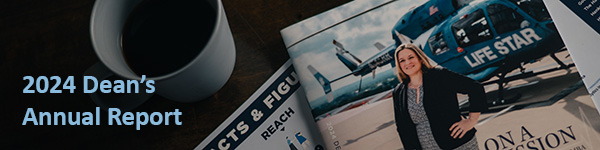
The 2024 Dean’s Annual Report is just dropping, and I’m excited to share some of the highlights and accomplishments at the School of Business this year.
Throughout our 20-page report, you’ll find articles, photos, employment statistics, and evidence of the boundless enthusiasm of our students, faculty, alumni and staff. Some of you will receive it in the mail, but in the interest of saving trees and reducing cost, it is also available online.
UConn Today – The School of Business’ Marketing Department has created a 30-credit Master of Science in Social Responsibility & Impact in Business, addressing an escalating demand for professionals in the field and significant student interest in pursuing careers that impact economic, environmental, and social sustainability.
The new degree program was approved by the University’s Board of Trustees on Wednesday, April 17, and launches this fall. The degree will prepare graduates to drive innovative and impactful business decisions for positive social change.