Faculty


Faculty Research: A Firm-Driven Approach to Global Governance and Sustainability

American Business Law Journal (forthcoming)

Stephen Park and Gerlinde Berger-Walliser.

The multifaceted role of multinational corporations as quasi-regulators is of growing importance to international business. Corporations increasingly participate in two kinds of international rulemaking: (i) non-binding “soft” law standard setting; and (ii) self-regulation through private rules and standards. Soft law and private regulation often fill governance gaps left by incomplete and/or ineffective governmental regulation. One of the most prominent examples is sustainability rulemaking, in which corporations have become increasingly active due to their growing awareness of the directly-borne costs of environmental degradation and the potential strategic benefits of corporate social responsibility.Continue Reading


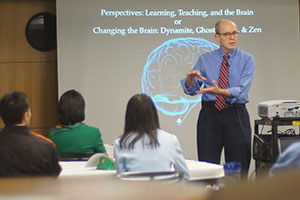
Faculty Attend Workshop on Brain, Learning; Dartmouth Prof Offers Suggestions on Retaining Knowledge


Presenter speaking to a crowd at a faculty workshop.
Many people think of the human brain as like a giant filing cabinet. Just open the right drawer, pull out a folder, and it will be loaded with all the information you need.

In fact, retrieving information is more like going on an archaeological dig, said G. Christian Jernstedt, professor emeritus of psychological and brain sciences at Dartmouth College.

“We find fragments and we assemble them into something meaningful,” he said. “That’s why we rummage around in our brains for the answers. Sometimes there isn’t even a correct answer. It’s the thinking that is the important part.”

Jernstedt spoke to 60 faculty and graduate students Oct. 31 at a workshop titled, “Perspectives on Learning, Teaching and the Brain.” Jernstedt specializes in human learning and speaks around the world about cognitive, social, behavioral and educational neurosciences.

During the full-day workshop, he talked about emerging research on increasing the ability to learn, building effective learning habits, and different ways to evaluate what has been learned.

Management Professor Travis Grosser said the lecture was fascinating. “I wanted to learn more about how the brain works and how to apply that knowledge in the classroom,” he said. “I appreciate that the School of Business is helping us become better teachers and helping us grow and develop our professional skills.”

Some 150,000 articles and books have been written about the human brain in recent years, Jernstedt said. Among his findings is that the more engaged a person is, the more active their learning becomes.

“Memory is constructed, it isn’t a passive situation. If it is an active process, it works,” he said. “The person who is ‘doing’ is the person who is learning.”

That’s why taking notes is more effective than listening; why talking to others is better than learning alone, he said.

What happens when you use an area of the brain a great deal? Before GPS was widely used, London cabbies had to study maps of the city until they knew every road. For them, the centers of the brain that learn place, direction and navigation blossomed. “When you use the brain, it changes,” he said.

But while some changes are universal, every individual learns differently. In fact, the human brain is a bit like a novelist, Jernstedt said.

“Our brain makes up stories about reality,” he said. “Our stories vary by experience. We all see things differently.”

For an example, he showed an abstract picture of a man and woman engaged in an embrace. When the same picture was shown to young children, they saw porpoises in the photo because their frame of reference is different, he said.

“So when we develop courses, programs and schools, it is important to recognize that how people code and retain information varies, depending what’s happened to them,” Jernstedt said.

The human brain contains 20 billion cells just for thinking, he said, yet we are most successful when we tackle one task at a time. “People who say they ‘multitask’ either do it poorly, or are really shifting between tasks,” he said.

Research by a jam-and-jelly company also indicates that too many options are overwhelming. On the days when customers could sample 20 or more types of jam, only 3 percent bought the product. When offered only five varieties, 30 percent of the customers purchased jam. Too many choices leads to indecision, he said.

In another analogy, Jernstedt noted that the tiger beetle runs about 5 1/2 miles per hour, but it does so in bursts, and then freezes, because its brain is filled up and it needs to rest it. Likewise, it is important for humans to take intellectual breaks in the classroom, and for faculty to build in time for students to process and reflect, he said.

The human brain is a powerful tool, he said. “This organ can do extraordinary things when we find out how to use it,” he said. With practice, people can even change the speed at which the brain operates.

Marketing Professor David Norton said he attended the workshop because he was interested in strategies to help his students. “We are asking them to learn a great deal in a rather short amount of time,” he said. “I’m interested in anything that helps to communicate that information more efficiently.”

“The biggest opportunity is to bridge science with practice,” said Management Professor Kevin Thompson, noting that students tend to retain only about 10 or 15 percent of what they hear in a lecture. “I’m here to find out what we can take away to help or improve learning for our students.”


Alternative Sabbaticals In Industry Develop Skills, Says Associate Dean Suresh Nair

Portrait of Suresh Nair.How do credit card companies decide when to boost your credit line or send you a new-card solicitation in the mail?

And how do banks save millions by carefully managing their cash reserves?

Professor Suresh Nair has worked on these, and other pivotal business-research issues, as a means to enhance his knowledge as an educator and as the associate dean for graduate programs at the UConn School of Business.

A project-based, research-focused sabbatical at a large company can be a wonderful alternative to a more traditional academic sabbatical experience, Professor Nair said.

Not only did his sabbaticals in industry save tens of millions of dollars for companies, he has also received research awards, started a company with seed funding from the National Science Foundation, and transformed and strengthened his teaching.

“This is a largely unexplored opportunity for our faculty,” Professor Nair said following his well-received presentation to more than 50 colleagues this fall. “I’ve participated in sabbaticals at General Electric, Merrill Lynch and Booz & Co., and have had excellent experiences.

“I wanted to use my sabbaticals to pick up new skills. Going back to industry helped me stay on top of current issues in financial services, healthcare and entrepreneurship, and also gave me the opportunity to help these companies achieve their goals,” he said. “I left each of my three sabbaticals with new topics to research, and many ‘war stories’ to share in the classroom.”

To a consumer, credit-card solicitations by mail (sometimes derisively called junk mail) may seem like a random process, Professor Nair said. In fact, it is very complex. Who gets offered a credit card, and at what rate, involves complicated analytics, Professor Nair said.

“A company may start out with 10 million contacts and narrow them down to a million or fewer,” Professor Nair said. “The marketing experts want more customers and the risk experts want fewer. If you go to a store and you’re close to your credit limit, and you want to buy furniture, how does the bank determine if it should increase your credit line? If they don’t, you’ll use another card. If they hike it up too much, they risk higher losses if you become delinquent.”

Professor Nair helped create an algorithm—using credit scores and other factors—to determine who would qualify for a credit increase. His work was so sophisticated and unique that it won the coveted Wagner Prize.

During another sabbatical, Professor Nair worked at Merrill Lynch, delving into research of banking reserves.

“The Federal Reserve requires banks to set aside about 10 percent of your checking account balances as reserves. The bank cannot invest these funds and gets very little interest on it from the Fed,” Professor Nair said. “This rule comes from the Depression era, to prevent a run on banks. However, it means that banks have millions of dollars that they can’t invest.”

Professor Nair helped Merrill Lynch optimize its “sweeps” program to save $4 million a year.

The program was so successful that Professor Nair wanted to develop a similar product for smaller banks. He began a successful start-up in South Windsor using a Small Business Innovation Research (SBIR) grant from the National Science Foundation.

“It gave me a good experience, the satisfaction of making payroll and creating and commercializing a new product,” he said. “It never would have happened without my sabbatical. It gave me a unique perspective as the founder of a company.”

Professor Nair said he began searching for sabbatical opportunities about a year prior to his leave, and that he was selective in the ones he considered. He found that industry was very welcoming, and wondered why more faculty don’t take advantage of similar opportunities. Industry is happy to host sabbaticals, since they are inexpensive to the firm, as long as an educator can demonstrate a skill that will complement and add value to the company.

Professor Nair worked on his sabbaticals without pay from the firm, since UConn continued to pay salary, asking that the corporations only cover his lodging and travel expenses. At the completion of his sabbatical, some of the companies asked that he continue his work as a paid consultant.

“It is difficult work,” he said. “I asked to be treated like an employee, with the badge, the email, the off-site meetings and everything. Sometimes I worked very long hours and I was away from home at least four days a week. It may not be for everyone. But the opportunities you get, and the real-life exposure to business problems and issues, really can’t be experienced any other way.”

After his presentation, many UConn colleagues said his work was eye-opening and that they would consider a similar, alternative sabbatical.

Professor Nair acknowledged that there is some trepidation on the part of faculty, who are under pressure to publish and might find an industry sabbatical a distraction. But Professor Nair has demonstrated that excellent published papers in top journals can result, and allayed some of those fears through his presentation.

“I felt I could navigate a path which would provide both research expertise, topics for publication, and also improve my teaching,” he said. “To me, it hit all the sweet spots I wanted.”


How to Navigate the Five Pathways of Corporate Legal Strategy

MIT Sloan Management Review (forthcoming)

Robert Bird. Co-author: David Orozco

CEOs, board members and executives are forced to navigate increased regulation, lawsuits, varying international legal regimes, and the greater prospect of liability due to stiffer legal penalties.  Top executives recognize that legal capabilities are a necessary element of long-term corporate success. A Financial Times study found that 24 percent of U.S. companies had lawyer-directors in 2000, and in 2009 that amount notably increased to 43 percent. Corporations generate tangible returns, such as higher stock market valuations, when they employ attorneys who serve as board members, and when top corporate officers have legal knowledge.

Paradoxically, the processes through which corporate legal departments provide competitive advantage remain poorly understood. The law is all too often viewed as a constraint on managerial decisions and is often perceived by executives as a source of costs. This prevailing cost perspective towards the law, while valuable, does not explain how leading companies employ their legal departments to secure long-term competitive advantage for the firm.

Robert Bird and his co-authors explain how viewing the law narrowly as a cost or compliance issue inevitably leads to foregone strategic opportunities, and introduce an actionable framework, the Five Pathways of Corporate Legal Strategy: avoidance, compliance, prevention, value, and transformation. These pathways should enable managers to think about the law strategically and identify value-creating opportunities, thereby creating long-term and sustainable value. Legal rules are not just a checklists to complete, but an opportunity to advance firm goals in a competitive business environment.


“I’m Moral But I Won’t Help You” – The Distinct Roles of Empathy and Justice in Donations

Journal of Consumer Research, (forthcoming)

William T. Ross, Jr. Co-Authors: Saerom Lee, Karen Page Winterich

Americans tend to think of donating to charitable causes as a moral, prosocial behavior, but understanding what makes people donate is not well understood. Professor Bill Ross and his colleagues examine how moral identity, defined as “how important being a moral person is” affects prosocial behaviors. Usually having a strong moral identity increases how much prosocial behavior the person engages in. However, sometimes individuals with a strong moral identity make lower donations to charitable causes. Four studies demonstrate that someone high in moral identity gives less when those whom they would be helping, the recipients, are seen by the potential donor as personally responsible for their plight, for example if they have AIDS because they shared hypodermic needles while taking illegal drugs.

Further analyses reveal that empathy and justice underlie these effects. Specifically, people high in moral identity increase donations to recipients who they view as not responsible for their plight out of empathy and decrease donations to recipients who they see as responsible for their plight because of justice concerns. Additionally and interestingly, people who are high in moral identity will donate to recipients who are responsible for their plight if donors are made aware of their own immorality, as it causes them have greater fellow-feeling, or empathy, for these recipients. Study results indicate that moral identity, empathy, and justice in communication programs are likely to affect donations.


The Relationship between Consumer Characteristics and Willingness to Pay for General Online Content: Implications for Content Providers Considering Subscription-based Business Models

Marketing Letters (forthcoming)

Girish N. Punj.

“People hate, hate, hate to subscribe to things on the Internet” (Bill Gates, 2005)

Over the past decade, there has been a substantial increase in the demand for online content, but there has been little change in consumers’ willingness to pay for it.Continue Reading


The Impact of Local Knowledge on Banking

Journal of Financial Services Research (forthcoming)

Robert Bird. Co-author: John Knopf

Do geographic factors influence the performance and behavior of modern banks? Advances in technology and global information sharing have seemingly made geographic characteristics irrelevant, but a bank with geographic advantages can have a positive impact on bank performance. A key factor influencing the geographic literature is the concept of local knowledge, i.e., information that influences bank decision making but is not readily transmittable beyond a limited geographic boundary. Banks possessing local knowledge can offer products and services to qualified local borrowers that other less informed banks might overlook, including for example a more diverse portfolio of products and services to start-ups and small businesses.

Using a combination of bank performance data, and differences in state laws allowing employers to require and enforce non-compete agreements, Professor Bird and his co-author find that strong not-to-compete laws restricting employee mobility in a state negatively impact the incidence of new bank charters while benefiting incumbent employers. Restrictions on the mobility of local knowledge decrease labor expenses because workers lack the bargaining power of being able to take a job with a local rival. Results indicate that increases in labor restrictions are positively correlated with profitability for established banks.  Thus, geographically-specific human capital remains an important differentiating factor that influences bank behavior and competition counter to standard theoretical accounts that might imply otherwise.


Targeted Social Transparency as Global Corporate Strategy

Northwestern Journal of International Law & Business (forthcoming)

Stephen Park.

Multinational enterprises (MNEs) are subject to a variety of U.S. laws that require public disclosure of their global activities, including adverse social and environmental impacts. In this article, Professor Stephen Park examines the recent emergence of mandatory disclosure requirements under U.S. federal securities law that require MNEs to disclose certain social impacts in order to address geographically-defined and/or issue-specific public policy objectives, collectively referred to as “targeted social transparency” (or “TST”). Compared to other social transparency laws, TST regimes target a set of intertwined social risks specific to an individual country, region, or industry.Continue Reading


2014 Marketing Faculty Awards

  • Nicholas Lurie, associate professor of marketing, received the School of Business 2014 Best Paper Award for his Journal of Marketing Research article, “Temporal Contiguity and Negativity Bias in the Impact of Online Word of Mouth,” co-authored with Zoey Chen, University of Miami.
  • Bill Ross, Voya Financial Global Chair and professor of marketing,  and coauthors Hang Thu Nguyen, Michigan State University, and Joseph Golec, University of Connecticut, received the Best Paper Award in the Branding Track at the 2014 American Marketing Association Winter Educators Conference for their paper titled, Acquisition Value Creation: The Role of Marketing Relationships in Uncertain Environments.
  • Girish Punj, professor of marketing, received the School of Business Graduate Teaching Award.

“Display: Marketing as Art” – A Collaboration with the School of Fine Arts

Marketing as Art Photo, Contemporary Art Galleries

Display: Marketing as Art,” an exhibition at the Contemporary Art Galleries in Spring 2014, featured the works of artists Martin Basher of New Zealand, Gabriele Beveridge of London, Dike Blair of New York, Josephine Meckseper of Germany, and Mika Tajima of Los Angeles. Barry Rosenberg, curator of CAG, transformed the gallery into an open space revealing the glass windows along the street-side of the gallery, “I wanted to take advantage of the reflected image, recreating retail space,” Rosenberg says. “Each use sculpture or work of art individually, but also together. The floor is painted red. It’s all about high-end design and product.” The artists’ works offered a fresh look at Marshall McLuhan’s “the medium is the message” and illustrate, engage, and challenge the visual language of commercialism.

On April 14, 2014, Barry Rosenberg hosted a symposium with Martin Basher, Dike Blair, and Mika Tajima presenting their work and Robin Coulter, professor of marketing, sharing observations of art, commercialization, and marketing. The Marketing Department was a sponsor of the exhibition.

‘Paradise Sale,’ a work by Martin Basher of New Zealand, is a mixed media work that includes Plexiglas, aluminum, and fluorescent lights. Located outdoors, at night it reveals a painting of a sunset beach.