Web cookies (also called HTTP cookies, browser cookies, or simply cookies) are small pieces of data that websites store on your device (computer, phone, etc.) through your web browser. They are used to remember information about you and your interactions with the site.
Purpose of Cookies:
Session Management:
Keeping you logged in
Remembering items in a shopping cart
Saving language or theme preferences
Personalization:
Tailoring content or ads based on your previous activity
Tracking & Analytics:
Monitoring browsing behavior for analytics or marketing purposes
Types of Cookies:
Session Cookies:
Temporary; deleted when you close your browser
Used for things like keeping you logged in during a single session
Persistent Cookies:
Stored on your device until they expire or are manually deleted
Used for remembering login credentials, settings, etc.
First-Party Cookies:
Set by the website you're visiting directly
Third-Party Cookies:
Set by other domains (usually advertisers) embedded in the website
Commonly used for tracking across multiple sites
Authentication cookies are a special type of web cookie used to identify and verify a user after they log in to a website or web application.
What They Do:
Once you log in to a site, the server creates an authentication cookie and sends it to your browser. This cookie:
Proves to the website that you're logged in
Prevents you from having to log in again on every page you visit
Can persist across sessions if you select "Remember me"
What's Inside an Authentication Cookie?
Typically, it contains:
A unique session ID (not your actual password)
Optional metadata (e.g., expiration time, security flags)
Analytics cookies are cookies used to collect data about how visitors interact with a website. Their primary purpose is to help website owners understand and improve user experience by analyzing things like:
How users navigate the site
Which pages are most/least visited
How long users stay on each page
What device, browser, or location the user is from
What They Track:
Some examples of data analytics cookies may collect:
Page views and time spent on pages
Click paths (how users move from page to page)
Bounce rate (users who leave without interacting)
User demographics (location, language, device)
Referring websites (how users arrived at the site)
Here’s how you can disable cookies in common browsers:
1. Google Chrome
Open Chrome and click the three vertical dots in the top-right corner.
Go to Settings > Privacy and security > Cookies and other site data.
Choose your preferred option:
Block all cookies (not recommended, can break most websites).
Block third-party cookies (can block ads and tracking cookies).
2. Mozilla Firefox
Open Firefox and click the three horizontal lines in the top-right corner.
Go to Settings > Privacy & Security.
Under the Enhanced Tracking Protection section, choose Strict to block most cookies or Custom to manually choose which cookies to block.
3. Safari
Open Safari and click Safari in the top-left corner of the screen.
Go to Preferences > Privacy.
Check Block all cookies to stop all cookies, or select options to block third-party cookies.
4. Microsoft Edge
Open Edge and click the three horizontal dots in the top-right corner.
Go to Settings > Privacy, search, and services > Cookies and site permissions.
Select your cookie settings from there, including blocking all cookies or blocking third-party cookies.
5. On Mobile (iOS/Android)
For Safari on iOS: Go to Settings > Safari > Privacy & Security > Block All Cookies.
For Chrome on Android: Open the app, tap the three dots, go to Settings > Privacy and security > Cookies.
Be Aware:
Disabling cookies can make your online experience more difficult. Some websites may not load properly, or you may be logged out frequently. Also, certain features may not work as expected.
Presidential Historian/Author Will Discuss Political Risk at UConn’s Annual Risk Forum in June
U.S. presidential historian and New York Times bestselling author Douglas Brinkley will be the keynote speaker at the 5th Annual Connecticut Risk Management Conference, sponsored by the University of Connecticut School of Business and its risk management program. Continue Reading
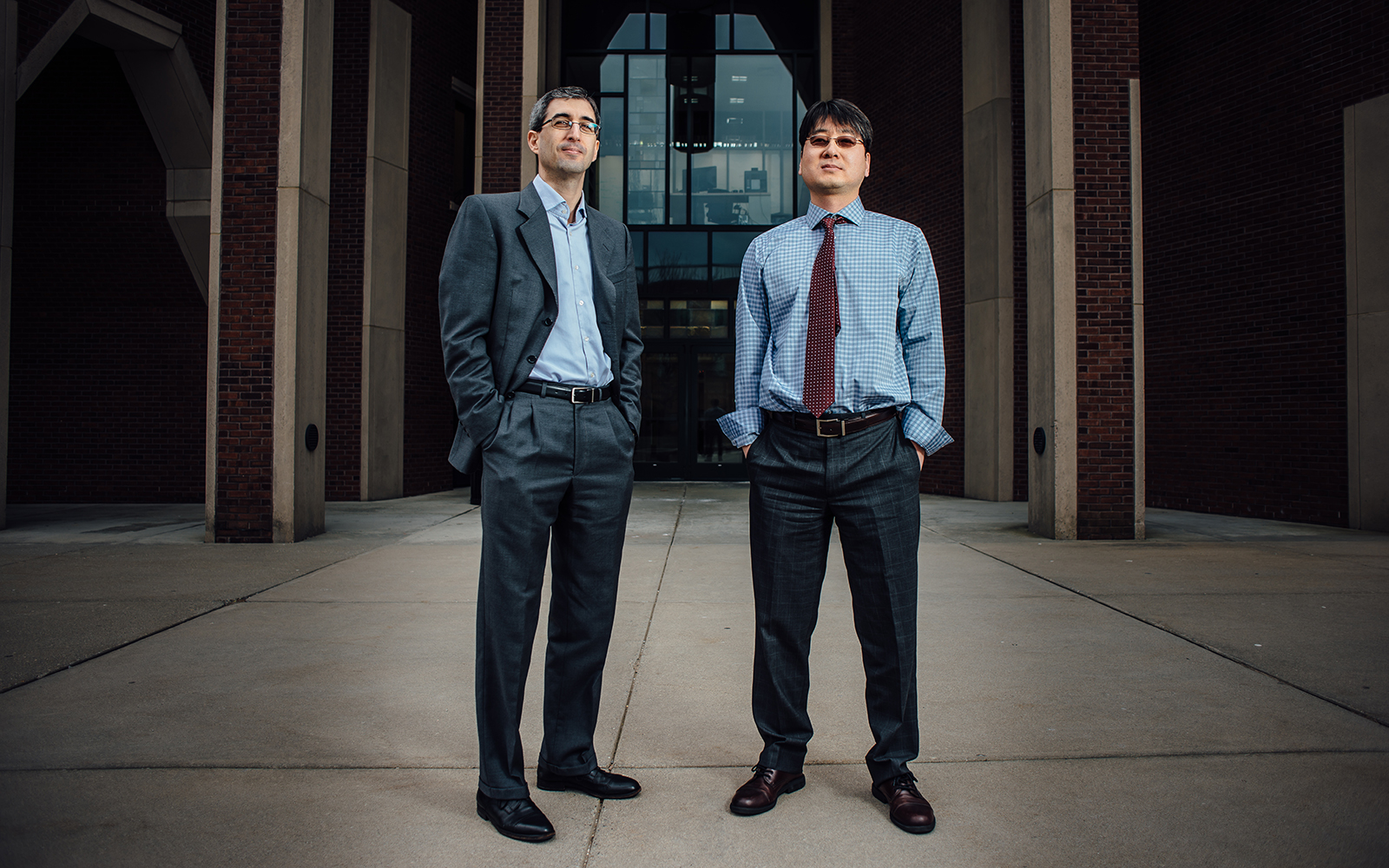
Jeffrey Noonan, left, and Kavisha Thakkar have been selected as two of UConn’s Leadership Legacy scholars, an honor bestowed on the University’s most exceptional students, who have demonstrated leadership, personal accomplishment and academic excellence. (Nathan Oldham/UConn School of Business)
Two Business Undergrads Honored as among University’s Most Promising
Kavisha Thakkar is planning a career as a physician, but is also pursuing a dual degree in accounting, so that she can better understand the healthcare-payment system and assist her future patients. Continue Reading
UConn Today– The Federal Reserve Board announced Wednesday that it would raise interest rates just in time for the new year. During its meeting on Dec. 14, the Federal Open Market Committee voted for a 0.25 percentage-point increase, raising the federal funds interest rate to 0.75 percent. It was the first increase since an identical rate boost at this time last year, which was the first increase in almost a decade.
Yaacov Kopeliovich, assistant professor-in-residence in the Department of Finance, discusses what the increase means for the economy and consumers. Kopeliovich recently left a career in industry to join UConn. Now he instructs students on such current issues as the microstructure of specific markets and the contemporary way that financial institutions manage their financial assets and set their targets.
The School of Business is launching a new, nationally recognized, online certificate program in Healthcare Informatics and Technology. Beginning in March of 2017, the program is designed to meet the growing demand for experts in that field.
“The field of healthcare IT is not only changing, but also expanding rapidly as changes take place in the industry, including the widespread use of the electronic medical record,” said Emeritus Professor Jeffrey Kramer, who specializes in the study of healthcare organizations and who designed the program. Continue Reading
Careers in investments, asset management, banking and prestigious Wall Street opportunities were the focus of the inaugural Finance Conference at the School of Business. (Joshua Weist/UConn School of Business)
Experts Encourage UConn Finance Students To Seek Jobs in Most Prestigious, Demanding Sectors
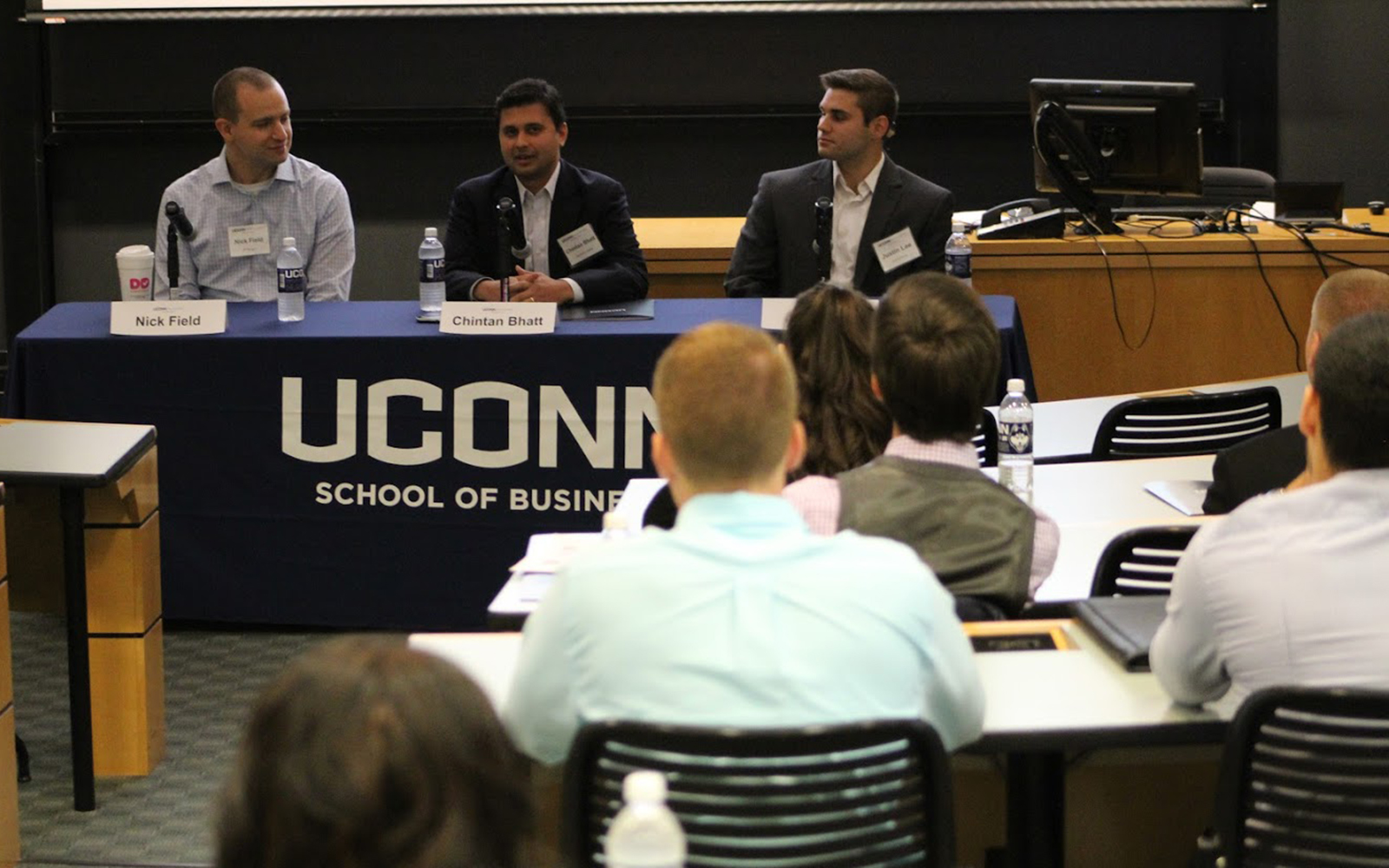
Careers in investments, asset management, banking and prestigious Wall Street opportunities were the focus of the inaugural Finance Conference at the School of Business.
“The conference continues the School of Business efforts to make a greater push to place students in more prestigious and demanding areas of the financial sector,” said Professor Larry Gramling, associate dean for undergraduate programs. Continue Reading
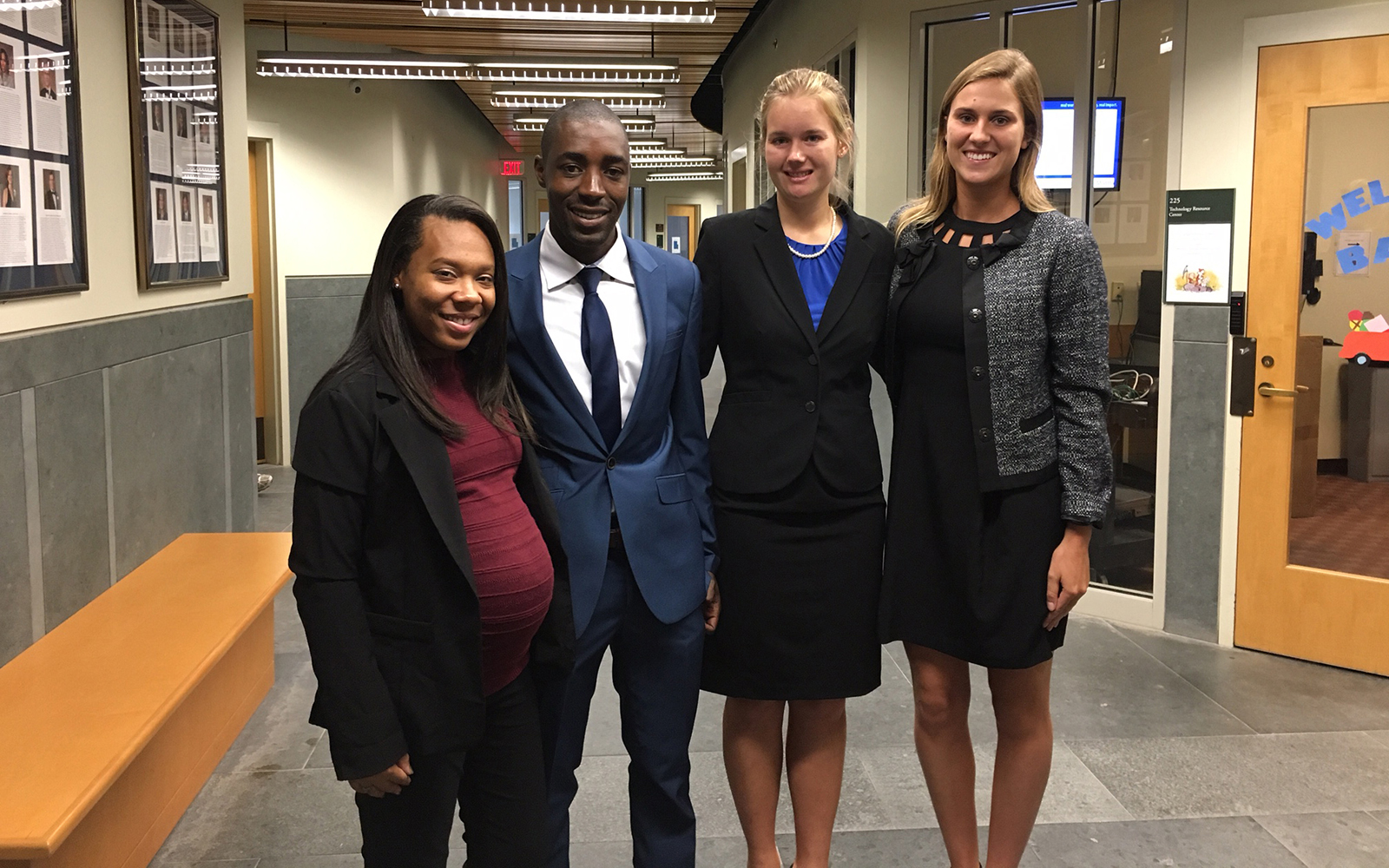
From left: Alexis Flowers, Southern University of Baton Rouge; Tshepo Makobela, University of Johannesburg; Alison Witschonke, University of Vermont; and Laura Van Eeckhoudt, Belmont University. (UConn School of Business)
CIBER Challenge Gives Students an Advantage in the Workplace
Career advice from GE executives, a scavenger hunt at Newport, R.I.’s famous mansions, a brain-teaser on global transportation, and a chance to meet business students from around the globe highlighted the 2016 UConn CIBER Case Challenge. Continue Reading
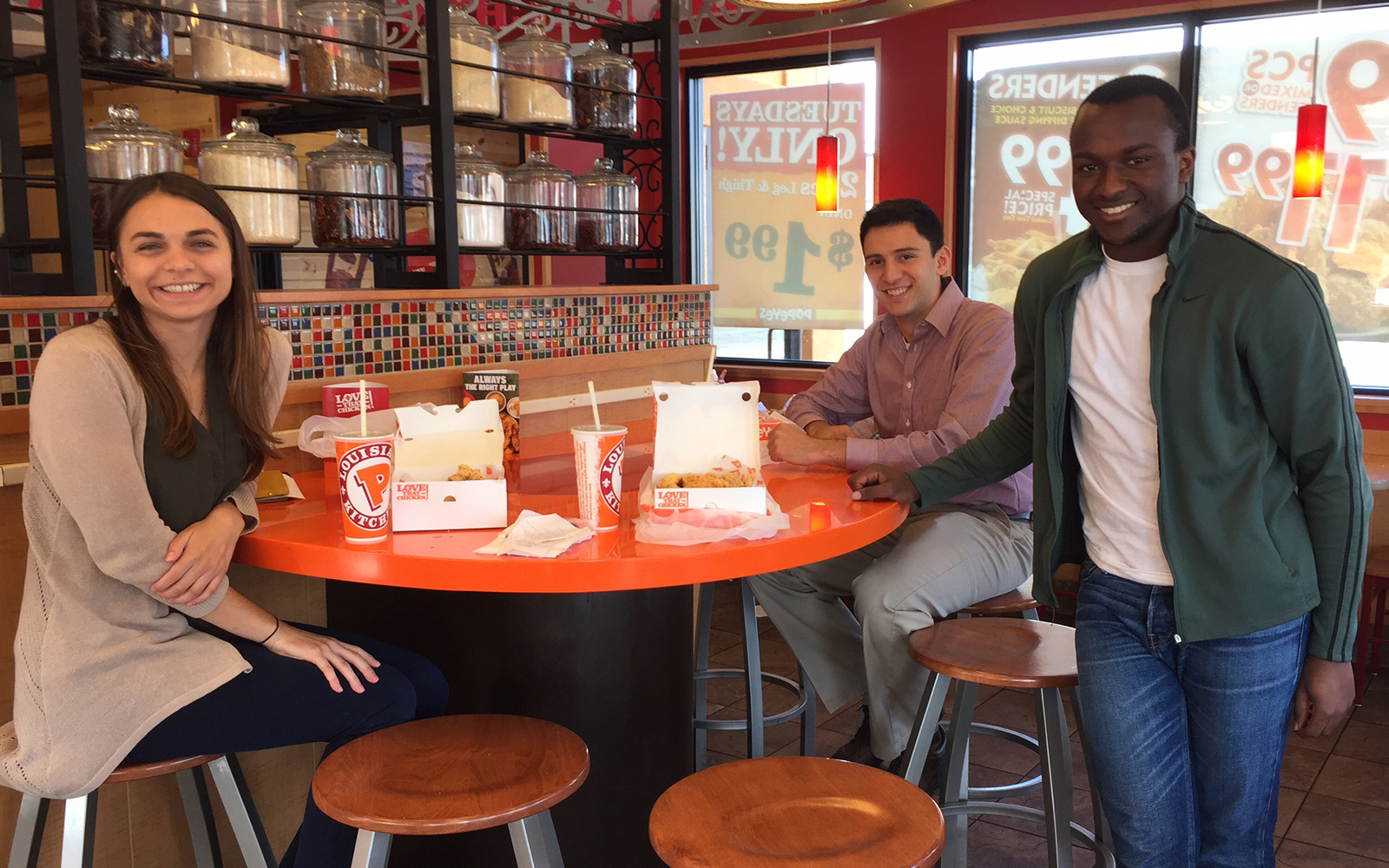
From left: Roma Romaniv, Joaquin Sanchez and Stephen Mwangi—the team of undergraduate finance students who took place in the Cornell Stock Pitch Challenge—pictured at a Popeyes Restaurant. (UConn School of Business)
UConn Finance Students Victorious at Highly Competitive Cornell Stock Pitch Contest
A team of UConn undergraduate finance students took third place in the highly prestigious Cornell Stock Pitch Challenge in Boston, going toe-to-toe with teams from Harvard, Columbia, Duke, Notre Dame and Amherst.
“We are very proud of our students’ success in the face of extremely tough competition,” said finance professor and department head Chinmoy Ghosh. “Their success confirms what we already know, that our students are able to compete and win against anyone.” Continue Reading
UConn Researcher Discovers that Retail Execs Downplay, Mislead Outlook in Reports to Stockholders
Many CEOs from major U.S. retailers tend to soften, possibly even distort, their company’s financial standings and offer stakeholders pessimistic predictions about the future, even when their companies are thriving.Continue Reading
U.S. Economic Expert Shares Vast Knowledge With Our Graduate Students
Economist Cletus C. Coughlin, senior vice president and policy adviser to the president of the Federal Reserve Bank of St. Louis, was a guest lecturer in the School of Business’ graduate program on Sept. 27.
Coughlin presented his knowledge on “The U.S. Economy: What’s Normal?” in Professor Jeffrey Cohen’s “FNCE 5533 – Real Estate Capital Markets” class at the Graduate Business Learning Center in Hartford.
Cletus Coughlin, senior vice president and policy adviser to the president of the Federal Reserve Bank of St. Louis (Federal Reserve Bank of St. Louis)
In his 30 years at the Federal Reserve, Coughlin’s responsibilities have focused on advising senior officials on monetary policy, as well as on academic research on the topics of international trade, urban, regional, and real estate economics. He has been with the Federal Reserve since 1987.
Coughlin and Cohen have been collaborating on research for the past 15 years, having published on a wide range of topics, including property taxation, airport infrastructure issues, housing price impacts of airport noise, and the boom and bust of U.S. housing prices.
Most recently, they co-authored an article with a third researcher on foreclosures, which was published in September 2016 in the Federal Reserve Bank of St. Louis Review. Read their article here.