Web cookies (also called HTTP cookies, browser cookies, or simply cookies) are small pieces of data that websites store on your device (computer, phone, etc.) through your web browser. They are used to remember information about you and your interactions with the site.
Purpose of Cookies:
Session Management:
Keeping you logged in
Remembering items in a shopping cart
Saving language or theme preferences
Personalization:
Tailoring content or ads based on your previous activity
Tracking & Analytics:
Monitoring browsing behavior for analytics or marketing purposes
Types of Cookies:
Session Cookies:
Temporary; deleted when you close your browser
Used for things like keeping you logged in during a single session
Persistent Cookies:
Stored on your device until they expire or are manually deleted
Used for remembering login credentials, settings, etc.
First-Party Cookies:
Set by the website you're visiting directly
Third-Party Cookies:
Set by other domains (usually advertisers) embedded in the website
Commonly used for tracking across multiple sites
Authentication cookies are a special type of web cookie used to identify and verify a user after they log in to a website or web application.
What They Do:
Once you log in to a site, the server creates an authentication cookie and sends it to your browser. This cookie:
Proves to the website that you're logged in
Prevents you from having to log in again on every page you visit
Can persist across sessions if you select "Remember me"
What's Inside an Authentication Cookie?
Typically, it contains:
A unique session ID (not your actual password)
Optional metadata (e.g., expiration time, security flags)
Analytics cookies are cookies used to collect data about how visitors interact with a website. Their primary purpose is to help website owners understand and improve user experience by analyzing things like:
How users navigate the site
Which pages are most/least visited
How long users stay on each page
What device, browser, or location the user is from
What They Track:
Some examples of data analytics cookies may collect:
Page views and time spent on pages
Click paths (how users move from page to page)
Bounce rate (users who leave without interacting)
User demographics (location, language, device)
Referring websites (how users arrived at the site)
Here’s how you can disable cookies in common browsers:
1. Google Chrome
Open Chrome and click the three vertical dots in the top-right corner.
Go to Settings > Privacy and security > Cookies and other site data.
Choose your preferred option:
Block all cookies (not recommended, can break most websites).
Block third-party cookies (can block ads and tracking cookies).
2. Mozilla Firefox
Open Firefox and click the three horizontal lines in the top-right corner.
Go to Settings > Privacy & Security.
Under the Enhanced Tracking Protection section, choose Strict to block most cookies or Custom to manually choose which cookies to block.
3. Safari
Open Safari and click Safari in the top-left corner of the screen.
Go to Preferences > Privacy.
Check Block all cookies to stop all cookies, or select options to block third-party cookies.
4. Microsoft Edge
Open Edge and click the three horizontal dots in the top-right corner.
Go to Settings > Privacy, search, and services > Cookies and site permissions.
Select your cookie settings from there, including blocking all cookies or blocking third-party cookies.
5. On Mobile (iOS/Android)
For Safari on iOS: Go to Settings > Safari > Privacy & Security > Block All Cookies.
For Chrome on Android: Open the app, tap the three dots, go to Settings > Privacy and security > Cookies.
Be Aware:
Disabling cookies can make your online experience more difficult. Some websites may not load properly, or you may be logged out frequently. Also, certain features may not work as expected.
Our third workshop of the semester is an introduction to data analysis with the Splunk platform next Friday, November 11th. All workshops are capped at 20 people so please make sure to register on the site ahead of time. Over the course of the fall semester we plan to have the following:
Virtual Reality Demo – (New) overview of the different levels of VR and hands-on experience (Completed)
Intro to 3D Printing – repeat of last semester, was very popular so we are offering it again (Completed)
Splunk Analytics – (New), introduction to the network analytics software Splunk (Completed)
Internet Of Things – (New), real time data analytics using smart devices (Completed)
Melissa Birnbaum, a junior Marketing major, was an Audience Marketing Intern at Penske Media Corporation this past summer. PMC is a digital media, publishing and information services company that owns publications like Women’s Wear Daily (WWD) and Variety magazine. Melissa had the chance to apply through a referral who introduced her to the company. Continue Reading
The UConn School of Business is among the top business schools in the country at which to earn an MBA, according to The Princeton Review’s 2017 edition of “The Best 294 Business Schools.” “We recommend UConn as one of the best to earn an MBA,” said Robert Franek, Princeton Review’s senior VP-Publisher. “We chose the 294 schools in this book based on our high regard for their academics and our assessment of institutional data we collect from the schools. We also solicited and greatly respect the opinions of 25,000 students attending these schools who reported on their experiences.”
The publication identified UConn as a great place to develop real-world credentials, noted its high regard in the areas of finance and risk analytics, and praised its smaller class sizes, which make it easy to build relationships with both professors and classmates.
“I have had interviews with Covidien, Pitney Bowes, General Electric and Travelers Insurance, and I know UConn has a strong presence when I see that I am competing in the second round interviews with students from Yale and Cornell,” one UConn MBA student wrote in a review.
UConn Magazine– Getting to the Red Planet is a lot more than just rocket science. Management Professor John Mathieu ’80 (CLAS) is working with NASA on the human mechanics.
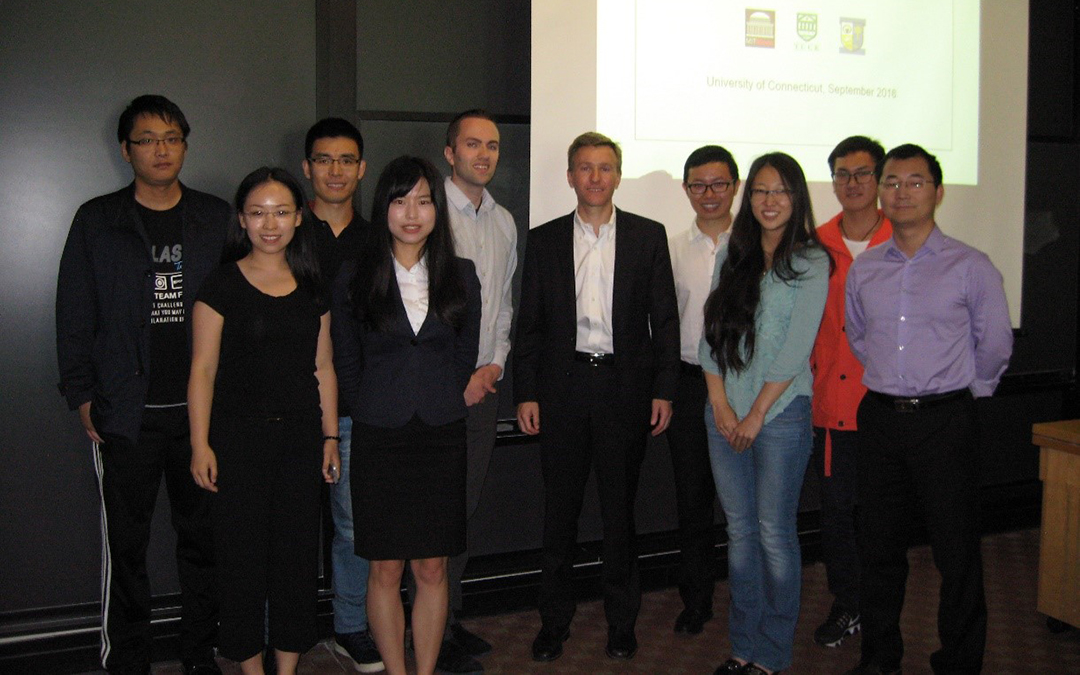
School of Business finance doctoral students with Professor Lewellen.
This Fall, I had the pleasure of coordinating the Finance Ph.D. Student Speaker Series. The purpose of the Speaker Series is to enhance the research culture of the School of Business by attracting speakers whose research is particularly relevant to doctoral students. Each year doctoral students of the five academic departments make the decision of whom to invite, decide the professor’s agenda, and otherwise facilitate and coordinate the professor’s visit. Continue Reading
Corporate compliance is one of the hot-topic issues in business today, and it will be the the subject of a Nov. 15 Executive Education breakfast program, “Building a Culture of Compliance,” offered by the University of Connecticut School of Business at its Stamford Campus. Continue Reading
UConn Researcher Discovers that Retail Execs Downplay, Mislead Outlook in Reports to Stockholders
Many CEOs from major U.S. retailers tend to soften, possibly even distort, their company’s financial standings and offer stakeholders pessimistic predictions about the future, even when their companies are thriving.Continue Reading
U.S. Economic Expert Shares Vast Knowledge With Our Graduate Students
Economist Cletus C. Coughlin, senior vice president and policy adviser to the president of the Federal Reserve Bank of St. Louis, was a guest lecturer in the School of Business’ graduate program on Sept. 27.
Coughlin presented his knowledge on “The U.S. Economy: What’s Normal?” in Professor Jeffrey Cohen’s “FNCE 5533 – Real Estate Capital Markets” class at the Graduate Business Learning Center in Hartford.
Cletus Coughlin, senior vice president and policy adviser to the president of the Federal Reserve Bank of St. Louis (Federal Reserve Bank of St. Louis)
In his 30 years at the Federal Reserve, Coughlin’s responsibilities have focused on advising senior officials on monetary policy, as well as on academic research on the topics of international trade, urban, regional, and real estate economics. He has been with the Federal Reserve since 1987.
Coughlin and Cohen have been collaborating on research for the past 15 years, having published on a wide range of topics, including property taxation, airport infrastructure issues, housing price impacts of airport noise, and the boom and bust of U.S. housing prices.
Most recently, they co-authored an article with a third researcher on foreclosures, which was published in September 2016 in the Federal Reserve Bank of St. Louis Review. Read their article here.
Margaret Luciano ’15 Ph.D. (Management), has added another honor to her long list of recognitions.
In September it was announced that her Ph.D. dissertation won the Society for Industrial and Organizational Psychology’s S. Rains Wallace Award, recognizing the best doctoral dissertation in the field of industrial and organizational psychology. Continue Reading
Richard Prackup, a senior Marketing major, spent his last four summers interning at Univision in New York City through The Emma Bowen Foundation. His most recent internship at the company was as a Digital Marketing Intern. He has also worked as a Strategy Insights Intern, Social Media Intern and Business Development Intern. Continue Reading