Stephen Park


Creating a Better World

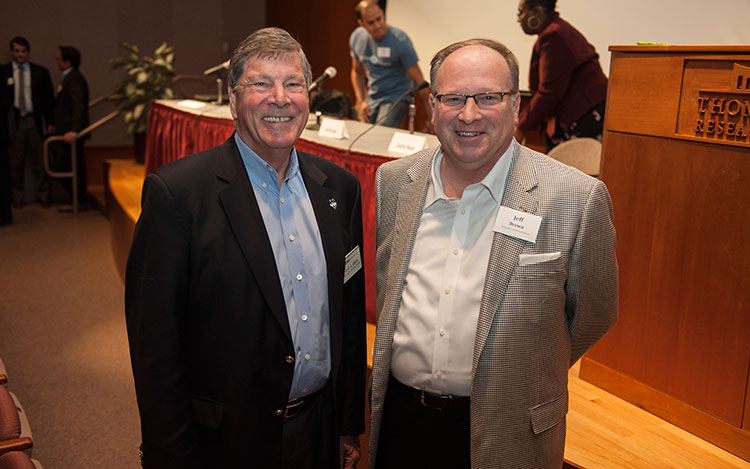
Duo photo of John Elliott and Jeff Brown from the Social Enterprise Conference.
Pictured L to R: School of Business Dean John Elliott and Jeff Brown, EVP at Newman’s Own Foundation.

Mission-Focused Businesses Subject of Recent Conference

Business partners Spencer Curry and Kieran Foran go to work at their FRESH Farm Aquaponics business in South Glastonbury every day, believing they’re one step closer to solving world hunger.

When Justin Nash was a Captain in the U.S. Army in Afghanistan, his soldiers looked to him for guidance. Now a civilian, he’s using those leadership traits at Til Duty is Done, an organization he created which seeks to provide housing, employment training and career opportunities for returning veterans. Til Duty is Done, Nash said, gives him a renewed sense of purpose.Continue Reading


Social Enterprise Conference

SE2 logo with the text "UConn Social Enterprise and Entrepreneurship Conference. Creating Value for Business and Society."

School of Business’ Social Enterprise Conference Attracting Leading Scholars, Entrepreneurs and Business Owners

“We don’t hire people to bake brownies, we bake brownies to hire people,” boasts the website of Greyston Bakery of Yonkers, N.Y.

Recognized as one of the best social enterprise companies in the world, Greyston Bakery’s mission is to provide individuals with employment, skills and resources to lift them out of poverty.Continue Reading


Faculty Research: A Firm-Driven Approach to Global Governance and Sustainability

American Business Law Journal (forthcoming)

Stephen Park and Gerlinde Berger-Walliser.

The multifaceted role of multinational corporations as quasi-regulators is of growing importance to international business. Corporations increasingly participate in two kinds of international rulemaking: (i) non-binding “soft” law standard setting; and (ii) self-regulation through private rules and standards. Soft law and private regulation often fill governance gaps left by incomplete and/or ineffective governmental regulation. One of the most prominent examples is sustainability rulemaking, in which corporations have become increasingly active due to their growing awareness of the directly-borne costs of environmental degradation and the potential strategic benefits of corporate social responsibility.Continue Reading


Targeted Social Transparency as Global Corporate Strategy

Northwestern Journal of International Law & Business (forthcoming)

Stephen Park.

Multinational enterprises (MNEs) are subject to a variety of U.S. laws that require public disclosure of their global activities, including adverse social and environmental impacts. In this article, Professor Stephen Park examines the recent emergence of mandatory disclosure requirements under U.S. federal securities law that require MNEs to disclose certain social impacts in order to address geographically-defined and/or issue-specific public policy objectives, collectively referred to as “targeted social transparency” (or “TST”). Compared to other social transparency laws, TST regimes target a set of intertwined social risks specific to an individual country, region, or industry.Continue Reading