Web cookies (also called HTTP cookies, browser cookies, or simply cookies) are small pieces of data that websites store on your device (computer, phone, etc.) through your web browser. They are used to remember information about you and your interactions with the site.
Purpose of Cookies:
Session Management:
Keeping you logged in
Remembering items in a shopping cart
Saving language or theme preferences
Personalization:
Tailoring content or ads based on your previous activity
Tracking & Analytics:
Monitoring browsing behavior for analytics or marketing purposes
Types of Cookies:
Session Cookies:
Temporary; deleted when you close your browser
Used for things like keeping you logged in during a single session
Persistent Cookies:
Stored on your device until they expire or are manually deleted
Used for remembering login credentials, settings, etc.
First-Party Cookies:
Set by the website you're visiting directly
Third-Party Cookies:
Set by other domains (usually advertisers) embedded in the website
Commonly used for tracking across multiple sites
Authentication cookies are a special type of web cookie used to identify and verify a user after they log in to a website or web application.
What They Do:
Once you log in to a site, the server creates an authentication cookie and sends it to your browser. This cookie:
Proves to the website that you're logged in
Prevents you from having to log in again on every page you visit
Can persist across sessions if you select "Remember me"
What's Inside an Authentication Cookie?
Typically, it contains:
A unique session ID (not your actual password)
Optional metadata (e.g., expiration time, security flags)
Analytics cookies are cookies used to collect data about how visitors interact with a website. Their primary purpose is to help website owners understand and improve user experience by analyzing things like:
How users navigate the site
Which pages are most/least visited
How long users stay on each page
What device, browser, or location the user is from
What They Track:
Some examples of data analytics cookies may collect:
Page views and time spent on pages
Click paths (how users move from page to page)
Bounce rate (users who leave without interacting)
User demographics (location, language, device)
Referring websites (how users arrived at the site)
Here’s how you can disable cookies in common browsers:
1. Google Chrome
Open Chrome and click the three vertical dots in the top-right corner.
Go to Settings > Privacy and security > Cookies and other site data.
Choose your preferred option:
Block all cookies (not recommended, can break most websites).
Block third-party cookies (can block ads and tracking cookies).
2. Mozilla Firefox
Open Firefox and click the three horizontal lines in the top-right corner.
Go to Settings > Privacy & Security.
Under the Enhanced Tracking Protection section, choose Strict to block most cookies or Custom to manually choose which cookies to block.
3. Safari
Open Safari and click Safari in the top-left corner of the screen.
Go to Preferences > Privacy.
Check Block all cookies to stop all cookies, or select options to block third-party cookies.
4. Microsoft Edge
Open Edge and click the three horizontal dots in the top-right corner.
Go to Settings > Privacy, search, and services > Cookies and site permissions.
Select your cookie settings from there, including blocking all cookies or blocking third-party cookies.
5. On Mobile (iOS/Android)
For Safari on iOS: Go to Settings > Safari > Privacy & Security > Block All Cookies.
For Chrome on Android: Open the app, tap the three dots, go to Settings > Privacy and security > Cookies.
Be Aware:
Disabling cookies can make your online experience more difficult. Some websites may not load properly, or you may be logged out frequently. Also, certain features may not work as expected.
Social Media Campaign Strives to Promote Acceptance, Challenge Extremism
A group of business students set out with a daunting task: to reduce negativity, extremism and hate on social media. Along the way, they garnered support from the Department of Homeland Security and Facebook to challenge extremist views across the world. Continue Reading
The CLS Blue Sky Blog– Corporate compliance — the internal processes that firms use to ensure that their employees do not violate applicable laws and regulations — has become big business. Regulation of business continues to grow, punctuated by landmark laws that have re-shaped the financial services (the Dodd-Frank Act) and health care (the Affordable Care Act) industries in the United States. Further, federal regulators have…
Pictured above, Hussein stands before the Mausoleum of Mohammed V, one of the top tourist attractions in the city of Rabat, both because of its architectural design and its tribute to a famous ruler. (Mo Hussein/UConn School of Business)
Accounting Professor Mohamed “Mo” Hussein recently returned from sabbatical in Morocco, where he researched the contributions of the financial system, stock market and banks to the economic development of the North African country.
The CT Mirror– AQR Capital Management of Greenwich not only oversees one of the world’s largest hedge funds, but it is known as an industry leader in using computers and algorithmic models to plot trades. The administration of Gov. Dannel P. Malloy sees AQR as a good investment for the state, even if it acknowledges state aid for a hedge fund manager never will be good politics.
Robert Bird (Nathan Oldham/UConn School of Business)
UConn Business Law Professor Robert Bird was a panelist at a presentation on “Conscious Capitalism” on Nov. 17 at the Toyota Oakdale Theatre in Wallingford, Conn., sponsored by the Greater New Haven Chamber of Commerce.
The presenters discussed conscious capitalism—business enterprises that follow a strategy in which they seek to benefit both human beings and the environment—its purpose and vision and what’s happening on a global scale.
Other participants included Doug Rauch, former president of Trader Joe’s, Larry Bingaman, president and CEO of the South Central Connecticut Regional Water Authority and Kate Emery, founder and CEO of The Walker Group, a technology services firm.
Hi! My name is Nicole C. Jones Young and I am an Assistant Professor of Organizational Behavior at Franklin & Marshall College in Lancaster, Pennsylvania. I graduated from the UConn School of Business in May 2016 with my Ph.D. in Organizational Behavior. Continue Reading
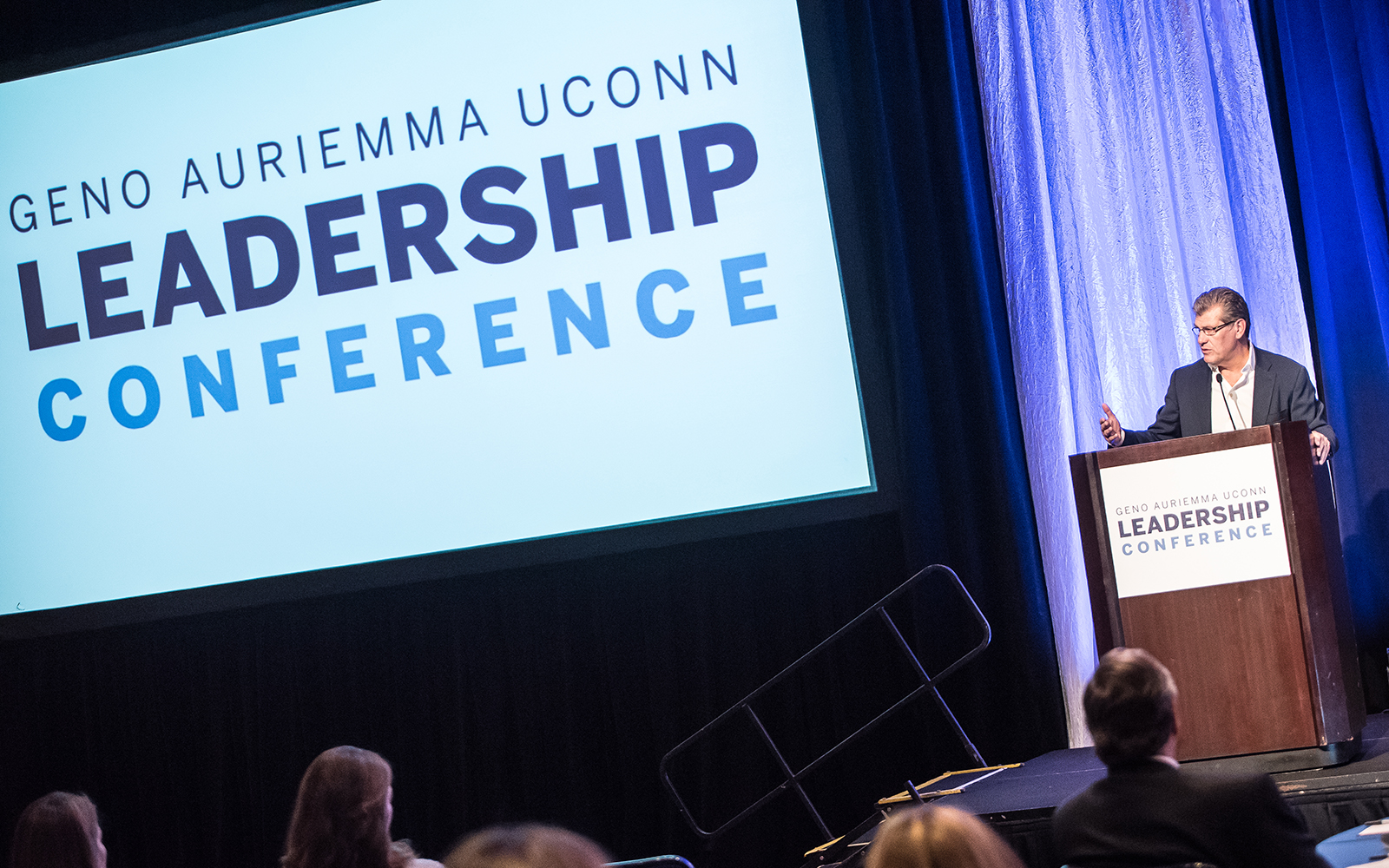
The third Geno Auriemma UConn Leadership Conference was held in October at Mohegan Sun, attracting some of the world’s top executives from a vast variety of industries. (Nathan Oldham/UConn School of Business)
Geno Auriemma UConn Leadership Conference Offers Plethora of Advice for Rising Executives
Transition is one of the most challenging aspects of leadership, but the ability to take charge in times of company turmoil or personal upheaval is the mark of a great leader.
That was the message that some of the world’s top executives, from a vast variety of industries, shared at the third Geno Auriemma UConn Leadership Conference in October at Mohegan Sun. Continue Reading
Jacqueline Ho is a senior Communication and Marketing major. She spent her summer as a Public Relations Intern at Eric Mower and Associates (EMA) in New York City. EMA is a full-service advertising and marketing agency and the New York City office specializes in public relations for the travel industry. Jacqueline called the NYC office in early May, inquiring if they were still hiring, and sent over her resume. Fortunately, they were still looking for one more intern to join the team over the summer! She completed an interview and a writing assignment before being offered the position. Continue Reading
Have you ever wondered what attending a networking event would be like? After three years as an undergraduate student in the School of Business, I am proud to say, I have finally attended my first networking event!
It’s a funny situation. Normally, I wouldn’t have attended the event. However, because I work for the Marketing Department and the event is hosted by the department, I was obligated to attend as a student and as the event photographer. Instead of being the one trying to persuade students to attend, I typically would have been the one being persuaded to attend. I found it to be a great experience. Continue Reading
The New York Times– After Lelaneia Dubay developed an intolerance for the gluten and chemical additives in many alcoholic beverages, she went looking for a way to salvage her cocktail hour. Already skilled at making cranberry liqueur, which she bottled and gave as gifts at Christmas, she came up with a formula for a lavender liqueur, using sprigs from her garden. When she shared it with friends at a holiday party, their response was emphatic: Get this to market.