Event Article


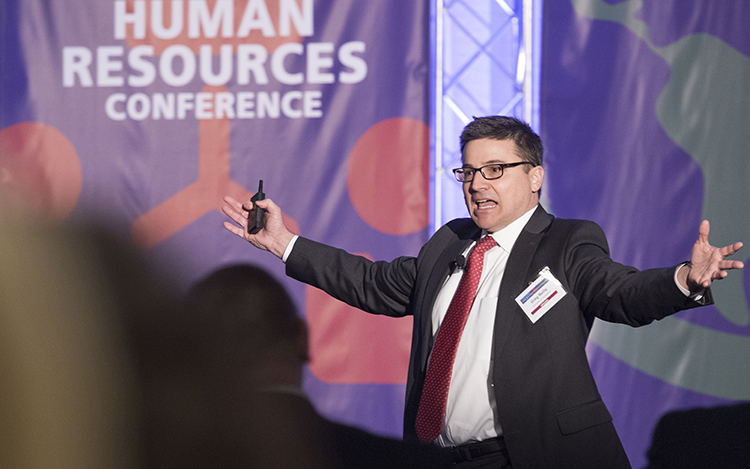
HR Strategy Matters, Says Professor

Human Resources Professionals Taking On Larger, More Strategic Roles, Professor Greg Reilly Tells CBIA Conference Members.
Photo courtesy of CBIA

Human Resources Professionals Taking On Larger, More Strategic Roles, Professor Greg Reilly Tells CBIA Conference Members

The most sought-after human resources professionals today are full partners in the strategic leadership team, identifying weaknesses within an organization and hiring the right people to make a company more competitive and robust.

That was the insight that management professor Greg Reilly shared with 150 participants during the Connecticut Business & Industry Association’s (CBIA) Human Resources Conference. Reilly was the keynote speaker at last month’s event at the Crown Plaza Hotel in Cromwell.Continue Reading


Academic Symposium

UConn Center for Real Estate 50th Anniversary Academic Symposium

In celebration of the 50th anniversary of the Center for Real Estate and Urban Economics Studies, the Center hosted an international academic symposium. Attendees included research professors from countries such as the United Kingdom, Singapore, The Netherlands and Italy as well as top academics from across the United States.

The event held from March 26 through March 28 drew the submission of nearly 60 papers, from which 14 were presented. The process was very competitive, which was evident in the conference through spirited research and lively and engaging debate.

The Center would like to thank C.F. Sirmans and Dean Gatzlaff of Florida State University, and David Ling and Wayne Archer of the University of Florida for paving the way and allowing the Center to step in and hold the conference that would annually take place within their institutions. This group also promoted the conference and ensured the successful attendance. We also thank the UConn Center symposium committee of John Clapp, Jeff Cohen, John Glascock and Steve Ross. A special thanks and appreciation to John Harding for direction and guidance through out the symposium planning.


These are ‘Best of Times, Worst of Times’ for Risk Managers

Thomas Sullivan '00 MBA speaking at a podium.
Thomas Sullivan ’00 MBA

When a major retailer had a security breach, and consumer information was compromised, it created a ripple effect at Stamford-based First County Bank.

First County Bank customers inundated their local branches seeking new debit cards, and many wanted replacements right away. The bank is able to produce about 1,000 new cards a day in-house, but has to contract out for bigger projects, said John Bonora, senior vice president and chief risk officer at the bank, and a 2011 graduate of UConn’s MSFRM program.Continue Reading


Have the Skills But Not Getting Promoted? Your Lack of Confidence May Be Sabotaging Your Career

Could you give a speech in front of a room of strangers? Would you have the courage to run for elected office? Could you ask for a raise—and stand a good chance of getting it?

Those were some of the questions that executive coach, lecturer and author Barbara Roche asked more than 100 people during a program titled, “Women, Wisdom and Worth.” Continue Reading


Top Connecticut Experts Discuss Success of Healthcare Initiative: “We’re Not There Yet—But We’re Making Great Strides”

The panel at the UConn School of Business program titled, "Grading the Affordable Care Act."When it comes to access to healthcare, Connecticut residents are much better off now than they were prior to the creation of the Affordable Care Act, according to a panel of experts.

But, this new system is still in its infancy and there is still much to be done in order to achieve an ideal healthcare delivery system, they agreed.

The five panelists shared their expertise in a UConn School of Business program titled, “Grading the Affordable Care Act.” The March 4 program drew 75 people to the Graduate Business Learning Center in downtown Hartford. Continue Reading


School of Business Retirees Gather for Business, Friendship

Crowd photo from the School of Business Retirees Gathering.Addressing a gathering of retired- and almost-retired UConn faculty, School of Business Dean John A. Elliott urged them to use their expertise to help mentor junior staff and graduate students.

Dean Elliott thanked those congregated for their years of service to the School of Business, their willingness to act in an advisory capacity to him and to newer faculty, and recognized them as a vital connection to some of the School’s most illustrious alumni.

Rob Hoskin, Harry Johnson, Keith Johnson, Lin Klein, Jeffrey Kramer, Richard Norgaard, David Palmer, Murphy Sewall, James Sfiridis, Susan Spiggle and Crayton Walker were among those assembled, with their significant others, at the beautiful Mansfield home of Richard Norgaard and Karen Zimmer. Dean Elliott’s charming wife, Laura Philips, also attended the first formal gathering of retired faculty on Dec. 7.

Other important purposes of the meeting were to reinforce contacts among lifelong colleagues, share memories and enjoy each other’s company.  Attendees enjoyed a catered, champagne brunch, entered a drawing for door prizes and shared stories of those who could not be present that day but wished to be remembered to all, such as Karla Fox who was in New York at the birth of her fourth grandchild.

One interesting discovery is the creative outlets in which some retirees are engaged.  Michael Lubatkin has just published a scholarly book, but focused more in the area of philosophy than in management.  Dick Kochanek has been painting for a number of years and his artwork has evolved such that he is currently receiving accolades at juried shows.  Rob Hoskin has honed his skills as a craftsman and produces beautiful objects in wood.

Among those who could not attend is Steve Messner.  His daughter would love to deliver any notes and well wishes, so please write to Steve in care of: Stephanie Brown, 144 Woodleaf Drive, Winter Springs, FL 32708.

Planning is underway to host a Spring 2015 event on the Storrs campus. More information will be provided soon.  Those wishing to remain in touch should contact Cynthia H. Adams, Professor Emerita from the former School of Allied Health, at cindyadams930@gmail.com or 860-230-8951.

Photos from the gathering can be viewed here.


Students Enter Their “Stay-Up-All-Night-Working-On-It’’ Projects In Hopes of Becoming UConn’s Innovation Quest Champ

Have you ever tried to buy concert- or theater- tickets online and been asked to retype two words, which are displayed in squashed, blurry, italic font that is virtually impossible to distinguish?

If you’re like Theo Marrinan, that hurdle absolutely drives you nuts. Marrinan has a plan that will make that task a little easier, a great deal more fun, and may also be intriguing to advertisers who could use it to promote their product.

Continue Reading


Business Expert: Understanding Culture is Vital to Conducting Business in Asia

Nighttime cityscape of Shanghai, featuring illuminated skyscrapers and a bustling circular intersection.If you were trying to market a chocolate product in China a few years ago, you’d have had a very difficult time. That’s because, until recently, the Chinese believed that eating chocolate could cause nosebleeds.

That was one of many stories that international marketing expert Dara MacCaba shared during a program titled “Building Innovative Brands—Insights from Asia.’’

If you don’t understand the Chinese culture, your efforts to promote even the best products will probably fail, MacCaba told 70 students and faculty during a January 14 program at the Graduate Business Learning Center in Hartford.

MacCaba is the founder of Lucid360, an innovation consultancy company, with offices in New York and Shanghai, which helps global companies position their products in new markets. Lucid360 has represented such industry giants as McDonald’s, L’Oreal, Unilever, Wrigley’s, Colgate, Coca-Cola, Microsoft, GlaxoSmithKline, Nestle, Philips and Castrol.

“You must empathize and walk in the shoes of the people you’re dealing with, and try to understand what it’s like to be a Chinese consumer,’’ said MacCaba, who typically spends two weeks in Shanghai every other month.

He described China as a big, competitive and challenging market, with rapidly changing trends. The business opportunities are further complicated by legal regulations, cultural beliefs and regional preferences.

MacCaba’s presentation offered insights into the many ways that Chinese culture differs from American beliefs. He began by displaying a map of the world, which showed China in the center and the rest of the world on the periphery. It illustrates how differently Americans and Europeans view their positions in the world, he said.

He also displayed an image of a Chinese beach where people donned colorful UV-protection masks which might resemble a Halloween mask to an American. It is important to keep an open mind when dealing with cultures that are different from yours, he added.

Lucid360 uses many ways of tracking trends, from traditional research to conversations with people on the streets, he said. In China, it is not unusual to select brands that are recommended by friends.

For instance, if you were trying to market baby formula in China, where there has been great mistrust, you would need to know that many new mothers turn to experienced friends–not their own mothers or advertising–for advice on which product to select, MacCaba said.

When Quaker Oats wanted to sell its product in China, the company discovered that breakfast cereal is a very tiny market in China. But because there is a bigger demand for snacks, Quaker Oats was able to devise an oatmeal shake that could be sold as a healthy, portable snack, and it sold well, MacCaba said.
One of the biggest challenges for MacCaba and his team was trying to introduce Glenfiddich whiskey to the Chinese market. The whiskey was the top brand in the world, but unknown to Asian consumers.

The problems were plentiful. In Chinese nightclubs, inexpensive whiskey was mixed with green tea as a fast-track method of getting drunk, MacCaba said. Its reputation wasn’t good.

Lucid360 recognized that Glenfiddich needed to present itself as a premium beverage and distinguish itself from other brands. Instead of competing with other whiskeys, it would vie for its place alongside cognac, long considered a luxury beverage in China. New packaging was designed by Glenfiddich that was more in line with the cognac bottle.

The last piece of the puzzle was recognizing that the Chinese place great importance on gifting, he said. So Glenfiddich was marketed as a desirable gift to give when deepening a relationship—perhaps with an architect or an entrepreneur. The positioning worked and the brand was embraced, he said. The lesson, MacCaba said, is don’t assume that similar products are your competition.

“You need to be distinctive and know why people like your product,’’ he said. Investigate how other companies have successfully integrated their products, he said.

For instance, when Wrigley’s wanted to introduce a new gum in China, it didn’t take the approach it might have in the United States—with an expert wearing a white lab coat, touting the benefits of oral hygiene. Instead, it promoted the vitamin benefits in the product, which appealed to Chinese consumers.

MacCaba said it is also important for U.S. companies to know “where they have permission to play.’’ One firm that tried to combine the benefits of Eastern and Western medicine and failed terribly. Another company that manufactured safe home-cleaning chemicals encountered unsurmountable legal regulations, he said.

To illustrate the competitive nature of the country, MacCaba described how Lipton created a “milk tea,’’ a drink that is popular in China. It did well in Shanghai but soon competitors were producing a product in similar packaging. Smaller companies were also able to introduce new flavors more quickly than the U.S. company. So over time, it became less profitable for Lipton.

One student asked about the “product copycat’’ issue in that country and MacCaba said there certainly are knockoffs. One beverage company he represents gets more bottles returned than it sells, so that indicates the prevalence of the problem.

Digital media is exploding in China now, he said. Facebook—currently barred from China—may never make it to that country, he said, because already the Chinese are integrating new, more sophisticated technology that may make it obsolete.

“The fact that China changes so rapidly,’’ MacCaba said with a big grin, “is very good for client retention!’’

UConn B-School to Host Free Breakfast Seminar Feb. 24 – Long-term Thinking in a Short-term World

The University of Connecticut School of Business will offer a free breakfast seminar for the business community titled, “Long-term Thinking in a Short-term World,’’ from 7:30 to 9:00 a.m. February 24 at the Graduate Business Learning Center, 100 Constitution Plaza, downtown Hartford.Continue Reading