Marketing


UConn Marketing Professor, Colleague Find that Merchants Can Use In-Store “Showrooming’’ to Boost Online Sales

Portrait of Jane Gu.

Most consumers today split their shopping experiences between traditional brick-and-mortar stores and internet purchases. But if you believe that traditional, in-store browsing is facing extinction, think again.

In fact, it is often a trip to the mall or shopping center that gives consumers the confidence they need to buy similar, or more upscale, items online, according to research conducted by UConn Assistant Professor Jane Gu and her colleague, Giri Tayi, from the State University of New York at Albany.Continue Reading


Be Bold Be Blue: Integrated Marketing Communication Campaign by UConn students

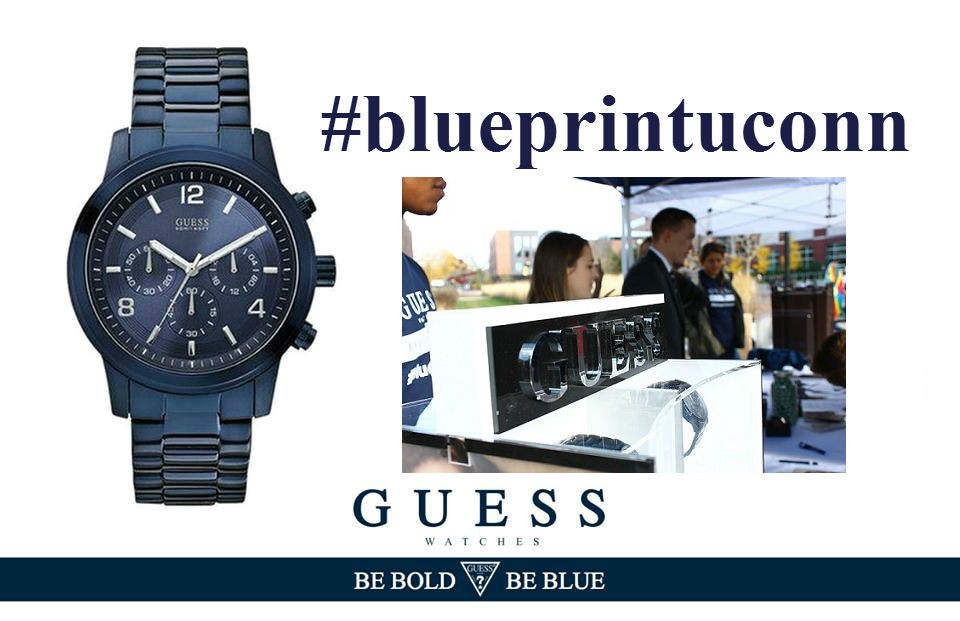
Thirty students in theGraphic featuring a Guess watch and the text "#blueprintuconn. Guess watches. Be bold, be blue." Beside the watch is a photo of a Guess logo placard with students in the background. ‘Integrated Marketing Communication in the Digital Age’ class taught by Joseph Pancras in Fall 2014 participated in a semester-long IMC campaign with Sequel, the brand licensee for GUESS Watches. GUESS Watches is a mid-level luxury brand that defines itself as bold, adventurous, and sexy. An iconic brand, it has launched the modeling careers of celebrities such as Brooke Shields, and is looking to expand its presence and relevance in campuses across the United States.

Students worked in four major functional groups: Strategy, Advertising/Creative, Public Relations and Budgeting, and Marketing Research. Teams consisted of members from each functional group to coordinate responsibilities for the UConn GUESS Watches campaign, which would serve as a pilot launch for related GUESS Watches events on other campuses.

The Advertising group created a strong logo and slogan, encompassing GUESS’ message and values and relating to UConn students with the slogan, “Be Bold, Be Blue”. They used bus advertisements, flyers, social media platforms, and useful promotional to attract students and raise awareness and online buzz.

The Strategy team organized and planned the campus event. Four of the event’s 500 student participants received GUESS watches, while others received branded items for participating in activities like spinning a wheel, “guessing the candy in the jar,” and surveys.

The PR/Budget team delivered the message the Advertising Team created to UConn students by targeting popular social media websites, placing advertisements in areas of high student use, and having Her Campus write about the event.

The Market Research Team focused on creating a pre-survey and post-survey to uncover how people perceived the GUESS brand and watches. Their findings revealed that most students perceived the brand as cool and high-end. Additionally, the post survey revealed that positive impressions improved by 17.7% after the event.

After the event, the students submitted a final report to Sequel and presented before senior Sequel executives, who attested to the project’s value.

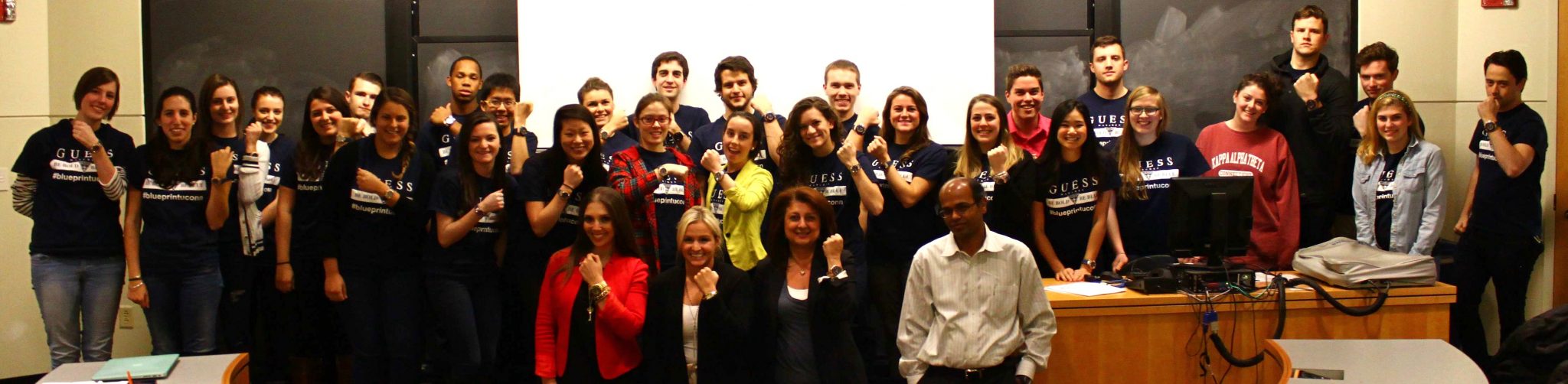
Group photo of the IMC Class of 2014.Sequel executives and Dr. Joseph Pancras’ Integrated
Marketing Communication class students at the Final Presentation


New Marketing and Digital Analytics Graduate Course

The Marketing Department has launched a new course entitled Marketing and Digital Analytics (MKTG 5251). Offered for the first time during the Fall 2014 semester, MKTG 5251 introduces students to the application of advanced analytics that support data-driven management. Students work with Microsoft Excel and JMP Pro 11 software to address marketing decisions related to various topics including demand estimation, market segmentation, price optimization, customer choice, and customer lifetime value. The digital component of the course examines analytical techniques to evaluate and strengthen website performance and the effectiveness of an organization’s social media platforms.

“Big data and analytics are taking center stage within many organizations,” commented Dr. Gregory M. Sottile, developer of the course and its instructor. “While MKTG 5251 is a hands-on course, its primary objective is develop students’ ability to critically recognize opportunities to apply marketing and digital analytics for better decision-making.” Marketing and Digital Analytics will be offered again during the Fall 2015 semester.


Faculty Research: Study Shows that Decision Aids Can Hurt Consumer Decision Making

Journal of Retailing (2014)

Nicholas Lurie. Co-Author: Na Wen.

To help consumers deal with increasing amounts of information, many online retailers offer simple decision aids, such as the ability to sort products on a particular product attribute. Intuitively, such aids should help consumers but, in a recent article, Nicholas Lurie and a colleague at City University of Hong Kong show that simple decision aids can hurt consumers’ ability to make good decisions.

Whether decision aids help or hurt depends on the extent to which choices involve tradeoffs among attributes. For example, a consumer buying a laptop might want a large screen and lots of memory. If large screen laptops usually come with lots of memory then using a decision aid to sort on screen size will help the consumer choose the best laptop for her. However if, instead, the consumer wants a large screen and light weight laptop, and large screen laptops tend to be heavy, sorting on screen size will not enhance choice. The authors suggest that consumers use simple decision aids as substitutes for cognitive effort and find that the more consumers use such aids, the lower the quality of their decisions. Providing consumers with multiple decision aids, such as the ability to eliminate as well as sort products, is one way to overcome the negative aspects of such aids.


Assistant Professor Gerlinde Berger-Walliser and MBA Student Group visit EM Lyon for International Business Study

In January 2015, a contingent of part-time MBA and MSBAPM students led by Business Law Professor Gerlinde Berger-Walliser spent two weeks studying international business at EMLYON, one of the top business schools in France. The group attended lectures taught by renowned EM Lyon faculty about the European business, social, and regulatory environment. As part of the inter-cultural program the UConn students worked on projects with EM Lyon’s International MBA students and traveled to Geneva, Switzerland to visit the World Trade Organization and the United Nations. In the evenings and on the free weekend, the group sampled the great food that Lyon is known for and toured different parts of Europe. Professor Berger-Walliser is looking forward to taking another group of MBA students to Lyon in January 2016.


Faculty Research: When Harry Bet with Sally: An Empirical Analysis of Multiple Peer Effects in Casino Gambling Behavior

Journal: Marketing Science (2015)

Hee Mok Park. Co-author: Puneet Manchanda.

In many consumption settings (e.g., restaurants, casinos, theme parks), individuals consume products either alone or with their peers (e.g., friends and/or family members). In such settings, it is likely that through social influence, a consumer’s decision on what to purchase or how much to consume is influenced by the purchase or consumption decisions of their peers.

Marketing researchers have had much interest in measuring such social influence and were primarily focused in estimating how one’s behavior (e.g., how much to spend) is influenced by the behavior of the peer. However, a consumer could not only be affected by the peer’s behavior, but also by other events that influence the peer to change his/her behavior. For example, if the peer gets a promotion, but the focal consumer does not, the focal consumer might judge the differential treatment to be unfair and react negatively. Another mechanism by which social influence could operate could be when the peer is physically present, but does not engage in the behavior under question. In other words, the peer’s presence could directly affect the focal consumer’s consumption behavior as the lack of consumption by the peer may signal a subtle or transient change in preferences. In response to this, the focal consumer may modify her behavior.

The authors develop an empirical model that allows them to identify all three effects simultaneously and apply it to behavioral data from a casino setting. The data comprise detailed gambling activity for a panel of individuals at a single casino over a two-year period. The results show that all three types of peer effects exist. The results also indicate that accounting for these peer effects simultaneously and identifying them at an individual level could help marketing managers draw up better guidelines for promotion policies as well as policy makers implement a more informed regulatory regime for the casino industry.


Is it Time to Hire a Chief Legal Strategist?

MIT Sloan Management Review – Could your company use its legal environment to look for strategic opportunities? Consider bringing in a chief legal strategist, recommend Robert C. Bird, associate professor of business law and Northeast Utilities Chair in Business Ethics at the UConn School of Business and David Orozco, an associate professor of legal studies and MBA program director at the Florida State University College of Business.


Stewart Lander named 2013-14 Outstanding Alumnus

SteStewart Landerwart Lander (UConn, ‘80) has been named the 2013-14 Outstanding Alumnus by the Marketing Department. The Marketing Department has been privileged to have Stewart as a friend for many years. We are very appreciative of the Lander Family Scholarship that Stewart and his wife, Pam, established, which provides financial support to some of our best students in the professional sales leadership area. Stewart has been integral to our Program for Sales Leadership as a member of the PSL Advisory Committee, contributing valuable insights and perspectives on professional selling trends that have enhanced our ongoing experiential learning curriculum initiatives. He has given generously of his time to mentoring our students and giving guest lectures in our undergraduate sales-focused courses, and graduate marketing courses.

Stewart has more than 30 years of experience in selling and leading large sales teams in the financial services industry. Stewart was successful in the distribution marketplace as a Sr. VP/ National Sales Manager and represented firms which included GE Financial, Genworth Financial and Invest Financial. Currently with Sandler Training-TEM Associates, Stewart coaches individuals and collaborates with companies on professional and personal development programs which increase the sales performance of individuals and teams.

Stewart earned his Masters Degree from the University of Connecticut in Guidance Counseling and Personnel, and has certification in Leadership and Sales Excellence from General Electric and the Darden School of Business, and also has Six Sigma Certification.

As a Founders Council Member for the Greatest Save/KinderVision Foundation, Stewart helps provide educational programs for families, law enforcement and the community at large on how to keep kids safe.

Stewart resides in Connecticut with his wife, Pam; they have two children, Helen and Stephen.


Faculty Research: Consumer Reactions to Round Numbers in Brand Names

Marketing Letters (forthcoming)

Kunter Gunasti and Timucin Ozcan.

In a recent research Kunter Gunasti and his-coauthor show that consumers prefer products labeled with brand names including round numbers (e.g., Centrum 100 multivitamins) to those including non-round numbers (e.g., Centrum 103). A systematic investigation of alphanumeric brand names used in numerous product categories indicates that round numbers such as 10, 50, 100, etc. are over-represented in the marketplace. Regardless of the product category, consumers have more favorable judgments and higher preferences of brand names including round numbers.Continue Reading