News

All School of Business pressroom news


Alumni Mentorship Program Forging Professional Relationships

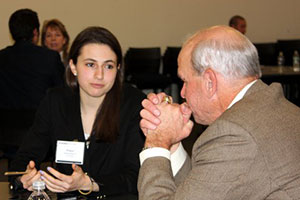
Young professional business woman conversing with an older professional business man at the Alumni Mentorship Program.The Alumni Mentorship Program, a collaboration between the School of Business Office of Alumni Relations and the Business Career Center, is actively creating opportunities for students to make professional relationships for a lifetime.

Connecting over 100 students one-on-one with alumni in their chosen field, the program spans four cities – Hartford, Conn., Stamford, Conn., New York, New York, and Boston, Mass. Mentoring activities include scheduled phone conversations, email exchanges, informational interviews, half/full day job shadowing, and networking meeting events. Over the 2013-14 academic year, mentors and mentees connected at two networking dinners that are planned again for this coming fall. Most recently, students connected with the alumni volunteers at “speed mentoring” events in Hartford and Stamford. See photos.

Launched in 2011, the program was designed to connect top School of Business students with alumni mentors in business who are committed to building a strong mentoring relationship in aiding students in launching their career. Discussions help the students to learn about opportunities that could broaden their education and knowledge of their chosen field, explore their strengths and weaknesses, and to learn how to communicate effectively in networking situations and build a solid network.

Alumni who are interested in volunteering or hearing more about this rewarding way to give back are encouraged to reach out to Fran Graham in the Alumni Relations Office at fran.graham@business.uconn.edu.

School of Business students who wish to apply for the program are asked to reach out to Kelly Kennedy in the Business Career Center at kelly.kennedy@business.uconn.edu.

Pictured: A student chats with Michael Golden ’84, strategic relationship manager for Fireman’s Fund Insurance Company.


UConn Finance Professors Propose New Method to Estimate the Full Value-Effect of an Event

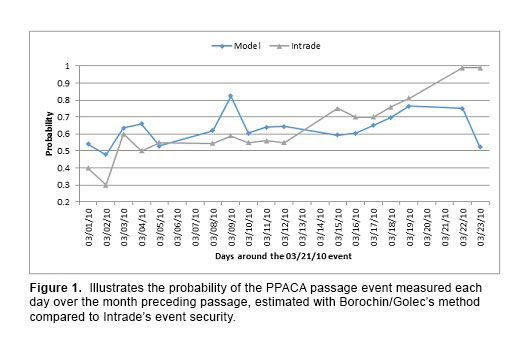
Line graph comparing the probability of PPACA passage: blue line (model) and gray line (Intrade) show fluctuations over March 2010 with key peaks. Caption states "Figure 1. Illustrates the probability of the PPACA passage event measured each day over the month preceding passage, estimated with Borochin/Golec's method compared to Intrade's event security.Storrs, Conn. – Paul Borochin, assistant professor of finance at UConn School of Business, together with finance professor Joseph Golec, propose an event study method using stock and option prices to account for the degree of investor anticipation to more accurately measure the full value effect of an event.

Finance researchers and practitioners both use the event study method to measure whether the announcement of new information has a statistically significant effect on a firm’s stock market value. Paul Borochin and Joseph Golec, professors of finance at the University of Connecticut, recently proposed a method that uses stock and option prices to account for the degree of investor anticipation of an event to therefore more accurately measure the full value effect of that event.

“The purpose of our study is to introduce a general method of estimating the degree of investor anticipation applicable to all significant events that affect firms with traded options,” says Borochin. “We apply this more general method to estimate probabilities to a complex event: U.S. House of Representatives passage of the healthcare reform law, the Patient Protection and Affordable Care Act of 2010 (PPACA). We also examine a related event with different potential for investor anticipation: the subsequent 2012 Supreme Court ruling on PPACA constitutionality, which was potentially a greater surprise due to the Court’s higher opacity.”

Borochin and Golec essentially interpret the financial market as a betting market. “…we get the same information from options prices that we could obtain from looking at the Intrade [or other betting market] website,” says Borochin.

“Indeed, one reason that we select PPACA passage to illustrate our method is that it also had event securities traded on Intrade, the leading prediction market at the time,” he says. “We compare the Intrade-generated probabilities for the 2010 and 2012 events to those we generate from options and stock prices as a robustness check. Our financial market-generated probabilities have two advantages over prediction market-generated probabilities: (1) they are derived from assets with much larger dollar volumes of trades,1 and (2), they can be estimated for any event that impacts companies with traded stock options.”

Borochin and Golec believe that their method could be useful for ex ante as well as ex post public policy analysis, citing legislation that often contains offsetting provisions negotiated among different political factions—in this case, the PPACA fee (tax) on brand name pharmaceutical sales.

They measure the effects ex post, but the method could be used for ex ante analysis by government or industry officials. “For example, Congress could publicly release a bill and a vote date. Based on the option market reaction to the vote announcement, both government and industry officials could determine investors’ estimates of the net effect of the bill’s provisions,” says Borochin.

“Our method could also be used to better estimate public or private damages associated with an event,” he adds. “The Securities and Exchange Commission often estimates damages from corporate fraud and the Federal Trade Commission estimates damages from illegal business practices. As long as some of the firms involved have traded stock and options, our method can give a more accurate estimate of total damages.”

Many event studies do not adjust for the fact that their events are partly anticipated, and in many cases, the degree of anticipation is difficult to measure. For the PPACA House vote event Borochin and Golec consider, the adjustment triples the measured effect of the event on the market value of the affected firms.

“We believe that [our method] is likely to be more precise than alternative methods such as using public data on firm-specific attributes to estimate event probabilities, or using event securities from relatively small prediction markets, because our method employs high-volume assets whose prices may partly reflect nonpublic information. For an event with substantial public information available (House passage), we find our probability estimate and that of a prediction market are quite close. But for an event with little public information (Supreme Court constitutionality), the estimates differ considerably,” said Borochin.

The working paper, “Using Options to Measure the Full Value-Effect of an Event: Application to the Healthcare Reform Act,” can be downloaded here.

>>More about this research

1The daily value of PPACA contracts on Intrade averaged about $90,000 around the 2010 House vote event, while the average daily dollar value of stock ($277 million) and notional value of options ($397 million) traded for each company in our model totaled $674 million. The daily Intrade value was $35,000 during the 2012 Supreme Court event, while the average dollar stock and notional options trade value was $640 million.

Figure 1 –
The model-generated probability of PPACA passage compared to the Intrade-generated probability.
This figure plots the model-generated probability of PPACA passage by the U.S. House of Representatives, which is the probability implied by the stock and options prices of six hospital firms and six insurance firms. The Intrade-generated probability of PPACA passage is the price of an event security traded on the Intrade prediction market. Probabilities are shown for three weeks of trading before the event, the event day (March 22, 2010), and the day following the event.


UConn ups business on the syllabus

“In a lightning-fast economy, universities must constantly adapt to the shifting job market by adding and subtracting courses, instructors and professional degrees, all while maintaining budget. Over the past several years, The University of Connecticut in Stamford has been responding to the job market by expanding its business school programs and strengthening its ties with the business community…

UConn Business School Executive Director Jud Saviskas said there’s been a definitive growth in the college and the business community plays a big role in providing direct input into that growth. Three new business programs have emerged in just four years

Four years ago, the business school launched a master’s degree program in financial risk management. Last fall, it started an undergraduate financial management program.

The one-year graduate program in financial risk management, which is offered in both the Hartford and Stamford campuses, grew from 23 students total in 2010 to 86 students [in Fall 2012]. The enrollment number is expected to reach 140 this fall.”

The full article  from insurancenewsnet.com, written by Crystal Kang (May 19, 2014) may be found here.


A Visit from the FASB, CTCPA, and CT State Board of Accountancy

The online MS in Accounting Program held its four day in-residence class, Acct 5505, from May 19-22, welcoming 100 new students to UConn. One highlight from the week was a session called “Steering the Profession,” which included a presentation by Jeremie Richer of the FASB about the FASB’s role in the accounting profession. Joining Jeremie in the workshop were Mark Zampino from the CT Society of CPAs, and Sonia Worrell Asare and Stephanie Sheff from the CT State Board of Accountancy. They provided an overview of how their state-based organizations can help accountants in their work. In addition, they discussed the requirements for continuing professional education for Connecticut, pointing out that each state has its own requirements.

A big thank you to Jeremie, Mark, Sonia, and Stephanie for their time and expertise.

Categories:

Project Management Certification Training for Veterans Approved

Connecticut Information Technology Institute (CITI), Project Management Institute (PMI), and the US Department of Veterans Affairs logos.Stamford, Conn. – The Connecticut Office of Higher Education / State Approving Agency has approved project management certification training for veterans and other eligible U.S. Department of Veterans Affairs beneficiaries at UConn’s Stamford campus, effective immediately.

University of Connecticut’s School of Business and their component for non-credit programs, Connecticut Information Technology Institute (CITI), have been authorized to provide project management certification training under the provisions of Title 38 Section 3675, United States Code of Federal Regulation for Veterans program.

The Project Management Institute (PMI)® has designated CITI as a “Global Registered Education Provider (R.E.P.)” This signifies that CITI has met PMI’s rigorous standards of quality curriculum and instruction for project management training.

CITI’s project management curriculum includes certification training programs for project practitioners of all education and skill levels. The Certified Associate in Project Management (CAPM)® is a good entry-level certification for those who are new to project management. The Project Management Professional (PMP)® is the most important globally-recognized and independently validated credential for experienced project managers.

Course offerings related to these and other credentials are offered at CITI on a monthly basis. Research studies have proven that project management certifications can positively impact project manager salaries, and help them stand out to prospective employers in the marketplace.

All of CITI’s Project Management Courses are approved for Professional Development Units, as well Education Development Units.

For more information, go to www.citi.uconn.edu or call (203) 251-9516.


International Business Society Visits Thomson Reuters

Group photo from the International Business Society visit to Thomson Reuters.Each year, the International Business Society participates in an annual corporate visit to gain access to, tour, and learn more in-depth about a particular company. This spring, the society’s trip was to Thomson Reuters in Times Square, New York.

Thomson Reuters was chosen because of its high level of interaction in the international business world. The company serves a global customer base as the world’s leading source of intelligent information for businesses and professionals.

“The students met with Benjamin Goodband, VP of Investor Relations, and learned about Thomson Reuters’ business structure, company culture, and methods for product development,” said Kelly Kennedy, career coach and instructor at the School of Business Career Center.

The students also received an in-depth introduction to one of Thomson Reuters’ products and a demonstration of how it impacts business decisions in real-time.

“Exposure to Thomson Reuters has given us a fresh, in-depth perspective on how international business is conducted in this ever-evolving business environment,” said Courtney Hong, one of the students who participated in the tour.

Students interested in joining the International Business Society can reach out to uconnibs@gmail.com.

Companies who may wish to host a visit from some of our best and brightest business school students are encouraged to contact Kelly Kennedy at kelly.kennedy@business.uconn.edu.

Pictured: Students Caroline WarrenPatience BearseSarah BiedermannDana ChoCourtney HongErica Hanner, and Kelly Kennedy from the Business Career Center.


Employees Recognized for Years of Service

Dean John Elliott and Associate Deans Sulin BaLarry Gramling, and George Plesko recognized employees for their years of service to the University and the State of Connecticut on Friday, May 2, 2014. The Employee Recognition Reception was held in the School of Business Board Room.

The employees recognized were: Continue Reading


Domestic Students Now Allowed Part-Time Option

school-of-business-wordmark-stacked-blue-gray

Important Change for Domestic Students

(Effective Immediately)

The MsFRM program now allows domestic students both full-time and part-time options.  The course sequence under the full time option is as follows:

Full-Time Option

  • Fall I – 2 courses                                                                   
  • Spring I – 3 courses
  • Summer I – 3 courses
  • Fall II – take 3 courses

Total – 11 courses (33 credits)

Graduation in the December of following year.

All course are lock-step and must be taken in sequence

Part-Time Option

 Under the part-time option, students are allowed the maximum possible flexibility to take as many or few courses as they wish every semester.  However, courses are still lock-step and part-time students must wait until the course is offered again next academic year.

A suggested sequence of courses for part-time students is as follows:

  •  Fall I – 2 courses                                                                   
  • Spring I – any 2 courses (should take Fin Modeling II)
  • Summer I – any 2 courses (should take Fin Modeling III)
  • Fall II – 3 courses
  • Spring II – 1 remaining course from Spring I
  • Summer II – 1 remaining course from Summer I

Total – 11 courses (33 credits)

Graduation in the May of second year.

All course are lock-step and must be taken in sequence

Under the above Part Time scheme, part-time students will graduate in May of second year.

However, the program allows the students the maximum possible flexibility to choose as many or few courses as the part-time student wishes, subject to the following caveats:

  1. Domestic students will be allowed to take as many (not exceeding 3) or as few (including not taking any course) courses they choose during each semester.
  2. All domestic students are strongly advised to take at least one course each semester.
  3. All domestic students are strongly advised to take the Financial Modeling course sequence before they take the Financial Risk Management sequence, to the extent possible.
  4. Domestic students must finish the experiential learning project with the group to which he/she is assigned.
  5. All domestic students are strongly advised to finish the program within 2 years.
  6. All domestic students must finish the program (33 credits for the 15 month, 42 credits for the 20-month program) within 3 years from starting the program.

***Important – Students need to take a certain number of credits to be eligible for financial aid and to not have to repay loans.  Students should be careful about their funding availability if they choose to take less credits per semester.  Students are responsible to check with Financial Aid Office regarding this issue.

The part-time option is available to all domestic students with immediate effect, meaning current domestic students can take advantage of this change from this summer.  Please also note that the current students choosing the part-time option will have to wait until next year when the same courses will be offered again, unless the course sequence is changed in which case they will be informed immediately.


Alum Shares Knowledge, Time and Scholarship for Stamford Students

This article first appeared in the UConn Business magazine, Volume 4, Issue 4 (Spring 2014)

chris lafondFor alumnus Christopher Lafond ’87 (CLAS), service to community goes hand-in-glove with philanthropy, and he demonstrates both through a new named scholarship fund for students studying at the Stamford campus, where he is also an active volunteer.
Lafond, the CFO and executive vice president of Gartner, Inc., a leading information technology research and advisory company based in Stamford, is a common sight on UConn’s regional campus. He serves on the advisory board for the MS in Financial Risk Management (MSFRM) degree program, regularly speaks to business classes and is helping with programs in the undergraduate marketing department.

“I have a pretty clear perspective, and I’ve chosen to spend my time volunteering in a few areas, mainly around education. Everyone deserves a great education like I had, and if you don’t build a strong, educated foundation in life, it’s very difficult to get ahead.”

He first became involved with the campus when the University reached out to him with an invitation to serve on the MSFRM advisory board, a step that he sees bringing benefits to both the University and the business community in Stamford.

“We have almost 700 employees here; this is local and close to home for us. When we looked to partner with educational institutions, we quickly realized ‘Hey, there’s a great University right here in Stamford.’ It just works for everyone involved.”

Lafond started a financial development rotation program within Gartner, exposing Stamford MBA students to a variety of financial service areas, as well as taxes, business intelligence and more. He says, though, that he especially enjoys personally sharing his business experience with classes of students.

“One of the best experiences for me is making education real,” he says. “I’ll get a question like, ‘Chris, I’m studying this business situation; how would you handle it?’ and I’m able to take the theoretical and turn it into applied practice. I just get a great deal of satisfaction out of it. It takes so little of my time and means so much.”

chris lafond-2

Lafond soon decided to make a major philanthropic gift to his alma mater, and the decision to create an endowed scholarship for business students at the regional campus was an easy one.

“I know from my involvement at UConn Stamford that there are a lot of students who may not be able to go to Storrs for family or personal reasons. But I want them to look back at their time at UConn and say, ‘I had a great education right here in Stamford.’ And I want to make sure that my gift provides ongoing support, not something that goes away after a one-year period. It will be there for years, helping many students.”

He sees countless opportunities for alumni like him to make UConn stronger through volunteering or philanthropy.

“There are literally endless ways to give back, whether to UConn or whatever else you care about in life. It doesn’t have to be money! If you take an hour of your life and spend it with students, you’ll get the most amazing feedback, and you’ll feel that you’re really making a huge impact in someone’s life. When I am at UConn, I know that I’m helping those students graduate with knowledge they didn’t have before, which will help them in their own careers. So, alumni have an opportunity every day to add value to even their own education. It’s a little thing we can do to help a student that makes a big difference.”

He says that just like the impact of educating students, he wants his philanthropy to pay dividends in life for those who receive the scholarship support.

“I would hope that my scholarship allows some students to have opportunity they otherwise would not,” he says. “If I can help even a single student, that would be such a great thing to accomplish.”


Lean Business: Not Just for Manufacturing Anymore

leanbusiness

This article first appeared in the UConn Business magazine, Volume 4, Issue 2 (Spring 2014)

No one can dispute the vital role that doctors, nurses and other medical specialists play in the functioning of a hospital.

But insiders know that the reliability of the transportation team—that takes people to the operating room, the birthing center, or to their waiting cars—is also vital to a hospital’s success.

At Middlesex Hospital, the transport team has increased its case load from 500- to 1,400- trips per week, not by adding staff but by creating efficiencies, according to Gary Havican, vice president of operations.

“That’s one of the changes that has helped us decrease the average patient length-of-stay by one day,” said Havican. And that’s making everyone happy—from patients to physicians to health insurers.

Middlesex is always looking for ways to improve customer service and efficiency, and to that end Havican enrolled in a two-day, Hands-On Lean Business Process Improvement workshop at UConn’s Graduate Business Learning Center in downtown Hartford.

Some 15 participants from various industries, including healthcare, insurance/financial services, creative services and higher education, took part in the inaugural “open enrollment” Lean Business seminar offered by the business school’s Executive Education program.

“Lean Business Processing is particularly important for Connecticut companies where the cost of doing business is one of the highest in the country,” said Colleen McGuire, director of UConn’s School of Business in Hartford.

Once the domain primarily of manufacturing companies, the Lean concept is growing in popularity among other sectors eager to streamline business processes, reduce waste and improve customer satisfaction.

leanbusiness-2

Companies today are facing enormous challenges as they fight to remain competitive and survive, said David A. Burn, Ph.D., an adjunct instructor at UConn who taught the course. The workshop gave participants a “road map” and simple tools to improve business processes by eliminating waste and improving services to enhance value for customers and stakeholders, said Burn, who also works as chief statistician and Six Sigma Fellow in corporate operations with Boston Scientific Corporation.

“We aren’t offering any one-size-fits-all solutions,” he said. “But this is a guide that does work.”

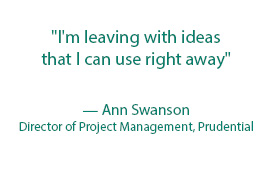
Ann Swanson, director of project management at Prudential, attended the program with three colleagues. “I enjoyed this course because it was hands-on,” she said. “I’m leaving with ideas that I can use right away.”

Swanson said she enjoyed an exercise in which the participants were required to organize a radiology department and were presented with confusing and incomplete information.

“I think that’s typical of what happens in companies when tasks become ‘siloed’,” she said. One of the important messages that Burn emphasized was that employees need to share knowledge and not rely solely on one specialist to address a particular issue.

Peggy Thomsen, business analysis manager for CIGNA, said the class was very helpful. Managing her company’s IT department is like running a small business, she said. She is returning to the insurance giant with new techniques to improve consistency across all areas of the department.

Alicia Huckle, director of financial services for UConn’s West Hartford campus, said she’s eager to try new ideas that will improve work flow. “We all want the same thing, which is a better experience for our students,” she added.

“This is something any business can use,” said Vikki Hampton, assistant director of loan programs in the Office of Student Financial Aid Services at UConn in Storrs. “Across many industries, people are looking to do more with less.”

The School of Business plans to offer the Lean Business program again in the fall, as well as other short-term classes, including Finance for Non-financial Managers, to meet the needs of the business community.

For more information on Executive Education courses or customized programs, please see our website at execed.business.uconn.edu or call 860-728-2400.