Web cookies (also called HTTP cookies, browser cookies, or simply cookies) are small pieces of data that websites store on your device (computer, phone, etc.) through your web browser. They are used to remember information about you and your interactions with the site.
Purpose of Cookies:
Session Management:
Keeping you logged in
Remembering items in a shopping cart
Saving language or theme preferences
Personalization:
Tailoring content or ads based on your previous activity
Tracking & Analytics:
Monitoring browsing behavior for analytics or marketing purposes
Types of Cookies:
Session Cookies:
Temporary; deleted when you close your browser
Used for things like keeping you logged in during a single session
Persistent Cookies:
Stored on your device until they expire or are manually deleted
Used for remembering login credentials, settings, etc.
First-Party Cookies:
Set by the website you're visiting directly
Third-Party Cookies:
Set by other domains (usually advertisers) embedded in the website
Commonly used for tracking across multiple sites
Authentication cookies are a special type of web cookie used to identify and verify a user after they log in to a website or web application.
What They Do:
Once you log in to a site, the server creates an authentication cookie and sends it to your browser. This cookie:
Proves to the website that you're logged in
Prevents you from having to log in again on every page you visit
Can persist across sessions if you select "Remember me"
What's Inside an Authentication Cookie?
Typically, it contains:
A unique session ID (not your actual password)
Optional metadata (e.g., expiration time, security flags)
Analytics cookies are cookies used to collect data about how visitors interact with a website. Their primary purpose is to help website owners understand and improve user experience by analyzing things like:
How users navigate the site
Which pages are most/least visited
How long users stay on each page
What device, browser, or location the user is from
What They Track:
Some examples of data analytics cookies may collect:
Page views and time spent on pages
Click paths (how users move from page to page)
Bounce rate (users who leave without interacting)
User demographics (location, language, device)
Referring websites (how users arrived at the site)
Here’s how you can disable cookies in common browsers:
1. Google Chrome
Open Chrome and click the three vertical dots in the top-right corner.
Go to Settings > Privacy and security > Cookies and other site data.
Choose your preferred option:
Block all cookies (not recommended, can break most websites).
Block third-party cookies (can block ads and tracking cookies).
2. Mozilla Firefox
Open Firefox and click the three horizontal lines in the top-right corner.
Go to Settings > Privacy & Security.
Under the Enhanced Tracking Protection section, choose Strict to block most cookies or Custom to manually choose which cookies to block.
3. Safari
Open Safari and click Safari in the top-left corner of the screen.
Go to Preferences > Privacy.
Check Block all cookies to stop all cookies, or select options to block third-party cookies.
4. Microsoft Edge
Open Edge and click the three horizontal dots in the top-right corner.
Go to Settings > Privacy, search, and services > Cookies and site permissions.
Select your cookie settings from there, including blocking all cookies or blocking third-party cookies.
5. On Mobile (iOS/Android)
For Safari on iOS: Go to Settings > Safari > Privacy & Security > Block All Cookies.
For Chrome on Android: Open the app, tap the three dots, go to Settings > Privacy and security > Cookies.
Be Aware:
Disabling cookies can make your online experience more difficult. Some websites may not load properly, or you may be logged out frequently. Also, certain features may not work as expected.
Hartford Business Journal – When Nancy Lennert decided to transition her career from animation to marketing, one of her first steps was to enroll in UConn’s part-time MBA program.
“I wanted a more solid foundation of business knowledge, including finance and accounting,” Lennert said.
Hartford Business Journal – When classes begin in late August, hundreds of UConn graduate students in social work, public policy and education will be coming to downtown Hartford.
They will join nearly 1,400 graduate students at UConn’s center-city business school along with the 250 or so grad students enrolled in the University of St. Joseph’s School of Pharmacy, located in the XL Center
Greenwich Time – Last year, Charter Communications supercharged its growth with two blockbuster deals. Now, other giants are apparently eyeing Charter for their own expansions.
UConn Innovation Portal – Students who participated in the UConn-TIP Summer Fellowship discussed their experiences learning about startups and entrepreneurship at the finale of the 10-week immersion program.
Greenwich Time – Charter Communications cemented its dominance of the cable market last year by acquiring two of the largest firms in the industry. Now it is forging closer ties with the country’s largest cable company and possibly one of the largest cellular carriers in a bid to tap into new markets.
UConn Today – Students entering the Doctor of Pharmacy program at UConn generally have a pretty good idea of what’s ahead of them. With solid skills in science and math and a broad interest in health care, at the beginning of their academic journey most expect that they’ll eventually be working in a patient-centered environment in a hospital or community pharmacy setting. Or, that they’ll find a niche somewhere in the pharmaceutical industry, perhaps in research or government relations. But, for a select few, their careers will take a slightly different turn.
As they explore their options, a certain number of PharmD students may have their interest piqued by the opportunities presented when combining their pharmacy education with the management tools earned through a Master’s in Business Administration (MBA).
The National Association of Women MBAs (NAWMBA) presented a plaque to John A. Elliott, dean of the School of Business, Marlys Rizzi, 2016 NAWMBA National Conference Chair and a business school assistant director, and John Knopf, Stamford campus director for the School of Business, on June 14. Missing is Lucy Gilson, head of the management department and the UConn faculty advisor to the local NAWMBA chapter. (Nathan Oldham/UConn School of Business)
National Association of Women MBAs Thanks UConn for Its ‘Vital’ Contributions to Program’s Success
A plaque was presented in appreciation for the UConn School of Business hosting the 2016 NAWMBA Conference and Career Fair in Stamford last October. The plaque thanks the School and describes its contribution as vital to the success of the educational and networking conference.
University of Connecticut, Stamford (Nathan Oldham/UConn School of Business)
The University of Connecticut’s downtown hub stands about 100 miles from its main campus. But it is no distant outpost.
UConn’s business school exemplifies the increasing prominence of the university in Stamford. Enrollment is growing and a major conference held last week reflects university officials’ view of the Stamford campus as an equal to the one in Storrs. Continue Reading
Shirley Tarabochia ’17 MBA with John DePuma of DePuma Pasta and Professor Wayne Bragg (Nathan Oldham/UConn School of Business)
UConn MBA Student Assists Small Business Company
When Gina DePuma was diagnosed with celiac disease 10 years ago, forcing her to abstain from eating traditional pasta, it was nothing short of a crisis in the DePuma family.
“My wife is Italian, and she just loves pasta,’’ recalled John DePuma, a professional chef. “I said, ‘I have to find a solution to that!’ It really was a labor of love.’’
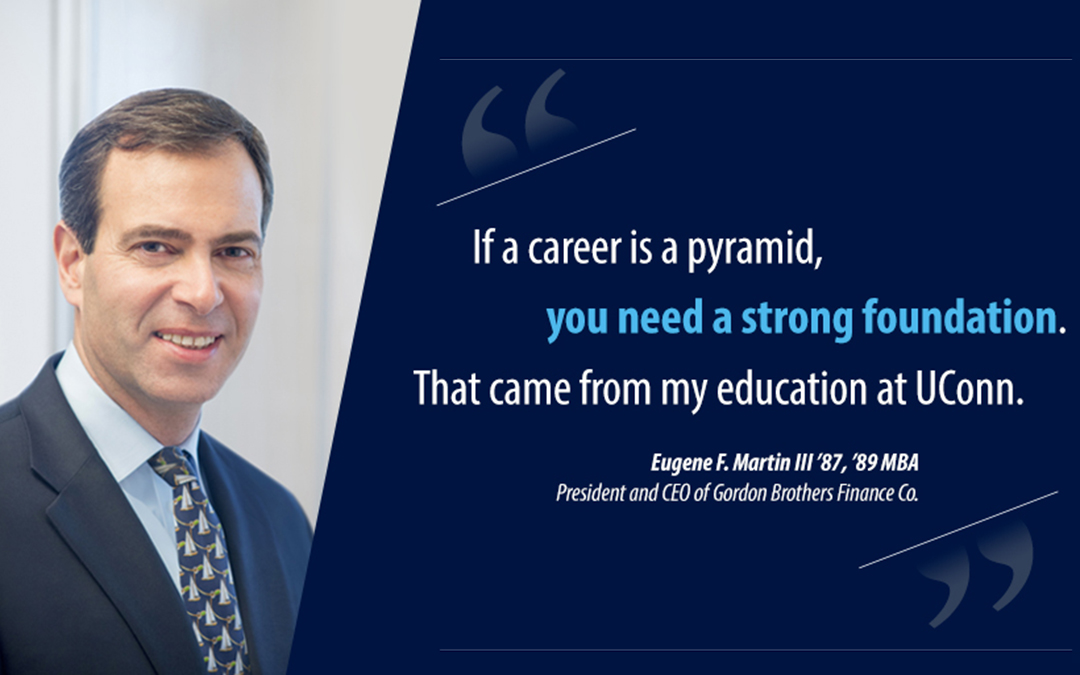
Eugene F. Martin III ’87, ’89 MBA, president and CEO of Gordon Brothers Finance Co., serves on the Dean’s Advisory Cabinet, offering valuable advice and advocacy for the School of Business.
“The UConn School of Business was the foundation for everything I did in my career. It set me on a great course,” said Eugene F. Martin III, ’87, ’89 MBA, president and CEO of Gordon Brothers Finance Co. “If a career is a pyramid, you need a strong foundation. That came from my education at UConn.” Continue Reading