Web cookies (also called HTTP cookies, browser cookies, or simply cookies) are small pieces of data that websites store on your device (computer, phone, etc.) through your web browser. They are used to remember information about you and your interactions with the site.
Purpose of Cookies:
Session Management:
Keeping you logged in
Remembering items in a shopping cart
Saving language or theme preferences
Personalization:
Tailoring content or ads based on your previous activity
Tracking & Analytics:
Monitoring browsing behavior for analytics or marketing purposes
Types of Cookies:
Session Cookies:
Temporary; deleted when you close your browser
Used for things like keeping you logged in during a single session
Persistent Cookies:
Stored on your device until they expire or are manually deleted
Used for remembering login credentials, settings, etc.
First-Party Cookies:
Set by the website you're visiting directly
Third-Party Cookies:
Set by other domains (usually advertisers) embedded in the website
Commonly used for tracking across multiple sites
Authentication cookies are a special type of web cookie used to identify and verify a user after they log in to a website or web application.
What They Do:
Once you log in to a site, the server creates an authentication cookie and sends it to your browser. This cookie:
Proves to the website that you're logged in
Prevents you from having to log in again on every page you visit
Can persist across sessions if you select "Remember me"
What's Inside an Authentication Cookie?
Typically, it contains:
A unique session ID (not your actual password)
Optional metadata (e.g., expiration time, security flags)
Analytics cookies are cookies used to collect data about how visitors interact with a website. Their primary purpose is to help website owners understand and improve user experience by analyzing things like:
How users navigate the site
Which pages are most/least visited
How long users stay on each page
What device, browser, or location the user is from
What They Track:
Some examples of data analytics cookies may collect:
Page views and time spent on pages
Click paths (how users move from page to page)
Bounce rate (users who leave without interacting)
User demographics (location, language, device)
Referring websites (how users arrived at the site)
Here’s how you can disable cookies in common browsers:
1. Google Chrome
Open Chrome and click the three vertical dots in the top-right corner.
Go to Settings > Privacy and security > Cookies and other site data.
Choose your preferred option:
Block all cookies (not recommended, can break most websites).
Block third-party cookies (can block ads and tracking cookies).
2. Mozilla Firefox
Open Firefox and click the three horizontal lines in the top-right corner.
Go to Settings > Privacy & Security.
Under the Enhanced Tracking Protection section, choose Strict to block most cookies or Custom to manually choose which cookies to block.
3. Safari
Open Safari and click Safari in the top-left corner of the screen.
Go to Preferences > Privacy.
Check Block all cookies to stop all cookies, or select options to block third-party cookies.
4. Microsoft Edge
Open Edge and click the three horizontal dots in the top-right corner.
Go to Settings > Privacy, search, and services > Cookies and site permissions.
Select your cookie settings from there, including blocking all cookies or blocking third-party cookies.
5. On Mobile (iOS/Android)
For Safari on iOS: Go to Settings > Safari > Privacy & Security > Block All Cookies.
For Chrome on Android: Open the app, tap the three dots, go to Settings > Privacy and security > Cookies.
Be Aware:
Disabling cookies can make your online experience more difficult. Some websites may not load properly, or you may be logged out frequently. Also, certain features may not work as expected.
Have you ever tried to buy concert- or theater- tickets online and been asked to retype two words, which are displayed in squashed, blurry, italic font that is virtually impossible to distinguish?
If you’re like Theo Marrinan, that hurdle absolutely drives you nuts. Marrinan has a plan that will make that task a little easier, a great deal more fun, and may also be intriguing to advertisers who could use it to promote their product.
When Management Professor Rich Dino started a course that helps non-business majors write a business plan, it filled almost instantly. He scheduled two more classes, and the same thing happened.
“This semester I have students majoring in everything from physics to music, and their different views enhance the class,” Dino said. “The doors are open to anyone with ideas.”Continue Reading
The School of Business and its faculty are key organizers of a new Entrepreneurship and Innovation Consortium on campus.
The consortium is designed to provide a coherent vision of UConn’s extensive entrepreneurial effort, as well as inspire, support, advise and encourage inventive and creative business ventures, simplify the start-up and grant-seek process, and introduce potential business partners.
“The School of Business is extraordinarily happy to be involved in the leadership of this effort for several reasons,” said Professor Timothy Folta, co-director of the consortium. “First of all, it will make an enormous impact on the university. Second, in today’s environment, entrepreneurship and innovation are critical for nearly every university stakeholder, so it makes sense to develop a coherent effort in this realm. Finally, the School of Business feels it has a great deal to contribute, because we offer programs and courses on entrepreneurship and have renowned scholars in this area.”
The consortium’s members come from across the university, representing diverse organizations that foster entrepreneurship and innovation. It is being led by the School of Business, School of Engineering, Office of the Provost, and Office of the Vice President for Research. The consortium was launched this Fall and will have its first Steering Committee meeting Jan. 28, 2015.
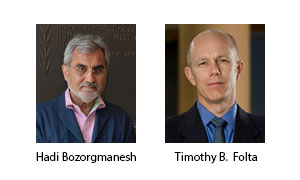
“The feedback we have received is phenomenal—it seems every organization wants to be part of the consortium,” said Folta, who serves as the consortium’s co-director with Hadi Bozorgmanesh, professor-in-residence in the School of Engineering.
The consortium will not be implementing programs, but will be a conduit for program leaders to share information and close the gaps on campus that inventors and business start-ups frequently encounter.
“We’ve found that people don’t know where to go to get information, and that’s something we can centralize, beginning with our web site,” Folta said. The newly created web site, entrepreneurship.uconn.edu, shares links to member organizations, stories of successful UConn-associated start-ups, grant application information, helpful business course links, and resources, both on- and off- campus, for people interested in starting businesses.
In addition to serving the immediate UConn community, Folta said he believes it will appeal to stakeholders beyond the university, including federal and state granting agencies that want more information about what innovation is occurring through the university.
Folta, who holds the School of Business’ Thomas John and Bette Wolff Chair in Strategic Entrepreneurship, said the participants will benefit from discussing ideas and sharing initiative and enthusiasm.
“We don’t want duplication of efforts,” he said. “We feel by improving connectivity, we will help coordinate new and exciting endeavors.”
What will it mean in the future?
“We hope that our member programs will develop new businesses and our educational programs will lead to a new generation of inventors of tomorrow,” Folta said. “We hope to increase the collaboration on campus, decrease duplication, promote a better statewide awareness of what we’re accomplishing at UConn and, ultimately, increase economic development.”
An October graduate of the School of Business’ Entrepreneurship Bootcamp for Veterans with Disabilities (EBV) has placed in the top five in a rigorous business start-up competition.
Mike Ennis, a retired Marine with experience as a military recruiter, successfully explained and defended his plan for a start-up called Veterans and Executive Talent Search (VETS) recruiting company, which will seek medical personnel interested in working for the Veterans Administration.
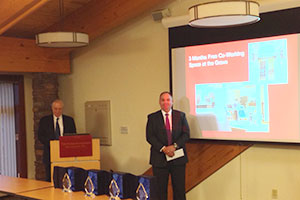
Ennis, who is from the Groton area, has already secured the support of a key angel investor, said Michael Zacchea ’12 MBA, director of the EBV program. Ennis impressed a panel of judges, all entrepreneurs or inventors, to place in the 18th annual Connecticut Collegiate Business Plan Competition, sponsored by the Entrepreneurship Foundation of Fairfield. Ennis was awarded free use of office space to grow his business at The Grove in New Haven.
His business will augment the Veteran’s Choice and Accountability Act, which seeks to expand VA services, including the number of doctors and mental health professionals, Zacchea said. Ennis currently works as a veteran employment specialist at the Connecticut Department of Labor.
The School of Business offers a nine-day Entrepreneurship Bootcamp for Veterans with Disabilities each year. The intensive course is funded by private donations and features the expertise of UConn faculty. While enrolled in the boot camp, veterans learn everything from creating a business plan to finding funding. They are offered additional planning support for their businesses during the ensuing year. The UConn program, now in its fifth year, has been recognized as one of the nation’s best for military personnel.
The 2014 EBV class was exceptional, Zacchea said. Twenty-six students were accepted into the class and there was no attrition, despite the difficult schedule, which started with 8 a.m. classes and continued with homework until midnight. Nine of the graduates from this class have already started businesses and a tenth will launch this month. Two others have accepted full-time jobs and another graduate enrolled in an MBA program, Zacchea said.
Providence Journal – “It was amazing,” says Steven D’Amico, referring to UConn’s Entrepreneurship Bootcamp for Veterans with Disabilities (EBV).
“You’re there for nine days, 18 hours a day, on your business. At the end of the time, you have to do a pitch.” D’Amico was one of 25 disabled veterans who attended the UConn EBV program (one of 8 nationwide) last October. He plans to use his business to help other injured veterans.
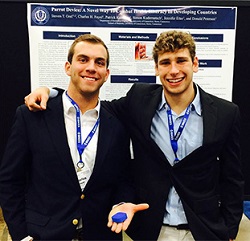
Pictured (L to R): Charles Fayal and Steve Graf show the Parrot Device, which they hope will prevent medication dosing errors.
When Steve Graf, and dozens of fellow volunteers, traveled to Ghana to help the sick, they brought 35 suitcases of medications and provision—and an endless supply of good intentions.
After a week of triaging patients, and distributing medications, Graf and his colleagues made a startling discovery. Many of the patients weren’t recovering, and some were consuming medications too quickly.
Some adults were doubling up on blood-pressure medications. Children were guzzling liquid acetaminophen from the bottle. And, compounding the problem, many of the patients were illiterate. Sometimes parents would leave the clinic with as many as 20 different prescriptions for their four children, leading to endless confusion.
Everyone on the medical mission was frustrated with the situation, but Graf just couldn’t let it go.
“I thought, ‘This is a terrible thing. I don’t understand how this could be,'” he said. Graf, now a UConn senior majoring in healthcare management, thought about the problem often after he returned from the trip in May of 2013.
How do you give clear and memorable instructions to someone who can’t read? The clinic had tried using illustrations, showing a sun or a moon, but that didn’t seem to work.
“We approach problems given our education and training,” Graf said. “Because we learned to read at age 6, we absorb information visually. Illiterate folks do not. Their traditional learning is verbal.”
Graf thought if the prescribing physician could give medical instructions using an inexpensive recording device, like the one found in a musical greeting card, patients would be able to more easily follow dosing instructions.
He mentioned that concept one day in front of friend Charles Fayal, now a UConn senior majoring in molecular cellular biology and biomedical engineering.
“The moment I heard the idea, I got pretty excited because I instantly knew how beneficial the prescription device could be—and how simple the idea is,” said Fayal, a Stonington native. “It’s funny how somebody else’s excitement spreads, because when I got excited about his idea, Steve got more excited. After that moment we knew we had to pursue this journey.”
After a great deal of research, experimentation and cost analysis, Graf and Fayal have found an inexpensive recording module, manufactured by a Chinese company, that they will be using as their first prototype. The “Parrot Device,” as they’ve nicknamed it, will allow a medical expert to record up to 60 seconds of medical instructions. The casing could be color-coded to match the medications, and both would be placed together in a travel bag.
Neither Graf not Fayal is looking for profit—or even much recognition. A successful solution, they both said, would be rewarding enough.
“We’re hoping this will save lives. That means everything to Charles and me,” said Graf, of Westport, who is the president of the UConn chapter of Global Brigades, a student-led organization that provides medical, public health, clean water and environmental relief trips to countries such as Ghana, Panama, Nicaragua and Honduras.
Graf and Fayal presented their idea at the Biomedical Engineering Society (BMES) annual meeting in San Antonio recently. It was well-received there, as it has been by physicians who are familiar with the challenges of working in third-world nations.
The biggest challenge for the two entrepreneurs has been keeping the price reasonable. Right now it is about $2 per device, and with a large order can probably be dropped to $1. Graf said he would like to try to get the price even lower. The cost of AIDS or blood-pressure medications can be several dollars per day, Graf said. The cost to resolve damage done by consuming prescriptions too quickly—or slowly—can be several times that, he said. The cost-versus-benefit of the Parrot Device is the focus that Graf and Fayal need to persuade organizations interested in their project.
Graf got his start-up funds for the project by winning a Connecticut Center for Entrepreneurship and Innovation pitch competition last year, which gave him $1,000 in seed money for the sound modules and plastic mold for the casing. He and Fayal are now seeking funding for a January trip to Haiti to test the device with patients.
“Haiti is somewhat of a make-or-break trip for us,” said Graf. “We hope to test our prototypes. Our main questions are, ‘Will the patients use the device as intended? Will the community adopt it? Will the patients benefit from it?'”
Beyond the initial concept, Graf and Fayal envision additional uses, such as education in infectious disease areas, such as Ebola-plagued villages. Prevention might become an even greater tool than treatment, they said.
Next semester Graf will take an entrepreneurship class and plans to write a business plan focused on the device. Graf and Fayal are hoping a large charitable organization will adopt the cause and fund the project.
“It has been a journey bringing this device to fruition,” Fayal said. “Some days we’ll realize that we have a mound of work in front of us, or a major obstacle to tackle regarding manufacturing or approval.
“On these days we get bummed out, but we know we have to power through because when we get to talk to somebody who has been to a place where this device is useful, it makes it all worthwhile. These people, whether they grew up in an impoverished area or worked in one, will get excited about the idea,” he said. “Just like when Steven first told me about the idea, we get excited about it all over again.”
Steven Therrien, of Harwinton, Conn., has what he believes is a great idea for creating a superior solar panel that would capture some of the sun’s energy that is now lost.
But Therrien, a former Navy corpsman and advanced x-ray technologist, was overwhelmed at the prospect of starting his own business.
“Before, I looked at it as an insurmountable mountain,” he said.
After enrolling in a nine-day Entrepreneurship Bootcamp for Veterans with Disabilities (EBV), sponsored by the UConn School of Business, he has increased confidence that he can make his business plan a reality.
The course is funded exclusively by private donations and features the expertise of UConn business faculty. This year, 26 veterans learned everything from how to write a business plan to finding funding. They developed social media skills and took a course on “discovering your personal genius.”
“It’s very flattering and humbling that so many people are willing to give their time and themselves to help a veteran,” Therrien said. “We all appreciate it very much.”
This fall, UConn’s EBV was recognized at the Pentagon by Newman’s Own, Fisher House Foundation and the Military Times as one of the nation’s best and most innovative programs for improving the quality of life for U.S. military personnel.
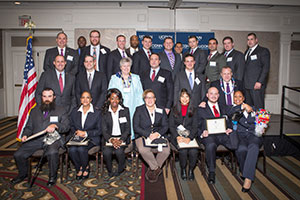
This is the fifth year that the EBV program has been offered at UConn. Seven of the veterans hail from Connecticut; most of the rest are from neighboring states. This year’s class was composed of 19 men and seven women.
“This was a great class, the first one that we had with no attrition at all from acceptance through graduation,” said program Director Michael Zacchea. “Our veterans said it was an amazing and transformative event.”
“These people aren’t in it for the money,” Zacchea said. “Every vet here wants to solve a problem. They are very focused on ‘mission accomplished.’ Because our veterans all come from diverse backgrounds, we offer a very hands-on program. We tell them how to find an accountant, a lawyer, how to establish a relationship with a bank.”
What makes the bootcamp unique is it addresses the veterans’ holistic needs—even providing a free suite and laptop for the future business
owners. It also offers mentorship for a year, to help veterans identify and overcome business barriers. The UConn program is also part of a larger community of veteran entrepreneurs throughout the country. The rigorous course usually had veterans working on their businesses until midnight.
Since they graduated on Oct. 10, the veterans have been preparing their business plans, for which they could be awarded a $3,000 grant to use as seed money.
“I would tell everyone to hire a veteran,” said Rosita Campbell of New Jersey, a bootcamp graduate, who wants to own her own fitness center. “We are dependable, reliable and offer standards of service and excellence that are beyond what is expected. We also have incredible integrity. All of that has been ingrained in us from a young age.”
CCEI is excited to announce the re-launch of the Innovation Accelerator for the Spring 2015 semester!
We are now seeking applications from students interested in earning experiential learning credit through this program. After an interview process, students will be selected to form interdisciplinary teams and assigned a consulting assignment from a Connecticut-based startup or early stage company. For more information about the program, click on the Innovation Accelerator tab in the menu on this homepage. We look forward to hearing from you soon!
LinkedIn.com – On Friday, October 10th, the University of Connecticut (Uconn) Entrepreneurial Bootcamp for Veterans made history during their annual business pitch competition. Over 20 startup companies led by military veteran leaders pitched their businesses LIVE on air in 4 separate classrooms to determine which startup would win the cash prize!
UConn Today – The School of Business’ Entrepreneurship Bootcamp for Veterans with Disabilities has been recognized as one of the nation’s best and most innovative programs for improving the quality of life for U.S. military personnel.