Web cookies (also called HTTP cookies, browser cookies, or simply cookies) are small pieces of data that websites store on your device (computer, phone, etc.) through your web browser. They are used to remember information about you and your interactions with the site.
Purpose of Cookies:
Session Management:
Keeping you logged in
Remembering items in a shopping cart
Saving language or theme preferences
Personalization:
Tailoring content or ads based on your previous activity
Tracking & Analytics:
Monitoring browsing behavior for analytics or marketing purposes
Types of Cookies:
Session Cookies:
Temporary; deleted when you close your browser
Used for things like keeping you logged in during a single session
Persistent Cookies:
Stored on your device until they expire or are manually deleted
Used for remembering login credentials, settings, etc.
First-Party Cookies:
Set by the website you're visiting directly
Third-Party Cookies:
Set by other domains (usually advertisers) embedded in the website
Commonly used for tracking across multiple sites
Authentication cookies are a special type of web cookie used to identify and verify a user after they log in to a website or web application.
What They Do:
Once you log in to a site, the server creates an authentication cookie and sends it to your browser. This cookie:
Proves to the website that you're logged in
Prevents you from having to log in again on every page you visit
Can persist across sessions if you select "Remember me"
What's Inside an Authentication Cookie?
Typically, it contains:
A unique session ID (not your actual password)
Optional metadata (e.g., expiration time, security flags)
Analytics cookies are cookies used to collect data about how visitors interact with a website. Their primary purpose is to help website owners understand and improve user experience by analyzing things like:
How users navigate the site
Which pages are most/least visited
How long users stay on each page
What device, browser, or location the user is from
What They Track:
Some examples of data analytics cookies may collect:
Page views and time spent on pages
Click paths (how users move from page to page)
Bounce rate (users who leave without interacting)
User demographics (location, language, device)
Referring websites (how users arrived at the site)
Here’s how you can disable cookies in common browsers:
1. Google Chrome
Open Chrome and click the three vertical dots in the top-right corner.
Go to Settings > Privacy and security > Cookies and other site data.
Choose your preferred option:
Block all cookies (not recommended, can break most websites).
Block third-party cookies (can block ads and tracking cookies).
2. Mozilla Firefox
Open Firefox and click the three horizontal lines in the top-right corner.
Go to Settings > Privacy & Security.
Under the Enhanced Tracking Protection section, choose Strict to block most cookies or Custom to manually choose which cookies to block.
3. Safari
Open Safari and click Safari in the top-left corner of the screen.
Go to Preferences > Privacy.
Check Block all cookies to stop all cookies, or select options to block third-party cookies.
4. Microsoft Edge
Open Edge and click the three horizontal dots in the top-right corner.
Go to Settings > Privacy, search, and services > Cookies and site permissions.
Select your cookie settings from there, including blocking all cookies or blocking third-party cookies.
5. On Mobile (iOS/Android)
For Safari on iOS: Go to Settings > Safari > Privacy & Security > Block All Cookies.
For Chrome on Android: Open the app, tap the three dots, go to Settings > Privacy and security > Cookies.
Be Aware:
Disabling cookies can make your online experience more difficult. Some websites may not load properly, or you may be logged out frequently. Also, certain features may not work as expected.
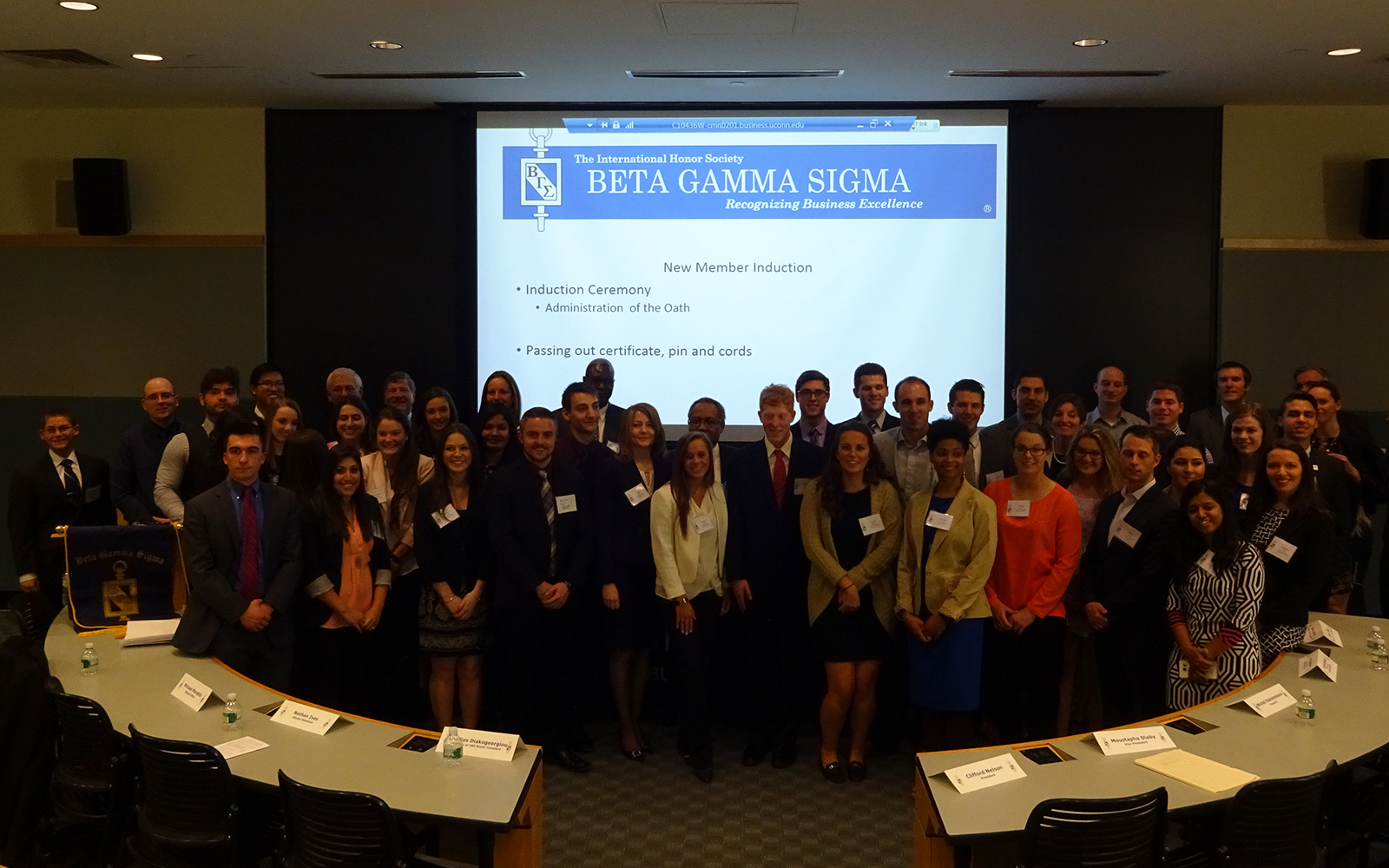
Students at a recent Beta Gamma Sigma induction ceremony. (Tina Pierce/UConn School of Business)
UConn Business Society Receives Highest Honors; Thriving Group Attracts Elite Students
The UConn chapter of Beta Gamma Sigma, an international honor society that recognizes outstanding academic achievements of collegiate business scholars, has been qualified for Highest Honors for the 2015-2016 academic year.
The status is indicative of a campus where academic excellence is valued and where the faculty officers of the chapter work diligently to enhance Beta Gamma Sigma’s stature on campus, the society said in a written statement.Continue Reading
Hartford Business Journal – Earlier this month, scientists, engineers and entrepreneurs looked on as UConn undergraduate and graduate-level students presented what they accomplished as summer interns working at the school’s incubator companies in Farmington and Storrs.
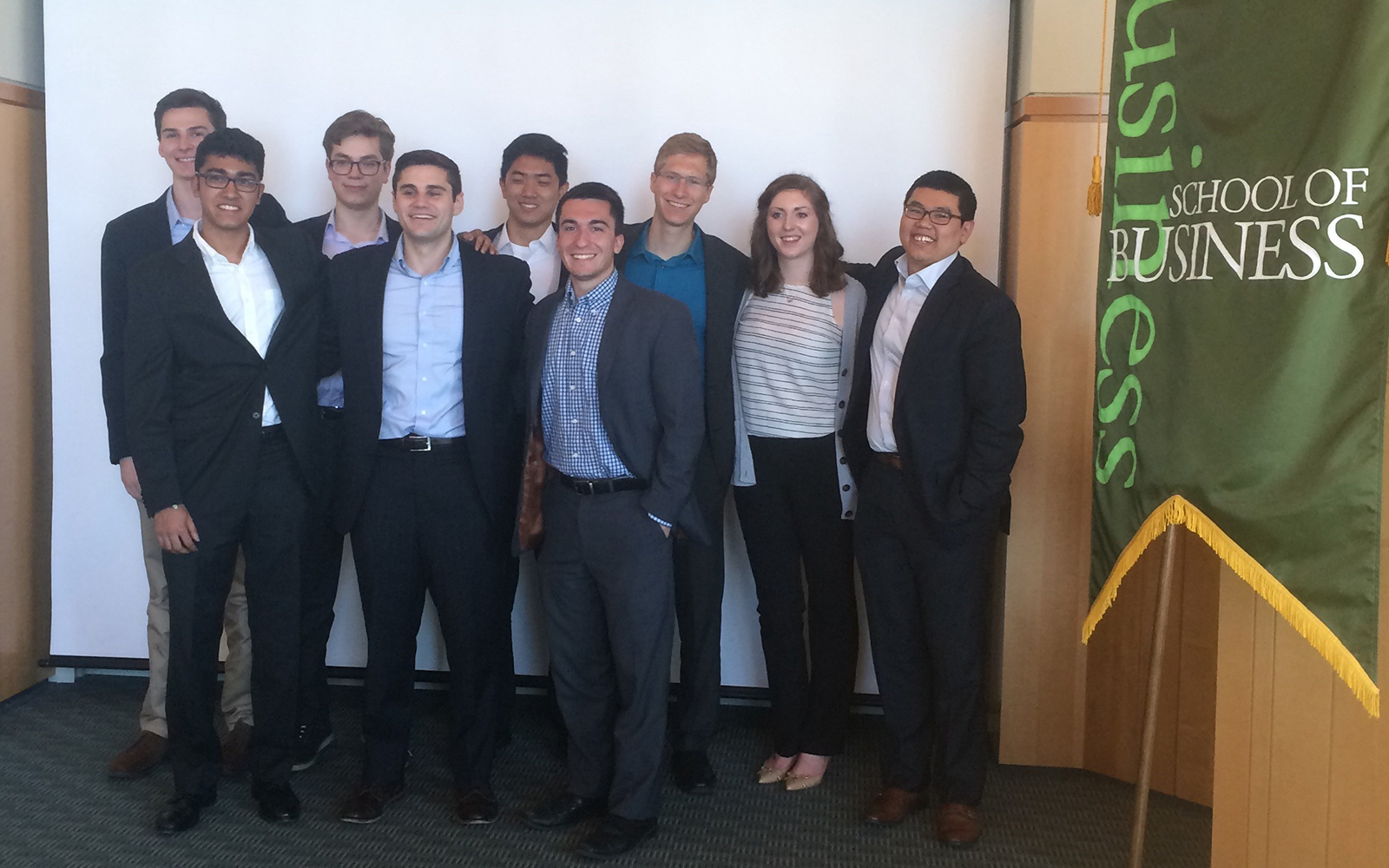
Back row, from left: Zachary Yellen, Edward Leardi, Eric Pan, Matthew DeLeon, Katie Cavanaugh, Liang Jian Wu (advisor & alumnus). Front row, from left: Ankur Shah, Justin Lee (advisor & founder), and Stephen Porcello after the final presentation in Storrs. (UConn School of Business)
Student-led UConn Consulting Group Offered Helping Hand to Financial Startups
Two financial services startups were the recent beneficiaries of a helping hand from the UConn Consulting Group, an undergraduate, student-led organization that works on real-life business projects to both assist companies and broaden student experiences.
“By working on a project for a startup, I had direct access to the CEO and felt like the UConn Consulting Group was consistently making an impact on the company,” said junior Matthew DeLeon. “The trust that the company placed in the group allowed us to push beyond what we had done in the past.” Continue Reading
UConn School of Business 75th Anniversary Alumni Stories: Bob Kaufman, Bob’s Discount Furniture.
Alumnus Bob Kaufman, Founder of Bob’s Discount Furniture: ‘I Believe Everyone Should Work for Themselves!’
One of the biggest decisions that anyone will make in life is whether to work for themselves—or work for someone else, said UConn business school alumnus Bob Kaufman ’74, founder and president emeritus of Bob’s Discount Furniture.
“I believe that everyone should work for themselves,” said the man who created the rapidly-growing, 73-store furniture giant. Thanks to his prolific advertising, Kaufman is arguably one of the most recognized people on television.
“Being an entrepreneur is harder, and easier, than you would think. It takes more time than you can imagine and, yes, you can work for less than minimum wage,” he said. “But the rewards are enormous. I feel like I’ve won the lottery.”
Established in 1991, the furniture giant Bob’s Discount Furniture now sells more than $1.1 billion in furniture annually, with stores in the Northeast, Midwest and Mid-Atlantic. It is ranked 14th among U.S. furniture retailers. Kaufman remains an active executive and the third-largest shareholder in the company, which is now owned by Bain Capital.
Working Hard for the Money
Kaufman’s focus on giving customers real value and “no phony gimmicks” has its roots in several key experiences in his early life. But probably the most profound was working as a factory supervisor, making parts for cars and boats.
“I worked 65 hours a week. I supervised 20 people on the production line. It taught me how hard people work for their money!” he said. “We worked 5 ½ days a week, from 6:30 a.m. to 6:30 p.m., Monday through Friday, and then 6:30 a.m. to noon on Saturday.”
“After 2 ½ years there, I realized that I would be there my whole life if I didn’t do something. I was getting burned out. One day, my sister came down to the lake where I lived for the day. We went to the beach, and I was exhausted, and I fell asleep. I woke up at 5:30 p.m., and she was gone. At that moment I knew it was time to try something else,” he said.
UConn Students Fascinated by TV Icon
Kaufman, who hasn’t granted an interview in 20 years, agreed to speak about his experiences in hopes of helping future business leaders at his alma mater.
The last time Kaufman spoke at UConn, in 1995, he was thrown for a loop. Twice a year, Kaufman would speak with a UConn business fraternity, but this time organizers told him the location had been moved. When he arrived at the Student Union, every seat was taken, people were standing in the back, and many were being turned away at the door.
“There were hundreds and hundreds of people there,” he said, with amazement. “I realize now that 20- and 30-year-olds have seen my ads since they were kids. They were curious about me. It was the last presentation I did. I wouldn’t have gone if I’d known it was that big. I would have been too scared!”
Despite his boisterous and take-charge TV demeanor, Kaufman describes himself as an extreme introvert, who, nevertheless, likes people. He went through high school with barely a friend. That all changed when he arrived in Storrs for his junior and senior years and there he formed long-lasting friendships. Today, despite his enormous success, he remains as humble and self-effacing as he was back at UConn—but now he no longer sports a ponytail.
Still the fame mystifies him. His office constantly gets requests for photos and autographs. “The irony is that almost nobody was photographed less than me as a kid,” said Kaufman, who tapes two Bob’s TV commercials a week. To now be one of the most recognizable faces in the Northeast is “odd to say the least,” he said.
An Accident Changed His Life
What changed Kaufman’s life forever was a devastating motorcycle accident in 1976, in which he broke his collarbone and almost lost his right leg. He was working as the manager of a Radio Shack store in Groton, Conn., at the time and was headed to a meeting in his native West Hartford. He became distracted and hit a telephone pole.
“The accident absolutely changed my life,” he said. His right leg was so badly injured that doctors almost amputated it. They predicted he would never walk again. His leg and foot are still partially paralyzed. His recovery took almost a year.
“Whenever you’re faced with your mortality, it changes your outlook. Heck, I was 25-years old and felt immortal,” he said. “It was a turning point. I developed a new mindset that said, ‘Get serious. What are you going to do with your life?'”
With the damage to his leg, it became difficult for Kaufman to get a good night’s sleep. A friend recommended he try a waterbed, which he did, and he loved it.
Before long, Kaufman, who describes himself as “very risk-averse” decided to sell the waterbeds that had been his salvation. He partnered with a distant cousin, Gene Rosenberg, who had a great deal of business smarts—and who offered good advice.
He was able to sell waterbeds for half the price of the competition. “It was truly a super deal,” he said. He would lease a space in larger stores and sell his waterbeds there. But by the 1980s, the waterbed business was all washed up and the industry crashed.
If ever there was a true example of the expression, “when one door closes, another door opens,” this was it. Kaufman had developed connections in the furniture business—selling dressers and nightstands to accompany the waterbeds—and he was able to negotiate a deal with the landlord of his Newington shop.
The landlord would pay the taxes, heat and other utilities, and, in return, Kaufman gave him a percentage of sales. In March 1991, in the midst of a recession, Kaufman launched his furniture business.
“I think of UConn and the importance of having a great business plan, and, honestly, none of that happened,” said Kaufman, who earned a bachelor’s degree in marketing from UConn in 1974.
Rosenberg was an ideal business partner in many ways, including that he was more willing to take a gamble than the younger Kaufman. “We joke that if it was up to Gene, we’d have had 100 stores the first year,” Kaufman said. “And if it was up to me, we’d still have two.”
Growing, Growing, Growing
Following the success of the first store, Kaufman and Rosenberg expanded into Windsor, then Middletown, and added a fourth store in Willimantic, all using a percent-of-sales agreement that kept fixed costs low.
“We were the only low-cost furniture company. People wanted good quality and one low price. They hated haggling,” he said. “The lowest price and the highest quality, that’s the bedrock of our company.”
To bolster business, Kaufman accepted any speaking engagement he could get—with the Lion’s Club or the Jaycees, at high schools, or whomever a group would welcome him. He would take his beloved dad, an advertising executive with 50 years of experience, with him on those trips. In 1995 alone, the business grew 54 percent.
Rosenberg was a great mentor and gave Kaufman the best advice he has ever received. “He said, ‘It’s all about your people. If the people who work for you aren’t happy, your customers won’t be happy,'” Kaufman recalled.
The delivery people have to be as courteous as the salespeople, or the whole company fails, he said. Before his employees can take to the selling floor, they must go through a three-week training session. Depending on their success, they can earn between $40,000 and $100,000 a year.
Kaufman makes it a point to meet every employee.
“I don’t want anyone to say, ‘I work at Bob’s Discount Furniture, but I’ve never met Bob,'” he said. “We run it like a small, family business.”
Kaufman will tell you the success of his business is predicated on good quality and a fair price. But as the business grew by leaps-and-bounds, Kaufman worked hard to make sure it never lost its core. “People do recognize value,” he said. “People are smart. They will respond if you give them a good deal. My success is 100 percent testament to that.”
At one point Raymour & Flanigan offered to buy out the company.
“We all got together over lunch, and started a conversation about the future of the company. We had 500 employees. I knew them all by name because I’d hired them. All of these people helped me to grow, and if we sold, many of them would be out of work,” he said. “We declined.”
The company is now owned by Bain but Kaufman remains active in the business and said he is inspired by the management team. “I’ve never been more excited about the future of the company. We will be in the top five in a few years,” he predicted. “Nobody is opening stores like we are. The growth projection is spectacular.”
Not Your Typical Pitchman
When Kaufman told his dad, Leo Kaufman, a decorated World War II veteran and advertising guru, that he planned to do his own ads, his father’s enthusiasm was non-existent.
“He said, ‘Son. I love you dearly, but you look like crap and your voice is worse. Don’t do it.’ Obviously, I ignored his advice,” Kaufman said. “The reason it works is because every business wants customer attention. But how do you get through the din? By not being your typical pitchman. By having a scratchy voice. By dressing in jeans and a polo shirt. I would work at the warehouse, go do an ad, and go back to the warehouse in the same clothes,” Kaufman said. (Many incorrectly believe Cathy Poulin, the woman who appears in his commercials is his spouse, but she’s the retailer’s public relations/outreach director.)
He has spent millions on advertising.
“I became the brand. People feel like they know me,” Kaufman said. “Do I give up some privacy? Yes. People come up when I’m in Kohl’s or Walmart and they say hello. I like people. We spend millions and millions on those ads, so I guess I’d be disappointed if they didn’t recognize me. Generally, people are happy to see me. Why begrudge that attention when that’s what made it all possible?”
One of the hallmarks of Bob’s is the large café in each store.
“The decision to put a café in the store was easy,” he said. “I read that buying furniture is the third most stressful experience in life, only surpassed by buying a house and a car. I wondered how we could make people more comfortable. Why not offer them freshly baked cookies? When I’m chewing on a cookie, I can’t be stressed. A lot of people stop in after lunch for a cookie, a piece of candy or a cup of coffee. They are always welcome. They may not buy something today, but they’ll be back.”
The furniture business has both changed and remained the same over the years, Kaufman said. “It’s a fashion business now,” he said. “We offer the latest, greatest fashions for your home.”
The company uses American products as well as imports from 10 or 11 countries. The stairway bunk, which retails for $699, comes from a Brazilian forest and the company sells 150 of them a week. The Bob-O-Pedic mattress has earned accolades from Consumer Reports. Ninety-five percent of the stores’ merchandise is in stock and can be delivered immediately.
“On a business level, I see myself as a serial entrepreneur, but I also think of myself as the waterbed guy!” Kaufman said. He also owns five construction companies and is involved in homebuilding in Salem and Colchester, Conn., as well as property in Misquamicut, R.I., the latter a business fondly named Tequila Associates.
At UConn, Kaufman Made Life-long Friendships
Kaufman describes himself as “a pariah” at Conard High School in West Hartford, Conn. “I didn’t have more than one friend. I was very shy, I wore horn-rimmed glasses and probably weighed 117 pounds,” he said. “I went through anonymously.”
He made the dean’s list at Bentley College but left after freshman year because he didn’t think his accounting major was for him. He spent his sophomore year at the UConn campus in West Hartford while working full-time at an East Hartford pharmacy. He transferred to Storrs for his junior and senior years.
“At UConn I was an OK student, but I wasn’t an academic standout. I guess I was having too much fun,” he said.
“The lasting legacy of UConn, for me, is my friendship with Mike Ricci ’76 (accounting)–his pony-tailed roommate from Belden Hall, Sixth Floor–and with George Clarke ’75 (political science),” he said. Both helped him with his waterbed business. Ricci, who made handicapped accessible ramps for vans, built waterbed frames for Kaufman; Clarke worked in the waterbed stores.
Retailer Gets 150 Charitable Requests Per Week
Bob’s Discount Furniture donates millions to charity each year, culled from the 150 requests it receives each week. An annual golf outing and dinner, last summer, netted $454,000 for charity.
“The only downside is that you realize the tremendous need that’s out there,” Kaufman said. Two of the company’s top charities are Camp Rising Sun for kids with cancer, which sponsors a summer camp each summer and Family & Children’s Aid, which provides safe homes for abused and neglected children. That organization asked Kaufman to donate some bunk beds. Now he’s on the Board of Directors.
“This is the first time I’ve ever talked about charitable work,” he said during an interview when asked about the company’s policies. “I never wanted any good deeds to be considered actions for public relations value.”
Best Part of His Career? Sharing His Success
Despite his success, Kaufman maintains a low-key lifestyle, living with his “honey” of 35 years, Joann Chapel, a pediatric nurse whom he met at his factory job, and their three dogs.
He enjoys time with family (his three sisters and their children; Chapel’s three children and five grandchildren) and friends, maybe a little boating or some golf. But the Bob you see on TV, the one with the polo shirt and jeans, is the real Bob, he said. He lives in a modest home in Eastern Connecticut, furnished with Bob’s Discount furniture. Many members of his extended family, Kaufman said, are UConn alumni.
He claims to have no affiliation or loyalty to either a sport team or a political party. He has been asked often by politicians for endorsements, which he flatly refuses.
“I want to sell furniture to Democrats and Republicans,” he said. “I want to sell furniture to Red Sox fans, Yankees fans and Mets fans. I’m a lucky guy. I hit a home run.”
In March, Kaufman announced an expansion of the corporate headquarters in Manchester, Conn., and the addition of 125 jobs over the next five years.
“What’s the most rewarding part of my career?” he repeated. “I went into business because I wanted to stop working for somebody else. Now I’m providing a livelihood to more than 5,000 people.”
“My favorite story is about a guy named Kevin Parker, who came to apply with us 18 years ago. He filled out the application and said he’d be a warehouse guy. Then he crossed it out and wrote ‘sales,'” Kaufman said. “Now he’s the regional sales manager for New York state. That to me is what’s thrilling… finding that talent and giving them the opportunity.”
Westfair online – The University of Connecticut’s Stamford campus is no longer a runner-up prize for students wanting to attend the university’s main Storrs campus.
“Six years ago we had part-time MBA, two small business undergraduate programs and we were largely a feeder school for students wanting to get to Storrs,” said John A. Elliott, dean of the UConn School of Business, at the June 15 CEO Evolution panel hosted by the university in Stamford.
Exciting news! The OPIM department is happy to announce a great opportunity for MIS students. We are offering skill-building workshops starting next week, and continuing the rest of the semester. All workshops will be held in the OPIM Research Lab, BUSN 391 and food and refreshments will be made available. Continue Reading
The Daily Campus – Business students filed into Konover Auditorium to get advice about their industry from University of Connecticut alum Peter Broadbent, who is vice president of U.S. and European sales at Photronics, as part of the global business leadership seminar series Wednesday night.
For the second year in a row, the School of Business is offering a 10-credit summer business program (Nathan Oldham/UConn School of Business)
B-School Offers 10-Credit Summer Program for Non-Business Majors
For the second year in a row, the School of Business is offering a 10-credit summer business program for undergraduate, non-business majors who want to gain valuable business knowledge and expand their marketability.
The seven-week UConn Business Fundamentals Program includes the following three-credit courses: Legal and Ethical Environment of Business, Managerial and Interpersonal Behavior, and Business Information Systems, plus a one-credit course on Workplace Readiness.
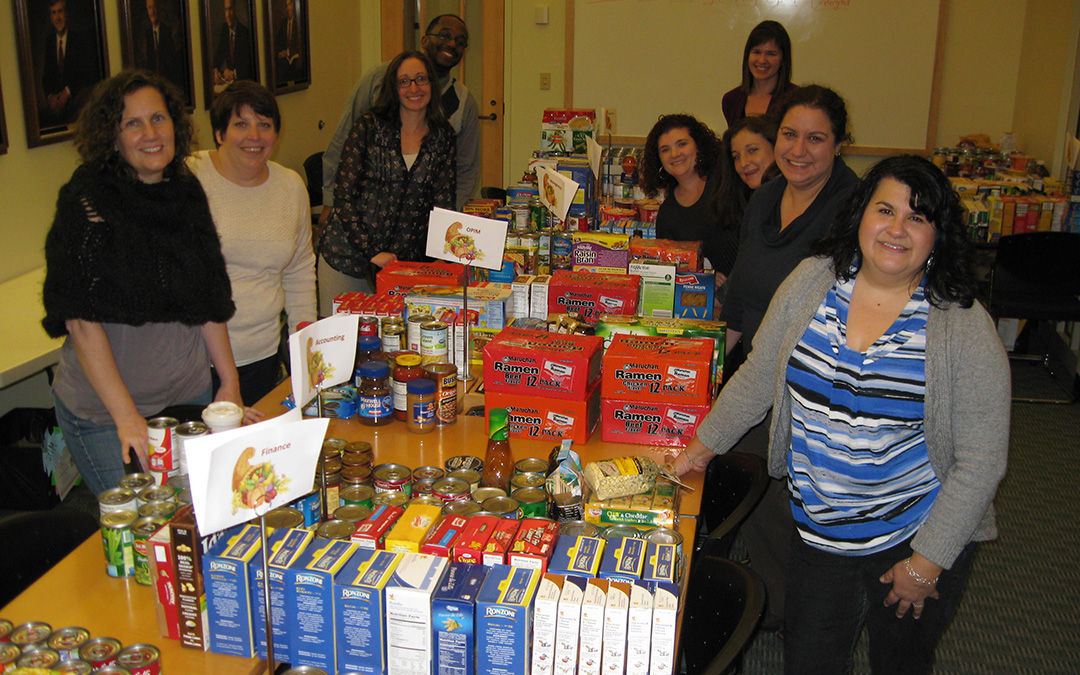
2015 Thanksgiving Food Drive (Olivia Rossetti/UConn School of Business)
Jars of peanut butter, boxes of crackers and rice, cans of soup and fruit and more filled a third-floor meeting room last week as the UConn School of Business’ Thanksgiving food drive brought in a record 1,400 donations for the Mansfield Food Bank.Continue Reading
Angel Charles, Connecticut National Guard and 2015 EBV Participant (Nathan Oldham/UConn School of Business)
UConn’s Entrepreneurship Bootcamp for Veterans Helps Military Heroes Become Business Moguls
The UConn School of Business has a strong and proud history of serving the educational and career needs of military leaders and veterans, a tradition that dates back to its earliest days.
After WWII, the university offered business classes at Fort Trumbull in New London to serve returning GIs. The creation of a full-time MBA program on the Storrs campus in 1960, another milestone at the School of Business, occurred as a direct result of a contract to expand educational opportunities for members of the Air Force.Continue Reading