Web cookies (also called HTTP cookies, browser cookies, or simply cookies) are small pieces of data that websites store on your device (computer, phone, etc.) through your web browser. They are used to remember information about you and your interactions with the site.
Purpose of Cookies:
Session Management:
Keeping you logged in
Remembering items in a shopping cart
Saving language or theme preferences
Personalization:
Tailoring content or ads based on your previous activity
Tracking & Analytics:
Monitoring browsing behavior for analytics or marketing purposes
Types of Cookies:
Session Cookies:
Temporary; deleted when you close your browser
Used for things like keeping you logged in during a single session
Persistent Cookies:
Stored on your device until they expire or are manually deleted
Used for remembering login credentials, settings, etc.
First-Party Cookies:
Set by the website you're visiting directly
Third-Party Cookies:
Set by other domains (usually advertisers) embedded in the website
Commonly used for tracking across multiple sites
Authentication cookies are a special type of web cookie used to identify and verify a user after they log in to a website or web application.
What They Do:
Once you log in to a site, the server creates an authentication cookie and sends it to your browser. This cookie:
Proves to the website that you're logged in
Prevents you from having to log in again on every page you visit
Can persist across sessions if you select "Remember me"
What's Inside an Authentication Cookie?
Typically, it contains:
A unique session ID (not your actual password)
Optional metadata (e.g., expiration time, security flags)
Analytics cookies are cookies used to collect data about how visitors interact with a website. Their primary purpose is to help website owners understand and improve user experience by analyzing things like:
How users navigate the site
Which pages are most/least visited
How long users stay on each page
What device, browser, or location the user is from
What They Track:
Some examples of data analytics cookies may collect:
Page views and time spent on pages
Click paths (how users move from page to page)
Bounce rate (users who leave without interacting)
User demographics (location, language, device)
Referring websites (how users arrived at the site)
Here’s how you can disable cookies in common browsers:
1. Google Chrome
Open Chrome and click the three vertical dots in the top-right corner.
Go to Settings > Privacy and security > Cookies and other site data.
Choose your preferred option:
Block all cookies (not recommended, can break most websites).
Block third-party cookies (can block ads and tracking cookies).
2. Mozilla Firefox
Open Firefox and click the three horizontal lines in the top-right corner.
Go to Settings > Privacy & Security.
Under the Enhanced Tracking Protection section, choose Strict to block most cookies or Custom to manually choose which cookies to block.
3. Safari
Open Safari and click Safari in the top-left corner of the screen.
Go to Preferences > Privacy.
Check Block all cookies to stop all cookies, or select options to block third-party cookies.
4. Microsoft Edge
Open Edge and click the three horizontal dots in the top-right corner.
Go to Settings > Privacy, search, and services > Cookies and site permissions.
Select your cookie settings from there, including blocking all cookies or blocking third-party cookies.
5. On Mobile (iOS/Android)
For Safari on iOS: Go to Settings > Safari > Privacy & Security > Block All Cookies.
For Chrome on Android: Open the app, tap the three dots, go to Settings > Privacy and security > Cookies.
Be Aware:
Disabling cookies can make your online experience more difficult. Some websites may not load properly, or you may be logged out frequently. Also, certain features may not work as expected.
At the Academy of Business Research Conference in New Orleans on March 23-25, Nicole Jackson, Assistant Professor of Management, and Kevin McEvoy, Assistant Professor In-Residence of Marketing, earned a Best Session Presentation Award for their work titled, “Mindfulness, Marketing and Management – Is it all that?”Continue Reading
UConn Today – UConn is creating a center to connect small and medium-sized technology and manufacturing businesses in Eastern Connecticut with the University’s resources and outside partners, after the Economic Development Administration agreed to fund a portion of the $1.5 million startup costs.
Fox61 – The authors of a new study of Connecticut’s aging population discuss what they call the “Baby Boomer Effect” on the state’s business landscape and economy. Al and Jenns’ guests are Tom Devitto from Blum Shapiro, New England’s largest business advisory group, and Professor David Souder of the UConn School of Business.
Science Codex – How much do consumers care about the carbon footprint of the products they buy? Would they care more if the goods were labeled with emissions data? Does it matter at which stage in the lifecycle of a product the carbon is emitted? Research published in the International Journal of Environmental Policy and Decision Making offers a way to find out.
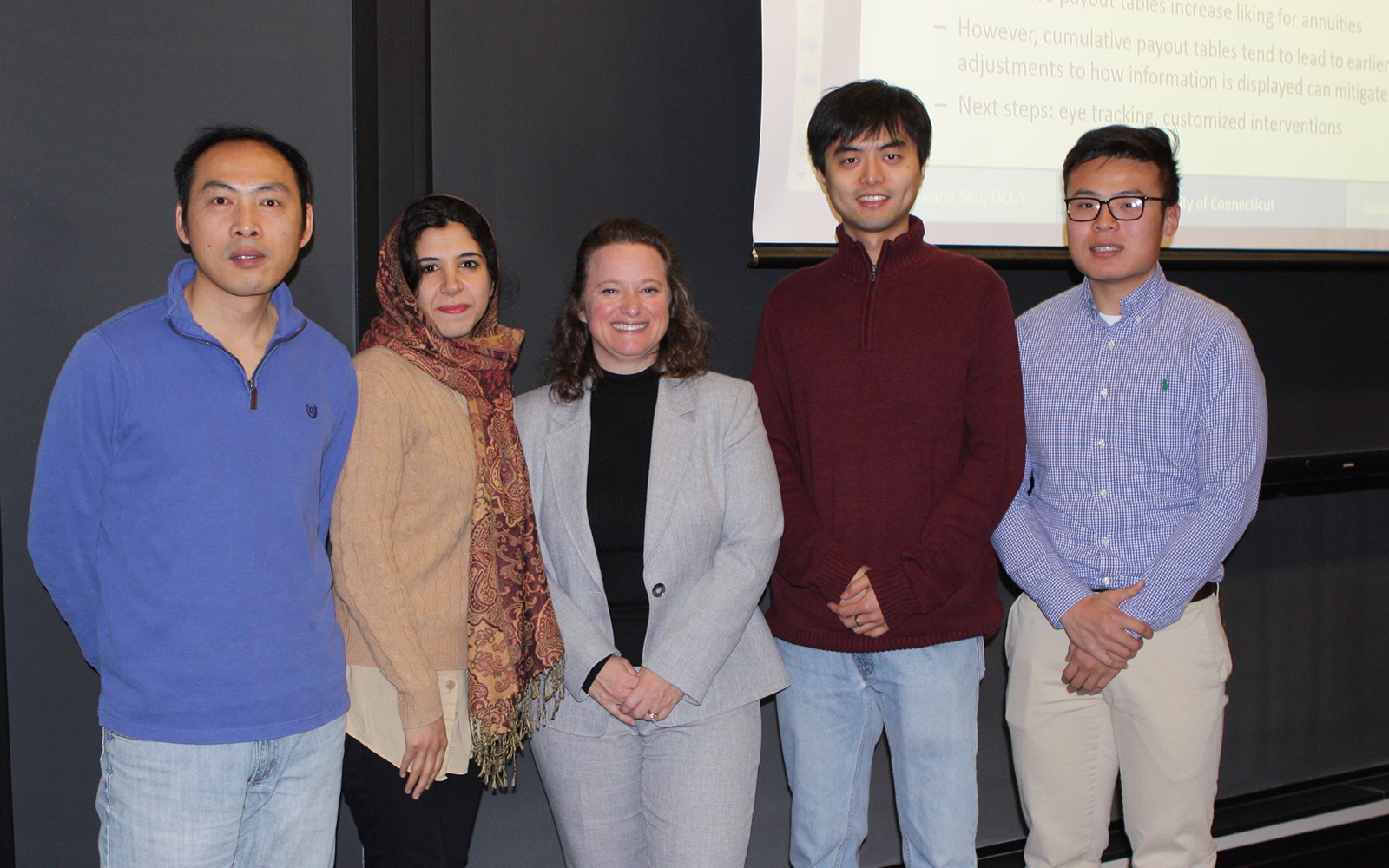
Suzanne Shu (centered) with Ph.D. Students Bin Li, Zahra Tohidinia, Lu Huang, and Qizhou Wang. (Nancy White/UConn School of Business)
Ph.D. Student Speaker Series Continues with Marketing
UCLA Marketing Professor Suzanne Shu discussed retirement savings, and how individuals make their decisions about how much to save and how much to spend, during a presentation to faculty and doctoral students on Jan. 29.
“Risk, Ownership and Loss in Decumulation During Retirement,” was the topic of her speech, presented as part of the School of Business Ph.D. Student Speaker Series, which was attended by faculty and doctoral students. Continue Reading
LSE Business Review – An ultimate challenge for technology entrepreneurs is the need for capital to continue to innovate, sustain, and commercialise their innovation. The considerable risks associated with the technological feasibility, business model credibility, and product or service viability severely limits access to capital, yet angel investors and venture capitalists fill this need by investing in startups in exchange for an equity stake in the company. Does private equity, in fact, provide value-added services by influencing startup innovation and commercialisation beyond mere capital infusion?
From L to R: Former School of Business Dean Ronald Patten; Robert H. Steele, United States Representative for the 2nd Congressional District of Connecticut 1970-1975; and Wallace Barnes, retired Chairman and CEO of The Barnes Group, at the Beta Gamma Sigma – Alpha of Connecticut Chapter induction on May 1, 1977 (UConn School of Business)
School of Business Dean Ronald Patten Used Faculty’s Competitive Spirit to Advance Research, Ph.D. Program
Ronald Patten, the third dean of the UConn School of Business, was a bright, fair, likeable and hard-working leader, whose knowledge of business was surpassed only by his charm, and an enviable talent for coaxing the best out of people.
Meanwhile, the faculty who served during his tenure, from 1974 to 1988, were also exceptionally intelligent and enthusiastic. But the trait that most defined the professors and department heads was an unyielding competitive streak.Continue Reading
UConn Professor, Colleagues Discover That Turkey’s Take-Charge Healthcare Initiative Saves Lives
Since the nation of Turkey launched an aggressive healthcare initiative, providing free and convenient access to primary care for all its citizens, at conveniently located walk-in clinics, the mortality rate has decreased, most dramatically among infants.Continue Reading
UConn Today – Two UConn researchers have developed a technology that promises big improvements on one of the most common and important emission control tools used to protect the environment: the catalytic converter.
With help from UConn’s NSF program, Accelerate UConn, the pair are now well on their way to commercializing their new technology
UConn Today – Imagine that due to your family medical history, you had an almost 100 percent risk of developing cancer in your lifetime. Now imagine that you discovered this fate before you even started high school. Today that is the reality for many patients with classic familial adenomatous polyposis (FAP), a hereditary colon cancer syndrome.
A team of researchers at UConn Health is exploring ideas for novel approaches to prevent FAP and other inherited colorectal cancer syndromes, and they’re getting out of the lab to do it with help from the University’s new National Science Foundation Innovation Corps Site, Accelerate UConn.