Undergraduate Commencement, 2012
Thank you so much! Good Morning. I am so honored to have been invited to speak to you today. When I was preparing this speech I was thinking about what UConn meant to me. I am not an alumna, however the time I spent on the Board was personally transformational – through it I grew both professionally and personally. I hope that you have likewise had an enriching and challenging experience here and have formed bonds with others that will last a life time.
As was mentioned in the introduction, I recently took over as CEO of Connecticut Innovations. For those of you who are unfamiliar with CI, we are the State’s venture capital and early stage investment arm. We invest in technology- and innovation-driven companies.
I’m going to talk about 4 lessons that I learned here and tie them to entrepreneurship and innovation.
Lesson 1: Harness the motivating properties of fear.
I was asked to join the UConn Board of Trustees when I was 38. As I headed to my first meeting, I was petrified. I was afraid to speak in front of people and very shy. I walked into my first meeting, not knowing really what to expect, and saw a long table with microphones, name cards at each seat and there was an audience. All I could think was “what am I doing here…..I hope I don’t pass out”.
I was pleased to be appointed to the Finance committee because I was extremely comfortable and confident with the subject matter. Budget time came as did a 3 inch thick book. I was nervous about asking dumb questions, about being wrong. So I decided that I needed to try to understand everything. I studied the book from top to bottom. I made notes of things that seemed inconsistent. At the meeting, I proceeded to point out where numbers didn’t agree or tie. People just looked at me with astonishment. Looking back, I know it was a bit extreme—and probably somewhat annoying—but that investment of time and energy made me a valuable contributor because I had built a deep knowledge of the content and how all of the pieces fit together.
A certain level of fear or adrenaline can drive your performance, but in other cases can paralyze thought and action. It is important to figure out how to capture the energy and drive without the paralysis.
Lesson 2, which may sound contradictory, do not fear failure.
As I became more confident in my role, I began to realize that to really make a difference I needed to reach out into areas where I was less comfortable; places where I couldn’t control the outcome; couldn’t study and work my way to accomplishment—where success wasn’t assured. I was approached by several staff members to work with them on the UConn 2000 initiative—the program that began the rebuilding of the University’s infrastructure. There were many who thought the effort could not succeed. It took a tremendous amount of work and participation from many, many people. We were able to obtain support and as they say “the rest is history”. If we hadn’t been willing to fail, we would never have tried, and therefore never have succeeded.
There are a myriad of examples of successful people who failed over and over before they succeeded—Abraham Lincoln and Michael Jordan are well known examples. But did you know that Walt Disney was fired by a newspaper editor because “he lacked imagination and had no good ideas”. Oprah Winfrey was fired from her job as a TV reporter because she was “unfit for television”. RH Macy had 7 failed start-ups before his successful New York City store and Henry Ford went broke 5 times before founding Ford Motor Company.
You have to been willing to take a risk and not be afraid to fail.
Early this year I attended the UConn Startup Weekend. Startup Weekend is an event where the goal is to create a new company in a weekend. At the beginning of the weekend, individuals or teams sign up to “pitch” their ideas. Each gets one minute to describe the problem that they are trying to solve, the proposed solution and what kind of help they need to develop their idea. Help could mean marketing, software development, legal…really anything. After the pitches, all those attending, then vote for the best ideas. Once the winning concepts are selected, people form groups and spend the next 48 hours creating a company.
On Friday, I listened as 70 new ideas were presented largely by students. I was astounded by the quality of the ideas as well as the courage of those who stood in front of an audience with an idea that was uniquely theirs that would get a very public “thumbs up” or “thumbs down”. I returned on Sunday for the final presentations and was even more impressed—business plans were refined, mobile apps and working proto-types developed. I was inspired.
I am looking forward to seeing many of these ideas move along the path of development. Some will succeed, but many will fail. Accepting failure doesn’t mean being reckless or unprepared. As articulated by the former co-CEO of Charles Schwab who led the company from a bricks and mortar business to a discount broker, there is stupid failure and “noble failure”. What he meant by this is that a team should analyze the opportunity carefully; create a comprehensive plan; commit to the venture’s success obtain the resources to do it right; execute and, if necessary, pivot; and lastly, if you fail, take responsibility and conduct a “post-mortem” to learn from mistakes.
If you have a “noble failure”, each successive attempt will have a greater and greater chance of success. As Thomas Edison said about the 10,000 attempts it took to invent the light bulb, ‘I have not failed. I have just found 9,999 ways that do not work’.
Lesson 3: There is great power in working in a group.
When I joined the Board, I was then in the investment management business. While much of the investment business does deal with people—colleagues, clients—you do spend a great deal of time alone with numbers, particularly in the early part of your career. In addition, it often isn’t collaborative and success is largely judged in a one dimensional fashion—return on investment, profit, how much money you make.
On the Board, I had to get used to a whole new way of working. We functioned as a collaborative body, making decisions as a group. I have to admit I found it somewhat frustrating at first – why does this take so long? Why do we have so many committees? But I grew to understand the power of diverse perspectives which result in better ideas and solutions. This has made me more thoughtful, strategic, creative, and a broader thinker.
In his latest book, Imagine: How creativity works, Jonah Lehrer talks about what he calls “group creativity”. He profiles how Steve Jobs laid out the Pixar headquarters in a way that forced all of the functions that would make people interact – like the cafeteria, coffee bar, bathrooms – into the center of the building. He felt that casual conversation and chance meetings could spur creativity and problem solving. While this might sound like a new idea, the concept was at the heart of how Bell Labs innovated from the early ‘20s on. This one company invented the transistor, silicon solar cell, communications satellites; digital communications; the cellular telephone, the CCD… to name only a few of the company’s groundbreaking innovations.
The architect of what they called the “culture of creativity” was Mervin Kelly who worked at Bell Labs between 1925 and 1959. As profiled in a recent New York Times article, he believed that he “needed a critical mass of talented people to foster a busy exchange of ideas. But innovation required much more than that. Mr. Kelly was convinced that physical proximity was everything; phone calls alone wouldn’t do. Quite intentionally, Bell Labs housed thinkers and doers under one roof. Purposefully mixed together on the transistor project [for example were] physicists, metallurgists and electrical engineers; side by side were specialists in theory, experimentation and manufacturing.”
Groups are not just important for creativity but are also critical for successfully moving an idea forward. Much focus in our culture is placed on the success of high profile individual entrepreneurs, rather than on a team, yet in a paper entitled “Characteristics of the Entrepreneur: Social Creatures, Not Solo Heroes”, Stamford University researchers, point out that entrepreneurship is largely a social activity. Successful builders of businesses must identify key people and firms to connect with in order to obtain feedback, funding, customers, and suppliers as well as collaborators, advisors, and mentors. It was found that the entrepreneurs with the greatest social networks tended to be the most successful.
Lesson 4: To succeed, you need to have a vision—dream, think big, aspire
When planning for UConn 2000, visions were created, metrics set. Many people thought the dream was way too big but here we are. Really … here you are. 20 years ago, we pictured you (obviously not literally). We envisioned that very smart young people would choose UConn as their first choice; we envisioned nationally ranked academic programs, leading faculty…all that UConn is today.
Every successful entrepreneur I have met has a grand vision. They believe in their ideas, themselves, their view of the possibilities.
I hope that we have the opportunity to look at your ideas, vision, and plans. I hope that you choose Connecticut for implementing your innovations whether it is starting your own company, joining one of the state’s many young businesses, or bringing your creativity to an established company.
I urge you to not be afraid to fail, to work hard, connect with as many smart and different people as you can, believe in yourself and your dreams….create, innovate, and celebrate.
Congratulations to you all! Thank You!
About the Speaker
Claire R. Leonardi
Chief Executive Officer and Executive Director
Connecticut Innovations
Claire joined Connecticut Innovations in March 2012. She manages CI’s array of initiatives, including its venture capital investments, laboratory infrastructure fund, SBIR Office, and startup assistance initiatives. Additionally, she oversees administration of the Connecticut Stem Cell Research Fund, Jackson Labs investment, and Angel Investor Tax Credit Program.
Claire is a veteran investment and venture capital executive with more than 30 years of experience in the financial services industry. Prior to joining CI, she was assisting startup and growing companies, as well as nonprofits, in upstate New York, advising them on capital structure and funding, strategic planning, and performance improvement. Earlier, she held senior positions with Fairview Capital L.P., a private equity fund-of-funds, Phoenix Home Life Mutual Insurance Co., and Crossroads Capital, one of the largest private equity fund-of-fund managers in the U.S.
In addition, Claire brings to CI a wealth of experience from her affiliations with various boards. Most notable have been her contributions serving as chair of the University of Connecticut Health Center Board of Directors and vice chair of the University of Connecticut Board of Trustees. She currently serves on the boards of the National History Museum of the Adirondacks and the Allianz Variable Insurance Products and Fund of Funds Trusts.
Claire earned a Master of Business Administration degree from The Wharton School at the University of Pennsylvania and a Bachelor of Arts degree, with a dual major in business administration and economics, from Rutgers University.
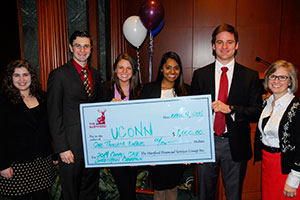 Congratulations to Katharine Coulter, Shailee Desai, Giovanni Sornatale, and Patrick Stimola! The four undergraduates kicked off Husky Weekend by winning the final round of an annual campus case competition sponsored by The Hartford Financial Services Group on Friday, April 4.