Web cookies (also called HTTP cookies, browser cookies, or simply cookies) are small pieces of data that websites store on your device (computer, phone, etc.) through your web browser. They are used to remember information about you and your interactions with the site.
Purpose of Cookies:
Session Management:
Keeping you logged in
Remembering items in a shopping cart
Saving language or theme preferences
Personalization:
Tailoring content or ads based on your previous activity
Tracking & Analytics:
Monitoring browsing behavior for analytics or marketing purposes
Types of Cookies:
Session Cookies:
Temporary; deleted when you close your browser
Used for things like keeping you logged in during a single session
Persistent Cookies:
Stored on your device until they expire or are manually deleted
Used for remembering login credentials, settings, etc.
First-Party Cookies:
Set by the website you're visiting directly
Third-Party Cookies:
Set by other domains (usually advertisers) embedded in the website
Commonly used for tracking across multiple sites
Authentication cookies are a special type of web cookie used to identify and verify a user after they log in to a website or web application.
What They Do:
Once you log in to a site, the server creates an authentication cookie and sends it to your browser. This cookie:
Proves to the website that you're logged in
Prevents you from having to log in again on every page you visit
Can persist across sessions if you select "Remember me"
What's Inside an Authentication Cookie?
Typically, it contains:
A unique session ID (not your actual password)
Optional metadata (e.g., expiration time, security flags)
Analytics cookies are cookies used to collect data about how visitors interact with a website. Their primary purpose is to help website owners understand and improve user experience by analyzing things like:
How users navigate the site
Which pages are most/least visited
How long users stay on each page
What device, browser, or location the user is from
What They Track:
Some examples of data analytics cookies may collect:
Page views and time spent on pages
Click paths (how users move from page to page)
Bounce rate (users who leave without interacting)
User demographics (location, language, device)
Referring websites (how users arrived at the site)
Here’s how you can disable cookies in common browsers:
1. Google Chrome
Open Chrome and click the three vertical dots in the top-right corner.
Go to Settings > Privacy and security > Cookies and other site data.
Choose your preferred option:
Block all cookies (not recommended, can break most websites).
Block third-party cookies (can block ads and tracking cookies).
2. Mozilla Firefox
Open Firefox and click the three horizontal lines in the top-right corner.
Go to Settings > Privacy & Security.
Under the Enhanced Tracking Protection section, choose Strict to block most cookies or Custom to manually choose which cookies to block.
3. Safari
Open Safari and click Safari in the top-left corner of the screen.
Go to Preferences > Privacy.
Check Block all cookies to stop all cookies, or select options to block third-party cookies.
4. Microsoft Edge
Open Edge and click the three horizontal dots in the top-right corner.
Go to Settings > Privacy, search, and services > Cookies and site permissions.
Select your cookie settings from there, including blocking all cookies or blocking third-party cookies.
5. On Mobile (iOS/Android)
For Safari on iOS: Go to Settings > Safari > Privacy & Security > Block All Cookies.
For Chrome on Android: Open the app, tap the three dots, go to Settings > Privacy and security > Cookies.
Be Aware:
Disabling cookies can make your online experience more difficult. Some websites may not load properly, or you may be logged out frequently. Also, certain features may not work as expected.
The first place team, from left: Jonathan Neal, Mariam Kurian, Jared Alexis, and Jin Du. (Nathan Oldham/UConn School of Business)
As Insurance Industry Grapples with Change, MBA Candidates Could Become Trailblazers
First-year UConn MBA students faced one of their first big hurdles earlier this month when they were presented with a real-life, pressure-filled case competition, made all the more interesting by the presence of a special judge. Continue Reading
UConn Professors Find that Some Self-Reporting is Flawed
Nursing homes may be inflating their self-assessments in an effort to improve their Medicare star ratings, according to a new study by UConn OPIM professors Niam Yaraghi and Ram Gopal and their colleague, Xu Han ’17 Ph.D. Continue Reading
UConn Today – After announcing his $22.5 million commitment to UConn to foster innovation on Dec. 4, donor Peter Werth attended presentations by alumni, graduate, and undergraduate student innovators during the Entrepreneurial & Innovation Student Huddle held at the newly named Peter J. Werth Residence Tower, formerly Next Generation Connecticut Residence Hall.
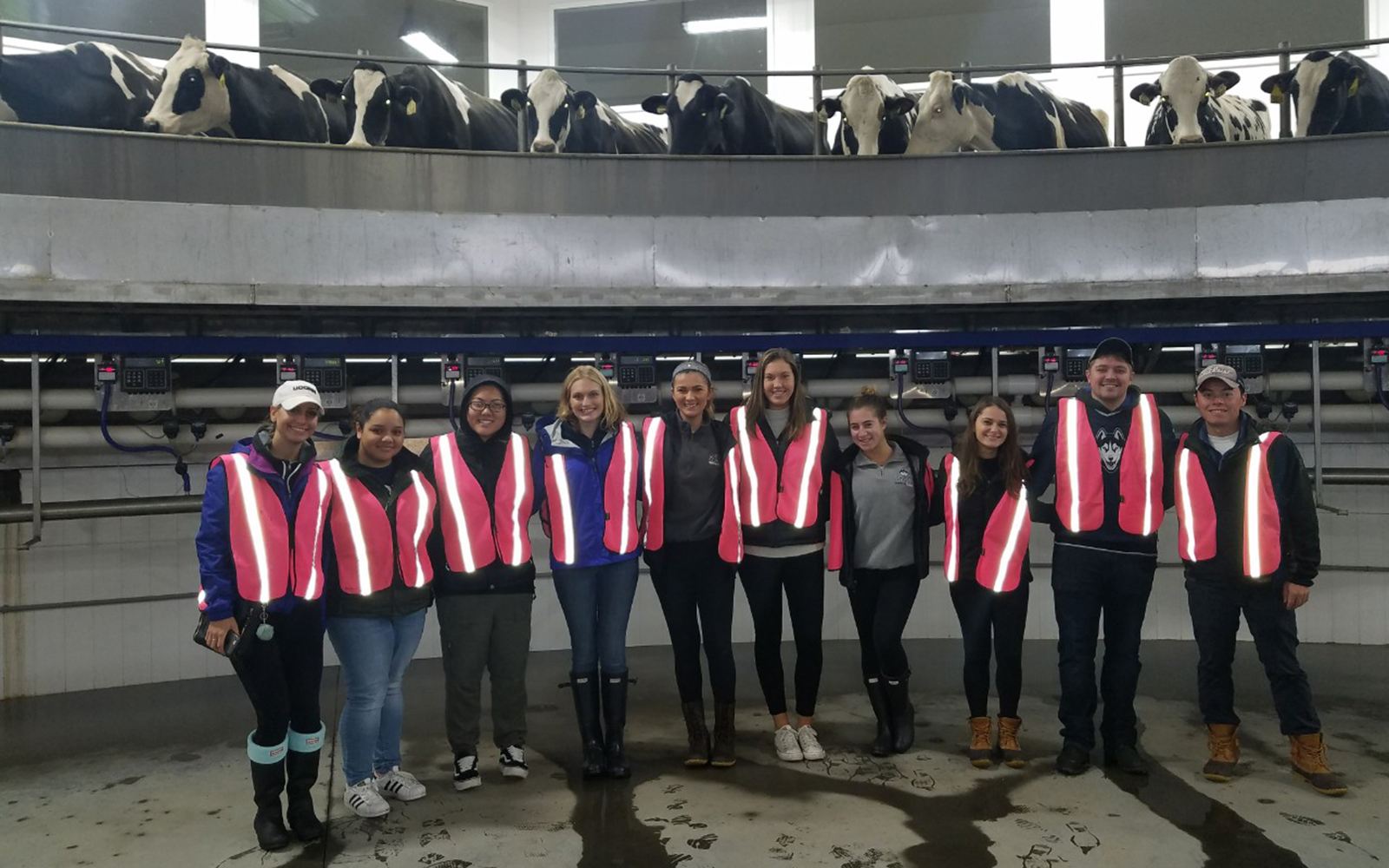
Marketing students at the Oakridge Dairy Farm in Ellington, Conn. (Seth Bahler/Oakridge Dairy)
Ellington’s Oakridge Dairy Seeks Business Expansion Suggestions from Marketing Students
The CEO of Oakridge Dairy Farm in Ellington is asking UConn’s senior marketing students to offer ideas on new ways to generate income for the sprawling, 1,600-acre farm, which is one of the largest of its kind in Connecticut. Continue Reading
Peter J. Werth speaks at an event to announce his $22.5 million commitment to the University on Dec. 4, 2017. The pledge from Werth, an innovator in generic prescription medication, is the second-largest in University history. Seated is President Susan Herbst. (Peter Morenus/UConn Photo)
The UConn Foundation has received a $22.5 million commitment from Peter J. Werth, ensuring a legacy of innovation and entrepreneurship for generations of students to come.
“Peter’s transformative and historic commitment cements his legacy as a most generous friend to UConn,” said Josh Newton, President and CEO, UConn Foundation. “As a steadfast UConn supporter for many years, Peter has previously given very generously to our athletic programs. We’re grateful that his generosity has expanded to include academics, especially into an area that supports the economy of our state: entrepreneurship and innovation. We hope he will inspire others to follow his lead.” Continue Reading
Professor Ricki Livingston on a week-long visit to Uganda earlier this month. (Ricki Livingston/UConn School of Business)
Earlier this month, I had the incredible opportunity of visiting the beautiful country of Uganda. I want to share a couple of photos that were taken at a school out in a remote village and an orphanage for children with AIDS. Continue Reading
Joel Thomas (Nathan Oldham/UConn School of Business)
Dubai Native Finds Purpose Leading Learning Community Council
“I think when people hear about UConn’s Learning Communities, they think it is all work and no play. But that’s not how it is,” said Joel Thomas, a junior majoring in finance. Continue Reading
In their studies, UConn marketing professor Kelly Herd (pictured, above) and Ravi Mehta of the University of Illinois at Urbana-Champaign, ask participants to design a child’s toy, select ingredients for a new kids’ cereal, and redesign a grocery cart for the elderly. Each time, the group that produced the most original products was the one instructed to imagine the target consumers’ feelings before beginning the task. (Nathan Oldham/UConn School of Business)
When Product Developers Invoke Emotion, Do They Generate More Creative Ideas?
What kind of potato chip would you create, and what would you name it, if you wanted to sell the product exclusively to pregnant women? Continue Reading
Managing Director and Head of Business Development at GLG Patrick Donegan chats with UConn School of Business Dean John Elliott (left) and others at “Leading in Turbulent Times.” The event was presented by GLG and UConn School of Business at GLG (Gerson Lehrman Group) on November 15, 2017 in New York City. (Photo by Andrew Toth/Getty Images for GLG)
Panelists: ‘Turbulent Times’ Provide Opportunities for Leaders to Emerge
Former U.S. Navy SEAL commander David Cooper knows a few things about leading in turbulent times.
Cooper served the elite unit for 25 years, ventured on dozens of dangerous deployments, and earned an array of medals, including one Silver Star and six Bronze Stars.
So when he talked about the U.S. Navy Seals’ 10-year manhunt for Osama bin Laden, and his killing in May 2011, the audience of UConn graduate business students, alumni and friends were engrossed. Continue Reading