Web cookies (also called HTTP cookies, browser cookies, or simply cookies) are small pieces of data that websites store on your device (computer, phone, etc.) through your web browser. They are used to remember information about you and your interactions with the site.
Purpose of Cookies:
Session Management:
Keeping you logged in
Remembering items in a shopping cart
Saving language or theme preferences
Personalization:
Tailoring content or ads based on your previous activity
Tracking & Analytics:
Monitoring browsing behavior for analytics or marketing purposes
Types of Cookies:
Session Cookies:
Temporary; deleted when you close your browser
Used for things like keeping you logged in during a single session
Persistent Cookies:
Stored on your device until they expire or are manually deleted
Used for remembering login credentials, settings, etc.
First-Party Cookies:
Set by the website you're visiting directly
Third-Party Cookies:
Set by other domains (usually advertisers) embedded in the website
Commonly used for tracking across multiple sites
Authentication cookies are a special type of web cookie used to identify and verify a user after they log in to a website or web application.
What They Do:
Once you log in to a site, the server creates an authentication cookie and sends it to your browser. This cookie:
Proves to the website that you're logged in
Prevents you from having to log in again on every page you visit
Can persist across sessions if you select "Remember me"
What's Inside an Authentication Cookie?
Typically, it contains:
A unique session ID (not your actual password)
Optional metadata (e.g., expiration time, security flags)
Analytics cookies are cookies used to collect data about how visitors interact with a website. Their primary purpose is to help website owners understand and improve user experience by analyzing things like:
How users navigate the site
Which pages are most/least visited
How long users stay on each page
What device, browser, or location the user is from
What They Track:
Some examples of data analytics cookies may collect:
Page views and time spent on pages
Click paths (how users move from page to page)
Bounce rate (users who leave without interacting)
User demographics (location, language, device)
Referring websites (how users arrived at the site)
Here’s how you can disable cookies in common browsers:
1. Google Chrome
Open Chrome and click the three vertical dots in the top-right corner.
Go to Settings > Privacy and security > Cookies and other site data.
Choose your preferred option:
Block all cookies (not recommended, can break most websites).
Block third-party cookies (can block ads and tracking cookies).
2. Mozilla Firefox
Open Firefox and click the three horizontal lines in the top-right corner.
Go to Settings > Privacy & Security.
Under the Enhanced Tracking Protection section, choose Strict to block most cookies or Custom to manually choose which cookies to block.
3. Safari
Open Safari and click Safari in the top-left corner of the screen.
Go to Preferences > Privacy.
Check Block all cookies to stop all cookies, or select options to block third-party cookies.
4. Microsoft Edge
Open Edge and click the three horizontal dots in the top-right corner.
Go to Settings > Privacy, search, and services > Cookies and site permissions.
Select your cookie settings from there, including blocking all cookies or blocking third-party cookies.
5. On Mobile (iOS/Android)
For Safari on iOS: Go to Settings > Safari > Privacy & Security > Block All Cookies.
For Chrome on Android: Open the app, tap the three dots, go to Settings > Privacy and security > Cookies.
Be Aware:
Disabling cookies can make your online experience more difficult. Some websites may not load properly, or you may be logged out frequently. Also, certain features may not work as expected.
Former First Lady Michelle Obama at a special event presented by The Connecticut Forum and The Bushnell on November 16, 2017. (The Connecticut Forum)
More than 3,000 people packed The Bushnell in Hartford recently to hear former First Lady Michelle Obama in a moderated conversation. While the venue was large, the evening came across as an intimate conversation because she was “authentic,” funny, and told engaging stories. Continue Reading
Our first full day in Israel was very busy and full of enlightening experiences. After only about 24 hours here, I am amazed at the versatility of the country. There is a huge focus on development of the next big technology and the future, yet as we toured Jerusalem, we experienced over 2000 years of history that brings together people of all backgrounds, ages and experiences.
Accountant. African American Woman. A small dot within the tech workforce.
This is my bio.
Being a person of color in the tech industry tends to feel like you’re a fish out of water. Though tech companies are working to improve diversity in the workplace, Black and LatinX employees still make up only a small margin of the workforce. Continue Reading
Peter J. Werth speaks at an event to announce his $22.5 million commitment to the University on Dec. 4, 2017. The pledge from Werth, an innovator in generic prescription medication, is the second-largest in University history. Seated is President Susan Herbst. (Peter Morenus/UConn Photo)
The UConn Foundation has received a $22.5 million commitment from Peter J. Werth, ensuring a legacy of innovation and entrepreneurship for generations of students to come.
“Peter’s transformative and historic commitment cements his legacy as a most generous friend to UConn,” said Josh Newton, President and CEO, UConn Foundation. “As a steadfast UConn supporter for many years, Peter has previously given very generously to our athletic programs. We’re grateful that his generosity has expanded to include academics, especially into an area that supports the economy of our state: entrepreneurship and innovation. We hope he will inspire others to follow his lead.” Continue Reading
The Eiffel Tower in Paris, France (Brendan Mulcahey/UConn School of Business)
Although I doubt the temperature rose above freezing, I spent this past weekend in Paris. I saw the obvious sights such as the Arc de Triomphe and Eiffel Tower. Continue Reading
A reindeer at a small holiday fair (Brendan Mulcahey/UConn School of Business)
As the U.S. celebrated Thanksgiving this past week, my workplace (for my internship) decided to get me a little baby pumpkin pie since I will be away from my family for the holiday. Continue Reading
London skyline (Brendan Mulcahey/UConn School of Business)
This past week was my first week of my London internship while interning at IlliquidX. Although the office is rather small, I was quite surprised by the ethnic diversity within the office. Continue Reading
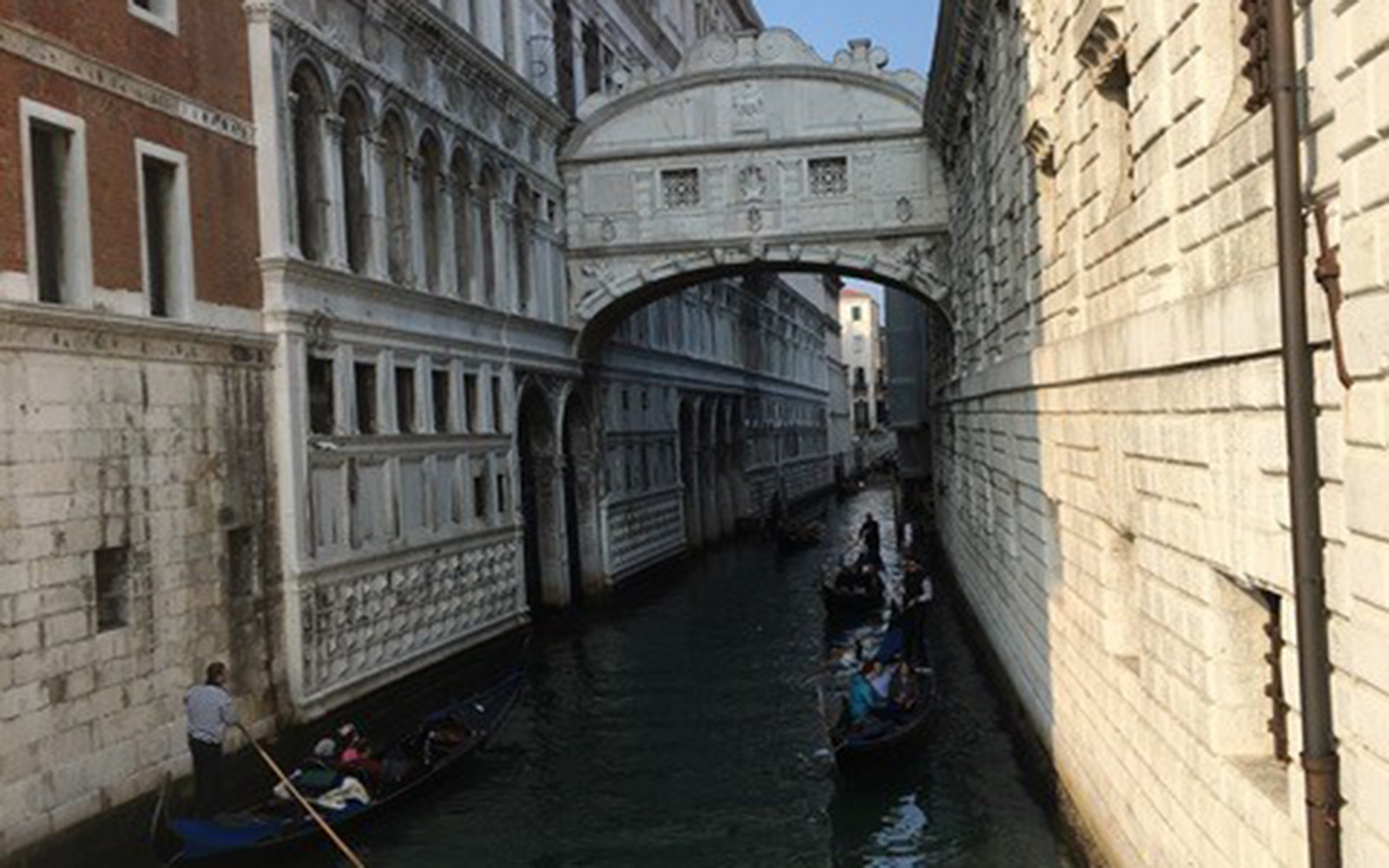
The “Bridge of Sighs” in Venice, Italy (Brendan Mulcahey/UConn School of Business)
While my classmates decided to venture further into Eastern Europe for the remainder of the Spring Break, I decided to head down to Italy and enjoy some warmer weather. Continue Reading