Author: Melissa Ferrigno


REFA Student Field Trip

The Fairfield/Westchester Chapter of REFA will be hosting students from UConn’s Center for Real Estate on February 26 at the UConn Stamford branch to introduce students to the different sectors of the commercial real estate industry. Professionals from the REFA membership will include: Ernest DesRochers and Deanna Polizzo of Northmarq Capital to discuss Mortgage brokerage; Jeff Gage of CBRE and Al Mirin of Cushman & Wakefield to discuss Leasing Brokerage/Capital Markets Brokerage; Brian Heelan of the Ashforth Company and Bob Hartt of Hartt Realty Advisors to discuss Asset Management and In-House Leasing; George Yerrall of RiverOak Investment Corp and David Genovese of Baywater Properties to discuss Development and Investing; and James Lane of Webster Bank and Bob Palermo of Bankwell to discuss Banking.

These roundtable discussions will take place from 12 pm to 5:30 pm and will be followed by a social from 5:30 pm to 7 pm, allowing the students additional time to network with REFA members. The event will take place at the UConn campus on Broad Street in Stamford.


Strategic Alliance Analysis: Special Olympics

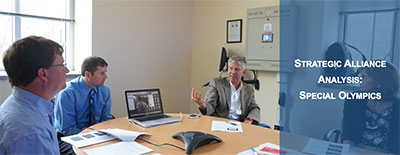
Business men conversing at a meeting table with an overlay featuring the words "Strategic Alliance Analysis: Special Olympics."This article was written by John Schumacher and originally appeared on the UConn Sport Management Program website.

This past summer, members of the UConn Sport Management program (Michael Mudrick, doctoral student, Raymond Cotrufo ’14 Ph.D., and Laura Burton, associate professor) partnered with the UConn School of Business SCOPE program (Sustainable Community Outreach and Public Engagement) and the Special Olympics for a project involving an examination of strategic alliances.

Through an extensive analysis, the research team discovered opportunities for the Special Olympics to achieve several goals as ancillary benefits from the procurement and continuance of successful partnerships. These goals included: augmented awareness of the Special Olympics brand, program relationship building, and additional participation opportunities for its athletes.

On September 30, 2014, the research team presented results of the project to Jon-Paul St. Germain, senior director of Unified Sports and Sport Partnerships and Aldis Berzin, senior director of sport of Special Olympics and SCOPE program director, Wynd Harris, with a best practices guide toward strategic alliance success. In addition, the research team proposed an application model to be utilized for analyses of partnership benefits and value.

The Special Olympics partnership with SCOPE is funded by an donation from UConn alumnus David A. Gang ’81, CEO and co-founder of Perfect Sense Digital, LLC, and his wife, Charmaine Gang.


National Association of Realtors ACE Awards

Each year the National Association of Realtors (NAR) honors accomplished REALTORS® in commercial real estate by celebrating their individual achievements with ACE awards. Honorees have received awards from their local association, state association, community organizations or brokerages, making them eligible to be nominated for this NAR recognition.

The Connecticut Commercial Real Estate Alliance together with the Greater Hartford Association of Realtors received an honorable mention in the Education/Professionalism category for their collaborative work on the Connecticut Commercial Real Estate Conference held on Oct. 2, 2014 in partnership with the University of Connecticut Center for Real Estate.


2014 Business Graduates Quickly Landing Competitive Jobs, Noteworthy Salaries

Two people shake hands across a table in a professional setting, smiling.The vast majority of the Class of 2014 from the School of Business, both undergraduate and MBA, were quickly employed following graduation, with many commanding impressive salaries.

UConn career services experts credited this success to well-prepared students who are ready to roll-up their sleeves, who have had meaningful internships, and a powerful and committed alumni team who are networking, coaching and hiring new grads.

Dean John Elliott has emphasized the power of this package. “Increasingly our courses and degree programs are designed and changed based on advice from committed alumni and other corporate friends, who help ensure that our students have the best education we can provide. Moreover, they step forward to mentor students and help open doors to them as job candidates. Of course the ultimate job offer is something the student earns and that is as it should be.”

MBA Graduates Averaging $101,000 Salaries

Graduates of the Full-time MBA program had great employment success, with 76 percent having jobs at graduation, and 94 percent having a job within three months of graduation. The mean salary was $101,562. The average student commanded a starting salary that was almost 12 percent higher than 2013 graduates. The highest salary reported among new graduates was $160,000.

New graduates from the MBA program also reported significantly larger sign-on bonuses as compared to their counterparts from 2013.The mean sign-on bonus for 2014 was $19,500, up 63 percent from 2013.

U.S. citizens reported higher salaries than foreign nationals, earning an average of $102,500 a year to the foreign students’ $95,000. However, the foreign students saw a 25 percent increase in their average base salaries compared with their counterparts from the previous year, indicating that the pay gap is closing. “We are recruiting stronger international students with great communication skills, and employers are recognizing their talent and hiring them,” said Meg Warren, assistant director of the MBA Career Development Office. All the foreign nationals accepting a job, did so in the United States.

“What we think is really impressive is that the jobs MBA candidates are accepting are diversified,” Warren noted. “Our students are getting great regional jobs, but also accepting challenging jobs across the country. Our students are fighting for competitive jobs, and getting them. We are a small program, but we’ve kept our admission standards at a high level, which, in turn, impacts successful job placement.”

Top companies like GE, T-Mobile, Paypal/eBay, Pitney Bowes, Philips, Prudential and The Hartford are regularly recruiting from the School of Business’ MBA program, she said.
“I don’t know what we’d do without our alumni,” Warren said. “They give generously of their time and willingly converse with our students. This has strengthened students’ preparedness and therefore affects the bottom line: securing a meaningful internship or job.”

Undergraduates Boast 77 Percent Employment

Undergraduate students also fared well in employment. Three months after graduation, 77 percent of those seeking employment had secured jobs. The average salary for student full-time hires was $55,683, but UConn business school graduates received offers up to $75,000 in management information systems and $70,000 in finance.

“The School of Business’ reputation has grown each year,” said Lorraine Liswell, program manager for the Undergraduate Career Development Office. Many more employers are coming in, hoping to interview students on campus, she said.

“Companies find UConn students competitive and willing to roll up their sleeves and go to work,” she added.

Many recent graduates are staying in Connecticut, or nearby in New York or Massachusetts, she said. She’s noticed that new alumni are gravitating to “rotational programs” in large companies that allow them to experience four or six different roles before selecting the one that best suits them.

Kathy Hendrickson, assistant director of the Undergraduate Career Development Office, said she’s noticed a change in undergraduate students, who arrive on campus with long-term plans.

“Freshmen are walking in our door and asking about the job-search process within the first few weeks of arriving on campus,” she said. “They’re asking what they need to do to land an internship as a freshman. This type of energy and preparation at the beginning of their college career makes them stronger candidates for landing competitive jobs.”

Likewise, the corporate community is also focused earlier in the process, and many firms are beginning the process of talent identification and relationship building in the freshman or sophomore year, earlier than ever before, Elliott noted.

More than ever, UConn faculty and alumni are invested in helping undergraduate students find good jobs right out of school, she said. For example, marketing professor Bill Ryan invited representatives from Whirlpool in Michigan to meet students, and this relationship helped create new internships and led to some students obtaining full-time positions.

“We also have a strong alumni base that consistently pushes the needle at their organizations to hire more UConn alumni,” Hendrickson said. “Dan Toscano ’87 at Morgan Stanley, and Tom Marshella ’79 at Moody’s, and Shapleigh Smith at Citi are examples of alumni who take a personal interest in the success of our students. It is a team effort that helps the School of Business students to compete and succeed in the job market.”


School of Business, Faculty to Play a Key Role in Creation of New On-Campus Business Percolator

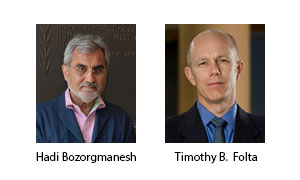
Portraits of Hadi Bozorgmanesh and Timothy B. Folta.The School of Business and its faculty are key organizers of a new Entrepreneurship and Innovation Consortium on campus.

The consortium is designed to provide a coherent vision of UConn’s extensive entrepreneurial effort, as well as inspire, support, advise and encourage inventive and creative business ventures, simplify the start-up and grant-seek process, and introduce potential business partners.

“The School of Business is extraordinarily happy to be involved in the leadership of this effort for several reasons,” said Professor Timothy Folta, co-director of the consortium. “First of all, it will make an enormous impact on the university. Second, in today’s environment, entrepreneurship and innovation are critical for nearly every university stakeholder, so it makes sense to develop a coherent effort in this realm. Finally, the School of Business feels it has a great deal to contribute, because we offer programs and courses on entrepreneurship and have renowned scholars in this area.”

The consortium’s members come from across the university, representing diverse organizations that foster entrepreneurship and innovation. It is being led by the School of Business, School of Engineering, Office of the Provost, and Office of the Vice President for Research. The consortium was launched this Fall and will have its first Steering Committee meeting Jan. 28, 2015.

“The feedback we have received is phenomenal—it seems every organization wants to be part of the consortium,” said Folta, who serves as the consortium’s co-director with Hadi Bozorgmanesh, professor-in-residence in the School of Engineering.

The consortium will not be implementing programs, but will be a conduit for program leaders to share information and close the gaps on campus that inventors and business start-ups frequently encounter.

“We’ve found that people don’t know where to go to get information, and that’s something we can centralize, beginning with our web site,” Folta said. The newly created web site, entrepreneurship.uconn.edu, shares links to member organizations, stories of successful UConn-associated start-ups, grant application information, helpful business course links, and resources, both on- and off- campus, for people interested in starting businesses.

In addition to serving the immediate UConn community, Folta said he believes it will appeal to stakeholders beyond the university, including federal and state granting agencies that want more information about what innovation is occurring through the university.

Folta, who holds the School of Business’ Thomas John and Bette Wolff Chair in Strategic Entrepreneurship, said the participants will benefit from discussing ideas and sharing initiative and enthusiasm.

“We don’t want duplication of efforts,” he said. “We feel by improving connectivity, we will help coordinate new and exciting endeavors.”

What will it mean in the future?

“We hope that our member programs will develop new businesses and our educational programs will lead to a new generation of inventors of tomorrow,” Folta said. “We hope to increase the collaboration on campus, decrease duplication, promote a better statewide awareness of what we’re accomplishing at UConn and, ultimately, increase economic development.”