Check out our Winter 2014 Accounting Department Newsletter!
Month: July 2014
UConn School of Business Announces New Graduate Human Resource Management Programs
The UConn School of Business just announced two new graduate programs in Human Resource Management available to students starting this fall – the Master of Science in Human Resource Management (MSHRM) and the Advanced Business Certificate in Human Resource Management.
Following a rigorous academic review by the Management Department and subsequent approval by School of Business faculty, the programs were officially approved by the UConn Board of Trustees on June 25, 2014. Applications to the program are currently being accepted for the fall cohort.
Stemming from the former Master of Professional Studies in Human Resource Management, an online-only program previously offered by UConn’s Center for Continuing Studies, the new programs are offered by the business school in a hybrid learning format that incorporates the flexibility of online education with the interactivity and connectivity of on-campus seminars.
“Every course in the program has been updated and several new courses have been added to facilitate greater integration across the curriculum and collaborative learning among members of the cohort,” said Greg Reilly, assistant professor and academic director for UConn’s Graduate Programs in Human Resource Management.
“We are delighted to deliver opportunities for human resource professionals to expand their education through the School of Business,” said Dean John Elliott.
MSHRM Degree
The MS in Human Resource Management (MSHRM) is a 33-credit, part-time program designed for professionals seeking skills to effectively lead and manage the complexity of human resources in a dynamic global environment. The program design enables students to focus on a single course each seven-week accelerated session while completing the program in 22 months with their cohort. Each session includes two integrated Saturday Seminars at UConn’s Graduate Business Learning Center in downtown Hartford.
The Graduate Programs in HRM are built upon a foundation of comprehensive curriculum designed specifically to develop strategic HR competencies in a collaborative learning environment of high-achieving peers and accomplished faculty. The curriculum reflects the skills needed for HR leaders to be partners with senior management, including core business areas such as business acumen, risk management, metrics and analytics, negotiation and ethical leadership.
Advanced Business Certificate in Human Resource Management
The Advanced Business Certificate in Human Resource Management is a 12-credit option for students seeking a concentration or detailed study in Human Resources, either as an addition to their existing graduate studies, or as an entry to graduate business degrees. Expected completion time for the certificate is two semesters. The certificate is designed to support students who choose to transition from the certificate to the MSHRM program as well.
More information about UConn’s Graduate Programs in Human Resource Management can be found at http://hrm.business.uconn.edu or HRM@business.uconn.edu.
UConn Executive MBAs Experience Business in South Africa
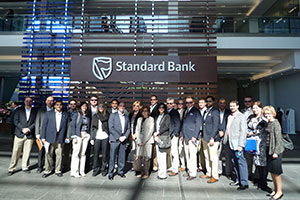 Each year, a team of UConn’s Executive MBA (EMBA) students travel abroad to enrich their experience and understanding of global business issues. As part of the curriculum, the international study trip enables participants to experience firsthand how concepts and theories learned in the classroom are applied in the global arena.
The program’s latest destination was South Africa, a diverse, emerging global market that serves as the gateway to the African continent. Students returned equipped with new knowledge and insights, having visited with executives from an array of companies and industries. The business visits covered discussions on topics such as investments in the country, banking, business ownership, and various challenges and opportunities:
“Investing in South Africa: High risk or High Return?”
Mteto Nyati, Managing Director, Microsoft“Finance and Banking in South Africa”
Carolina Reddy, Head of Distribution and Sales, Standard Bank“Challenges and Opportunities in the South African Real Estate Industry”
David Stoll, Regional Head and Martin Kearns, Development Executive at Victoria and Albert Waterfront, both of Growth Point“Retail Strategies for Low-Income Population”
Suzanne Ackerman-Berman, Transformation Director, Pick n Pay“Labor Market Challenges in South Africa”
Nico Grobbelaar, Executive Director of Human Resources, Paarl Media Group“Building a Successful Business in South Africa”
Tony Gerrans, CEO, Grotto“The Wine Industry in South Africa”
Gary Jordan, Owner, Jordan Wines
While in South Africa, students also explored its cultural history. One of the cultural highlights was The Apartheid Museum—the first of its kind—illustrating the rise and fall of apartheid, the system of racial segregation in South Africa that blighted much of its progress for half a century. EMBA students were also able to visit Robben Island; where Nelson Mandela served his prison term for his rebellion against the Apartheid regime.
A guided tour of Johannesburg and Soweto—an urban section of the city—immersed the EMBAs in its turbulent history and diversity of people and cultures.
“Understanding the history and culture of a country in which you conduct business is critical,” said Noel Petrolati, a current EMBA student. “I knew it was important, but to see and experience South Africa’s turbulent past and to see its economic development was enlightening,” she said.
Real Estate Professor Admitted to U.S. Supreme Court
 A professor at the UConn Center for Real Estate and Urban Economic Studies was recently admitted to practice law before the United States Supreme Court. Attorney Lucy Michaud, whose areas of expertise are real estate and business law, has been working with the real estate center at the School of Business as asst. ext. professor and a liaison to the Department of Consumer Protection.
Michaud was among 14 attorneys invited to apply for the special designation by the Phi Alpha Delta Law Fraternity, International (P.A.D.). The accepted group was inducted to the Supreme Court of the United States in a ceremonial ritual on June 2, as part of the 48th annual P.A.D. Day held in Washington, D.C.
Phi Alpha Delta Law Fraternity, International is the largest co-ed professional law fraternity in the United States. Justices Samuel Anthony Alito, Stephen G. Breyer, Ruth Bader Ginsburg, Elena Kagan, and Sonia Sotomayor are all P.A.D. members. Following the swearing-in ceremony, Justices Ginsburg and Sotomayor visited with the group to individually meet the inductees.
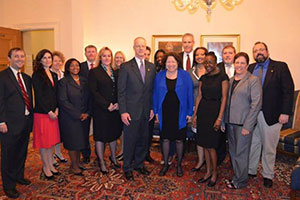
Pictured: Lucy Michaud (front, right) and P.A.D. members pose with Supreme Court Justice Sonia Sotomayor (front, center).
SC2 Hartford Challenge
The SC2 Hartford Challenge is a US EDA grant-funded program offered through the President’s Strong Cities, Strong Communities (SC2) initiative. The SC2 Challenge is an opportunity to create an economic development strategy and actionable plan—one that includes game changing policy, infrastructure and programming—to drive positive change for Hartford and impact revitalization efforts for other cities. Hartford’s goal is to become internationally known as the city where entrepreneurs come to start and stay to grow their businesses.
The City is calling for the formation of qualified teams by July 24thto submit their proposals. The top three proposals will share $100,000 in prize money. The top six teams will each be tasked with developing detailed, actionable economic development plans. These six teams will share $800,000 in EDA-funded prizes. The top prize is $500,000. UConn’s School of Business is honored to be a member of the review panel.
If you would like more information, please contact Stephen Cole at the Hartford Economic Development Division at COLES001@hartford.gov or 860-757-9071. Please note: SC2 Hartford registration closes July 24th, and proposals are due September 22nd. Learn more at hartford.sc2prize.com/
Research Study by Professor Bill Ross Finds Charitable Giving Hinges on Perception of ‘Worthiness’
Charities assisting people perceived as responsible for their plight may have a difficult time attracting donations, says a new study.
With more than $200 billion donated to causes each year in the United States alone, consumers are inundated with donation requests from charities supporting an array of recipients. Contrary to the idea that people who fit the profile of “givers” are uniformly charitable, their donations may be based on information or preconceived notions about the beneficiaries.
“As consumers have limited financial resources to allocate to charitable giving, they may evaluate how ‘deserving’ the recipients are before making donations,” according to William T. Ross, Jr., ING Global chair and professor of marketing at University of Connecticut and the paper’s co-author. “It’s not only the characteristics of the giver that determine their likelihood of donating, but of characteristics they perceive in the recipient.”
The finding contradicts previous studies that have focused on characteristics of people with the option to give suggesting an important boundary particularly among the most charitable—those defined as having a strong moral identity.
Ross was part of a team of researchers led by Saerom Lee, a doctoral student, and Karen Page Winterich, assisting professor of marketing at the Pennsylvania State University. Their findings are published in the latest Journal of Consumer Research.
The team looked at the responses of 600 participants studied in four scenarios.
In one, researchers examined the response of participants who were given an amount of cash to donate to a real nonprofit organization, the Pennsylvania Association of Community Health Centers.
Participants were asked to choose between donating to medical patients described alternately as having a low-level of responsibility for their situations and those having a high-level of responsibility. The recipients were described either as unable to pay for medical treatment because of “low-wage jobs with poor benefits due to economic conditions” or unable to pay for treatment because of inability “to hold a steady job due to their drug and alcohol abuse or gambling addiction.”
The findings indicate that charitable organizations marketing their causes need to be cautious when describing the beneficiaries that they support, particularly if the recipient could be perceived as responsible for their plight and, by extension, undeserving.
According to the researchers, even when charities do not specifically highlight the responsibility of their recipients, consumers tend to assign their own preconceived notions about beneficiaries in stigmatized groups. For example, the plight of the homeless or drug addicts is often attributed to their own behaviors.
The study was funded by a Smeal Small Research Grant from the Smeal College of Business, Pennsylvania State University and is based on the dissertation by author Saerom Lee, which was the winner or the 2013 Society for Consumer Psychology Dissertation Proposal Competition.