Finance


Accounting, Finance Faculty Members Recognized for Outstanding Research

2015-03-20_facultyThe School of Business has awarded its 2015 Best Paper Award to professors David Weber, from accounting, and Jose Martinez, of finance, for their exceptional research articles that will appear in esteemed academic journals.

Weber’s research paper is titled, “Does SOX 404 Have Teeth? Consequences of the Failure to Report Existing Internal Control Weaknesses.”

“Picking Winners? Investment Consultants’ Recommendations of Fund Managers,” is the title of Martinez’s work. His paper also recently received a prize from the University of Cambridge and the Commonfund Institute.

“Both papers are to appear in very prestigious journals in their respective fields, The Accounting Review and Journal of Finance,” said Sulin Ba, associate dean of academic and research support. “The selection committee was particularly impressed by the public policy implications that came out of both research projects. These implications will have an impact on our society in the years to come.”

The competition was intense this year with 10 nominations, all papers accepted in top academic journals, Ba said.

“Dr. Weber’s paper, co-authored with Ph.D. student Biyu Wu, addresses the requirement that corporations and their auditors publicly disclose internal control weaknesses, which is one of the most contentious and costly provisions of the Sarbanes-Oxley Act,” said Mohamed Hussein, accounting department head. “The study is important because it shows that the enforcement mechanisms surrounding internal control reporting are often ineffective and in some cases may even provide disincentives for compliance.”

“This paper is one of many research projects conducted by the UConn accounting faculty that addressed critical accounting and tax issues,” said Hussein, noting that UConn accounting faculty research has been cited in Congressional hearings and in the British Parliament.

Chinmoy Ghosh, department head in finance, said he is pleased with his colleague’s success.

“Within a very short period of time since arriving at UConn in August 2014, Jose has made a significant contribution in almost every aspect of the job. Acceptance of his paper by the Journal of Finance, the top journal in the discipline, brings tremendous visibility and prestige to the department and the school,” he said. “Very recently, his research has been recognized by a leading academic group in Europe. His style of teaching and knowledge drew great praise from the Risk Management students at both our Hartford and Stamford campuses.

“Jose has also shown great interest and objectivity in various academic issues currently under review by the department faculty. We are very pleased to have him as a colleague and look forward to many more productive years from him at the School of Business.”

The Best Paper Award is funded by the generous support of the Arnold M. Robin & Rochelle M. Robin Excellence Fund.

Related articles:

Professor Jose Martinez Earns Triple Recognition for Work on Dubious Investment Management

Professor David Weber Finds Lack of Enforcement Surrounds Key Provision of Sarbanes-Oxley Act

Top Connecticut Experts Discuss Success of Healthcare Initiative: “We’re Not There Yet—But We’re Making Great Strides”

2015-03-16_aca2When it comes to access to healthcare, Connecticut residents are much better off now than they were prior to the creation of the Affordable Care Act, according to a panel of experts.

But, this new system is still in its infancy and there is still much to be done in order to achieve an ideal healthcare delivery system, they agreed.

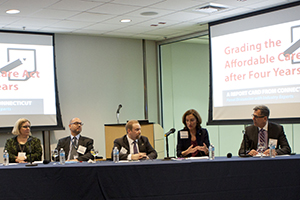
The five panelists shared their expertise in a UConn School of Business program titled, “Grading the Affordable Care Act.” The March 4 program drew 75 people to the Graduate Business Learning Center in downtown Hartford. Continue Reading


The Connecticut Economic Outlook: February 2015

UConn economists at The Connecticut Center for Economic Analysis predicted strong economic progress and growth for the state in a report released Wednesday.

One model predicts Connecticut’s gross domestic product would grow 4.85 percent in 2015 and in 2016, but a second model predicted even more robust growth. The group also anticipates strong progress in the jobs market, from the current level of 1.69 million jobs in December 2014 to 1.73 million by the end of 2016.

The economists urged state government to invest in education, transportation and high-speed communications systems to enable long-term economic and job growth. The same organization also warned that extensive government ‘belt tightening’ could damage the state’s robust recovery and thwart its chance at sustained employment growth.


Proposed Power Plant is an Economic Winner According to New UConn Study

A proposed power plant in Oxford, Conn. would create both an enormous number of jobs and tremendous economic benefits for the area, according to a UConn study released on Jan. 13.

The report, created by the Connecticut Center for Economic Analysis (CCEA) at UConn, estimates the construction of the power plant would create more than 2,300 construction jobs and 1,800 sustained jobs. Furthermore, the proposed CPV Towantic Energy Center would generate almost $8 billion in new personal income for Connecticut residents over the next 25 years.

The study was commissioned by Competitive Power Ventures, the Maryland company that wants to build the plant on 26 acres adjacent to Waterbury-Oxford Airport.

“This project delivers dramatic economic benefits that will reverberate throughout Connecticut’s economy, both now and for decades to come,’’ said Fred Carstensen, CCEA Director. The plant would  boost Connecticut’s economic health and competitiveness, he said.

The plan has met with resistance from neighbors both in Oxford and adjacent towns, who have expressed concerns about the environment, health and decreased property values.  The Federal Aviation Association has also raised concerns because of the proposed plant’s proximity to the regional airport.

Meanwhile, the proposal has won the backing of some chambers of commerce, building trade professionals and Oxford First Selectman George Temple, who said he has already received inquiries from people who are interested in creating new businesses in town if the power plant is approved. The plant would also generate more affordable electricity for Connecticut residents.

The power plant was originally proposed and approved 15 years ago, but CPV is seeking to modify the application to build a larger facility. The Connecticut Siting Council agreed to review the application. Additional public hearings are pending.

The CCEA is located within the UConn School of Business and specializes in economic impact and policy analysis studies as well as advising clients regarding business strategy, market analysis and related topics. The CCEA focuses attention on the economic and business dynamics of Connecticut. Created in 1992, the organization serves the state by providing timely and reliable information to equip the public, decision makers and stakeholders with transparent analysis to facilitate thoughtful debate of public policy issues.


“I Don’t Understand How This Could Be” UConn Students Try to Solve Life-Threatening Medicine Mix-Ups

2014-12-17_graf-fayal
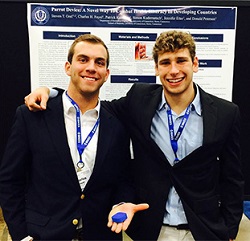
Pictured (L to R): Charles Fayal and Steve Graf show the Parrot Device, which they hope will prevent medication dosing errors.

When Steve Graf, and dozens of fellow volunteers, traveled to Ghana to help the sick, they brought 35 suitcases of medications and provision—and an endless supply of good intentions.

After a week of triaging patients, and distributing medications, Graf and his colleagues made a startling discovery. Many of the patients weren’t recovering, and some were consuming medications too quickly.

Some adults were doubling up on blood-pressure medications. Children were guzzling liquid acetaminophen from the bottle. And, compounding the problem, many of the patients were illiterate. Sometimes parents would leave the clinic with as many as 20 different prescriptions for their four children, leading to endless confusion.

Everyone on the medical mission was frustrated with the situation, but Graf just couldn’t let it go.

“I thought, ‘This is a terrible thing. I don’t understand how this could be,'” he said. Graf, now a UConn senior majoring in healthcare management, thought about the problem often after he returned from the trip in May of 2013.

How do you give clear and memorable instructions to someone who can’t read? The clinic had tried using illustrations, showing a sun or a moon, but that didn’t seem to work.

“We approach problems given our education and training,” Graf said. “Because we learned to read at age 6, we absorb information visually. Illiterate folks do not. Their traditional learning is verbal.”

Graf thought if the prescribing physician could give medical instructions using an inexpensive recording device, like the one found in a musical greeting card, patients would be able to more easily follow dosing instructions.

He mentioned that concept one day in front of friend Charles Fayal, now a UConn senior majoring in molecular cellular biology and biomedical engineering.

“The moment I heard the idea, I got pretty excited because I instantly knew how beneficial the prescription device could be—and how simple the idea is,” said Fayal, a Stonington native. “It’s funny how somebody else’s excitement spreads, because when I got excited about his idea, Steve got more excited. After that moment we knew we had to pursue this journey.”

After a great deal of research, experimentation and cost analysis, Graf and Fayal have found an inexpensive recording module, manufactured by a Chinese company, that they will be using as their first prototype. The “Parrot Device,” as they’ve nicknamed it, will allow a medical expert to record up to 60 seconds of medical instructions. The casing could be color-coded to match the medications, and both would be placed together in a travel bag.

Neither Graf not Fayal is looking for profit—or even much recognition. A successful solution, they both said, would be rewarding enough.

“We’re hoping this will save lives. That means everything to Charles and me,” said Graf, of Westport, who is the president of the UConn chapter of Global Brigades, a student-led organization that provides medical, public health, clean water and environmental relief trips to countries such as Ghana, Panama, Nicaragua and Honduras.

Graf and Fayal presented their idea at the Biomedical Engineering Society (BMES) annual meeting in San Antonio recently. It was well-received there, as it has been by physicians who are familiar with the challenges of working in third-world nations.

The biggest challenge for the two entrepreneurs has been keeping the price reasonable. Right now it is about $2 per device, and with a large order can probably be dropped to $1. Graf said he would like to try to get the price even lower. The cost of AIDS or blood-pressure medications can be several dollars per day, Graf said. The cost to resolve damage done by consuming prescriptions too quickly—or slowly—can be several times that, he said. The cost-versus-benefit of the Parrot Device is the focus that Graf and Fayal need to persuade organizations interested in their project.

Graf got his start-up funds for the project by winning a Connecticut Center for Entrepreneurship and Innovation pitch competition last year, which gave him $1,000 in seed money for the sound modules and plastic mold for the casing. He and Fayal are now seeking funding for a January trip to Haiti to test the device with patients.

“Haiti is somewhat of a make-or-break trip for us,” said Graf. “We hope to test our prototypes. Our main questions are, ‘Will the patients use the device as intended? Will the community adopt it? Will the patients benefit from it?'”

Beyond the initial concept, Graf and Fayal envision additional uses, such as education in infectious disease areas, such as Ebola-plagued villages. Prevention might become an even greater tool than treatment, they said.

Next semester Graf will take an entrepreneurship class and plans to write a business plan focused on the device. Graf and Fayal are hoping a large charitable organization will adopt the cause and fund the project.

“It has been a journey bringing this device to fruition,” Fayal said. “Some days we’ll realize that we have a mound of work in front of us, or a major obstacle to tackle regarding manufacturing or approval.

“On these days we get bummed out, but we know we have to power through because when we get to talk to somebody who has been to a place where this device is useful, it makes it all worthwhile. These people, whether they grew up in an impoverished area or worked in one, will get excited about the idea,” he said. “Just like when Steven first told me about the idea, we get excited about it all over again.”


Real Estate Professor Admitted to U.S. Supreme Court

UConn Center of Real Estate and Urban Economic StudiesA professor at the UConn Center for Real Estate and Urban Economic Studies was recently admitted to practice law before the United States Supreme Court. Attorney Lucy Michaud, whose areas of expertise are real estate and business law, has been working with the real estate center at the School of Business as asst. ext. professor and a liaison to the Department of Consumer Protection.

Michaud was among 14 attorneys invited to apply for the special designation by the Phi Alpha Delta Law Fraternity, International (P.A.D.). The accepted group was inducted to the Supreme Court of the United States in a ceremonial ritual on June 2, as part of the 48th annual P.A.D. Day held in Washington, D.C.

Phi Alpha Delta Law Fraternity, International is the largest co-ed professional law fraternity in the United States. Justices Samuel Anthony AlitoStephen G. BreyerRuth Bader GinsburgElena Kagan, and Sonia Sotomayor are all P.A.D. members. Following the swearing-in ceremony, Justices Ginsburg and Sotomayor visited with the group to individually meet the inductees.

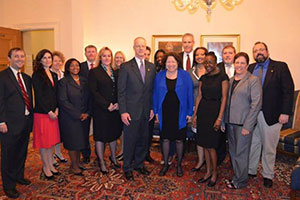
Pictured: Lucy Michaud (front, right) and P.A.D. members pose with Supreme Court Justice Sonia Sotomayor (front, center).