Web cookies (also called HTTP cookies, browser cookies, or simply cookies) are small pieces of data that websites store on your device (computer, phone, etc.) through your web browser. They are used to remember information about you and your interactions with the site.
Purpose of Cookies:
Session Management:
Keeping you logged in
Remembering items in a shopping cart
Saving language or theme preferences
Personalization:
Tailoring content or ads based on your previous activity
Tracking & Analytics:
Monitoring browsing behavior for analytics or marketing purposes
Types of Cookies:
Session Cookies:
Temporary; deleted when you close your browser
Used for things like keeping you logged in during a single session
Persistent Cookies:
Stored on your device until they expire or are manually deleted
Used for remembering login credentials, settings, etc.
First-Party Cookies:
Set by the website you're visiting directly
Third-Party Cookies:
Set by other domains (usually advertisers) embedded in the website
Commonly used for tracking across multiple sites
Authentication cookies are a special type of web cookie used to identify and verify a user after they log in to a website or web application.
What They Do:
Once you log in to a site, the server creates an authentication cookie and sends it to your browser. This cookie:
Proves to the website that you're logged in
Prevents you from having to log in again on every page you visit
Can persist across sessions if you select "Remember me"
What's Inside an Authentication Cookie?
Typically, it contains:
A unique session ID (not your actual password)
Optional metadata (e.g., expiration time, security flags)
Analytics cookies are cookies used to collect data about how visitors interact with a website. Their primary purpose is to help website owners understand and improve user experience by analyzing things like:
How users navigate the site
Which pages are most/least visited
How long users stay on each page
What device, browser, or location the user is from
What They Track:
Some examples of data analytics cookies may collect:
Page views and time spent on pages
Click paths (how users move from page to page)
Bounce rate (users who leave without interacting)
User demographics (location, language, device)
Referring websites (how users arrived at the site)
Here’s how you can disable cookies in common browsers:
1. Google Chrome
Open Chrome and click the three vertical dots in the top-right corner.
Go to Settings > Privacy and security > Cookies and other site data.
Choose your preferred option:
Block all cookies (not recommended, can break most websites).
Block third-party cookies (can block ads and tracking cookies).
2. Mozilla Firefox
Open Firefox and click the three horizontal lines in the top-right corner.
Go to Settings > Privacy & Security.
Under the Enhanced Tracking Protection section, choose Strict to block most cookies or Custom to manually choose which cookies to block.
3. Safari
Open Safari and click Safari in the top-left corner of the screen.
Go to Preferences > Privacy.
Check Block all cookies to stop all cookies, or select options to block third-party cookies.
4. Microsoft Edge
Open Edge and click the three horizontal dots in the top-right corner.
Go to Settings > Privacy, search, and services > Cookies and site permissions.
Select your cookie settings from there, including blocking all cookies or blocking third-party cookies.
5. On Mobile (iOS/Android)
For Safari on iOS: Go to Settings > Safari > Privacy & Security > Block All Cookies.
For Chrome on Android: Open the app, tap the three dots, go to Settings > Privacy and security > Cookies.
Be Aware:
Disabling cookies can make your online experience more difficult. Some websites may not load properly, or you may be logged out frequently. Also, certain features may not work as expected.
Ryan Radue ’15, who was able to complete his undergraduate degree in accounting, with a certificate in management information systems a semester early. Then he started his master’s degree in accounting—all while undergoing six brutal rounds of inpatient chemotherapy. (Nathan Oldham/UConn School of Business)
UConn Baseball Pitcher/Grad Student Ryan Radue Didn’t Let Cancer Call the Play
On the baseball mound, UConn pitcher Ryan Radue can strike out his fiercest opponent with the combination of a steely gaze, a powerful right arm and a sizzling fastball.
Science Codex – How much do consumers care about the carbon footprint of the products they buy? Would they care more if the goods were labeled with emissions data? Does it matter at which stage in the lifecycle of a product the carbon is emitted? Research published in the International Journal of Environmental Policy and Decision Making offers a way to find out.
Westfair Communications – The town of Fairfield’s Office of Community and Economic Development and the Connecticut Small Business Development Center have opened a satellite office in Fairfield’s Old Town Hall, 611 Old Post Road, that is geared toward startups and small businesses.
Isabelle Hou is a marketing major who completed an internship with Alibaba Group, a leading online and mobile marketplace for retail and other services in the world headquartered in Hangzhou, China. She heard about the internship from her cousin when she studied abroad in China last semester. After she completed her application and essay, which were done in English, she landed a group interview and an individual interview with HR. A month later, she was offered the internship position.Continue Reading
Mansfield-Storrs Patch – Academy Award-winning director Oliver Stone and radio and television journalist Charles Osgood are among the commencement speakers who have been selected for the University of Connecticut’s 2016 commencement weekend in May.
WFMY News 2 – John Clapp studies retail at the University of Connecticut. He says it’s common for companies to cover an area with their own stores.
“It’s a game they’re playing with each other. Of course they’re trying to do well with sales but they’re also trying to block each other out,” says Clapp.
UConn Today – The director of the National Science Foundation, an Academy Award-winning producer, and a U.S. Court of Appeals judge are among UConn’s honorary degree recipients this year. Each year, the University bestows honorary degrees in recognition of extraordinary and lasting distinction that represents the highest intellectual and moral values.
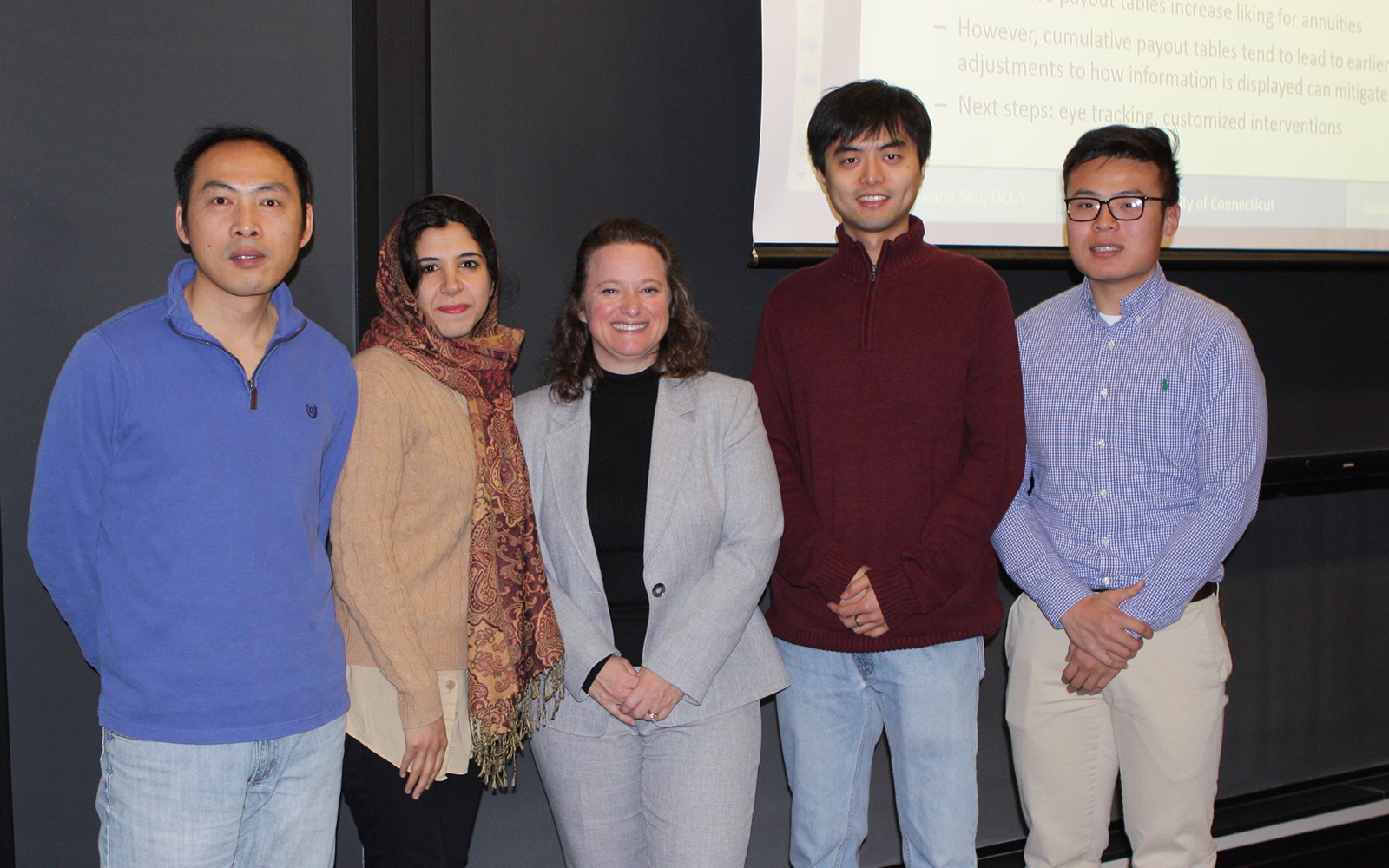
Suzanne Shu (centered) with Ph.D. Students Bin Li, Zahra Tohidinia, Lu Huang, and Qizhou Wang. (Nancy White/UConn School of Business)
Ph.D. Student Speaker Series Continues with Marketing
UCLA Marketing Professor Suzanne Shu discussed retirement savings, and how individuals make their decisions about how much to save and how much to spend, during a presentation to faculty and doctoral students on Jan. 29.
“Risk, Ownership and Loss in Decumulation During Retirement,” was the topic of her speech, presented as part of the School of Business Ph.D. Student Speaker Series, which was attended by faculty and doctoral students. Continue Reading