OPIM Innovate


Demonstration of Raspberry Pi

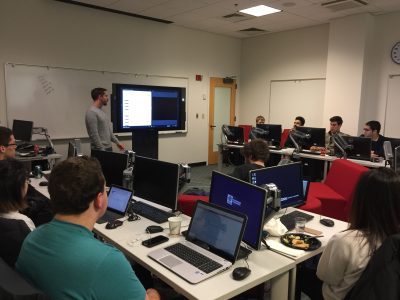
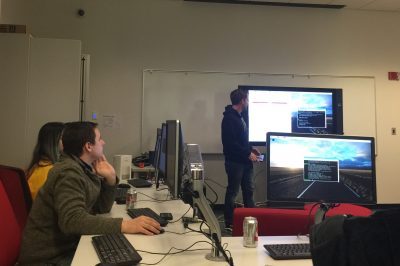
The latest in a series of technology workshops held by UConn’s Operations and Information Management (OPIM) Department demonstrated Raspberry Pi.

The latest in a series of technology workshops held by UConn’s Operations and Information Management (OPIM) Department demonstrated Raspberry Pi. The workshop was held in the OPIM Department’s Gladstein Lab on Friday, April 7th, as part of the department’s new OPIM Innovate Initiative.

The attendees of the workshop came from a wide range of backgrounds beyond Management Information Systems (MIS), including students from the School of Engineering and Computer Science Department.

OPIM adjunct faculty member, Ryan O’Connor instructed the workshop, stating his goal was to explain Raspberry Pi technology and show students what the technology is capable of.

O’Connor said that Raspberry Pi is a Microcontroller, which is basically a tiny portable computer. He said that some common uses of Raspberry Pi technology are to control devices in the home, to host a web server and for Internet of Things (IoT) technology, just to name a few.

“The possibilities are pretty much endless with Raspberry Pi,” O’Connor said.

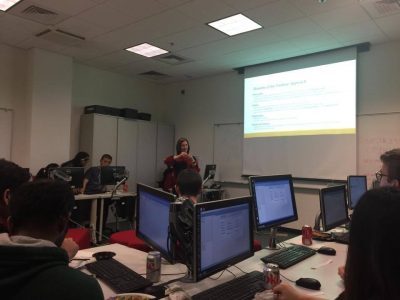
During the workshop, O’Connor gave an introduction to Raspberry Pi and instructed students on Students working on computers at the latest in a series of technology workshops held by UConn’s Operations and Information Management (OPIM) Department demonstrated Raspberry Pi.how to host and solve a web server using the technology.
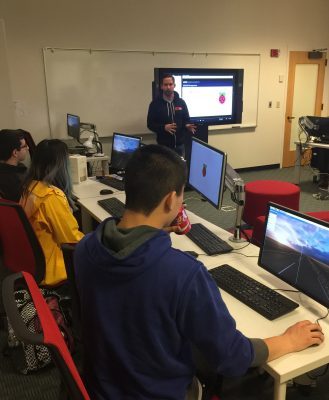
“By the end of the class everyone was hosting a web server off of Raspberry Pi. I don’t think that’s something they thought they’d be able to say coming out of the workshop, so I think it went well,” O’Connor said.

Students in attendance said they found the workshop and O’Connor’s presentation to be extremely informative. O’Connor said he was pleased with the outcome of the workshop, calling it a great success.

The next workshop, an Introduction to Gamification will be taking place on Friday, April 14th in the Gladstein Lab. Please register here to reserve your spot in the workshop as space is limited.

Getting Started with SAS

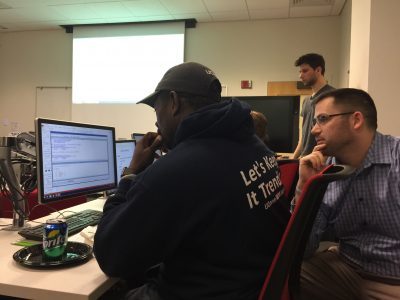
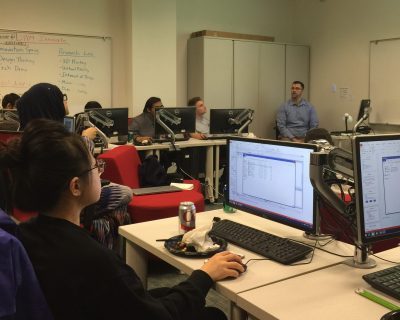
Individuals looking at a computer collaboratively at an SAS workshop.

The Operations and Information Management (OPIM) Department’s technology workshops continued on Friday, March 24th with an Introduction to SAS. The workshops are sponsored by the department throughout the semester as part of the OPIM Innovate Initiative.

UConn Management Information Systems (MIS) graduate and current OPIM adjunct faculty member, Marshall Dougherty instructed the workshop in the Gladstein Lab. In addition to his position here at UConn, Dougherty works at Traveler’s in Hartford where he said he uses SAS technology to perform analytics and automation.

According to Dougherty, SAS is a programming language, computer program and a software suite all in one. He said that the reason he really likes SAS is because it allows you to code the way you want to. A foundation of knowledge in SQL is very helpful to understanding SAS, because it can be used within the SAS program.

Through the workshop, Dougherty said he hoped to help the attendees to get over the initial “fear factor” of starting to work with SAS. He said his goals were to provide attendees with an educational first experience with SAS by introducing them to the basic functions, such as inputting information.

Student working on a computer at an SAS workshop.

The workshop gave a hands-on, interactive experience with SAS. Dougherty gave recommendations on how to successfully work with SAS and he guided students through using the program. Students were able to ask questions and receive assistance during the presentation.

“I hope the audience came away with a basic understanding of how to take excel files, put them into SAS and work with it,” Dougherty said.

One MIS student in attendance, Marc Senatore said he found the workshop to be very instructional. He said it sparked his interest in exploring SAS further. Senatore said it made him very interested in taking Dougherty’s SAS class in the Fall, if he were not graduating.

The next workshop, an Introduction to Raspberry Pi will be taking place on Friday, April 7th in the Gladstein Lab. Please register here to reserve your spot in the workshop as space is limited.
Additionally, Jon Moore, the coordinator of the OPIM Innovate Initiative said he would like to hear any feedback or suggestions that students have and to please email him at jonathan.a.moore@uconn.edu with these requests.


Practicing with SQL

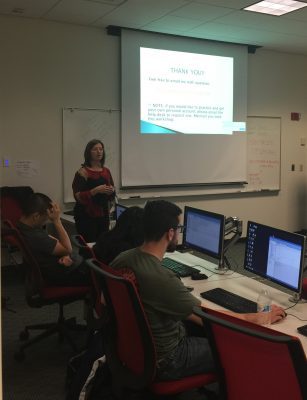
Presenter speaking at practicing with SQL workshop.

On Friday, February 24th, the Operations and Information Management (OPIM) Department’s Gladstein Lab maxed out in attendance for the second technology workshop of the semester, an Introduction to SQL. The workshop is part of a series of technology workshops being put on by the department throughout the semester, as part of the new OPIM Innovate Initiative.

For those who do not know, SQL (Structured Querying Language) is a data-driven application that retrieves information from databases and allows for creating, processing and querying data by retrieving information.

Anna Radziwillowicz, an Instructor in-Residence at the Hartford and West Hartford campuses, taught the workshop with the goal of giving students a basic understanding of SQL and practice writing queries. Radziwillowicz gave a background on databases before moving into creating a data table.

Presenter speaking at practicing with SQL workshop.Three students at the workshop claimed to have previous experience using SQL, Radziwillowicz said. Because the majority of the students did not have any or limited experience, she concentrated on giving students a basic overview of the technology, not going too far in depth. She said that a continuation class was a possibility if there was enough interest.
 

The OPIM Department created demo accounts for students to practice with SQL. During the workshop, students practiced retrieving data from a database, creating a data table and entering data to the table.

At the end of the workshop, Radziwillowicz said students could request a personal account to further practice with SQL at the Business Help Desk by mentioning completion of the workshop.

Keep up-to-date with the upcoming workshops and register online ahead of time to reserve your spot at the next workshop.


About the OPIM Innovate Initiative

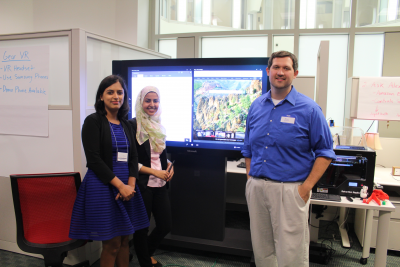
Three individuals posing in front of a presentation screen.

OPIM Innovate is the new initiative adopted by the Operations and Information Management (OPIM) Department in the Fall 2016. The initiative was developed to market the Management Information Systems (MIS) major and to bring new emerging technology to students.

Department Head Ram Gopal and Instructor in-Residence Jonathan Moore developed and implemented the initiative by expanding the department’s research lab space, bringing in new emerging technology. The lab is equipped with Virtual Reality (VR), 3D Printing, Internet of Things (IoT), Microcontrollers and data analytics.

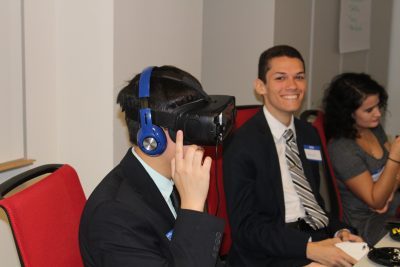
Student wearing headphones while wearing a VR headset as another student smiles next to him.

Initially, the OPIM Department came up with the initiative because they were finding that MIS students with internships in the field were working in innovation centers with technologies, such as IoT, drones, and VR.

“We realized that many interests lie in technology outside the provided curriculum,” Moore said of the expansion.

Moore said that this idea lead to building a more dedicated space for students and faculty in the department to work on projects and learn about different types of technology outside of the classroom. As a whole, the initiative is meant to help students work through the process of completing a project, while learning new technology in the process.

Beginning in the Fall, Moore organized multiple workshops for students featuring different topics relating to new technology. So far there have been workshops about Linux, 3D Printing, Splunk Analytics, IoT, Tableau, and VR. What started as exclusive to MIS students, workshops are now open to all students.

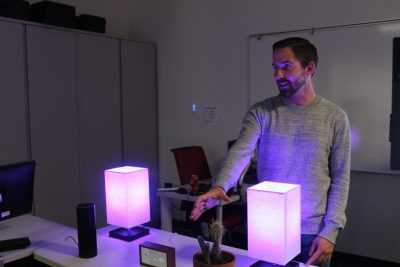
Man gesturing toward purple glowing lights.

This spring, with the initiative more developed, OPIM Innovate hired a team of students, trained in the design thinking process to operate the Innovation Space and Research lab. Having these students involved helps guide users of the space and to provide technology demonstrations and follow ups to the formal workshops.

An advisory group, made up of students and faculty, has been formed for the initiative to brainstorm different ideas, provide feedback on the current processes and to build buy-in from different areas. Moore said that they are always looking for students or faculty interested in joining the advisory group to share their ideas for the innovation space, future workshops, and to give him any feedback they may have. Any individuals interested in joining the advisory group should contact Jonathan Moore at jonathan.a.moore@uconn.edu.

In the future, Moore hopes to team up with other groups at UConn and potentially outside companies to advance the space and better the experience for students.


Get Up and Running with Linux

OPIM faculty member, Ryan O’Connor instructing the Linux workshop.

The Operations and Information Management (OPIM) Department kicked off the first in a series of technology workshops on Friday, February 10th as part of the department’s newly implemented initiative called OPIM Innovate.

OPIM faculty member, Ryan O’Connor instructed the workshop, introducing the Linux operating system. The workshop focused on giving attendees a background on Linux and how to use it.

O’Connor went on to explain the different systems that operate on Linux, such as – research systems, gaming systems, Androids, supercomputers and point-of-sale machines. As for what makes Linux a superior operating system, O’Connor said it is more secure than Windows or Mac.

“Every Facebook post you make, every YouTube video you watch, every Google search you run, is done on Linux,” O’Connor said, quoting an article from ZDNet.

Because of this fact, Linux is important beyond just the information technology field, but in every day life, O’Connor said. The Internet would not run without the Linux system, he said.

When O’Connor asked the group if they had any experience using Linux in the past, many students responded to having some exposure to the software. One student admitted to using Linux for his every day needs for a year, giving up Windows and Mac programs. He said that through this experiment he found that the only thing he missed from other operating systems were the Microsoft Office programs. Other than that, he said Linux was very efficient.

Another student said that prior to the workshop he was aware of Linux. Alex, an engineering student, said he came to the workshop to gain more exposure and experience with the technology because he knows just how widely it is used.

To conclude the workshop, O’Connor gave students information on how to get up and running with Linux, using VirtualBox software.

Despite the snow from the day before, there were 22 students in attendance for the workshop, which took place in the OPIM Department’s Gladstein Lab. The majority of attendees registered in advance with a few students walking in.

The next workshop, an Introduction to SQL, will take place on Friday, February 24th in the Gladstein Lab.


OPIM Workshops for the Spring 2017 Semester

The OPIM Department is excited to announce the schedule for this semester’s technology workshops. The first in a series of skill-building workshops will be held next week, followed by three others over the course of the semester.

All workshops will be held in the OPIM Research Lab (BUSN 391). Food and refreshments will be provided for participants.

Over the course of the spring semester we plan to have the following workshops:

  • Introduction to Linux – Friday, February 10th
  • Introduction to SQL – Friday, February 24th
  • Introduction to SAS – Friday, March 24th
  • Introduction to Raspberry Pi – Friday, April 7th
  • Introduction to Gamification – Friday, April 14th
  • Exploring IOT through SPLUNK Analytics – Friday, April 21st

All workshops will be capped at 20 people.