Web cookies (also called HTTP cookies, browser cookies, or simply cookies) are small pieces of data that websites store on your device (computer, phone, etc.) through your web browser. They are used to remember information about you and your interactions with the site.
Purpose of Cookies:
Session Management:
Keeping you logged in
Remembering items in a shopping cart
Saving language or theme preferences
Personalization:
Tailoring content or ads based on your previous activity
Tracking & Analytics:
Monitoring browsing behavior for analytics or marketing purposes
Types of Cookies:
Session Cookies:
Temporary; deleted when you close your browser
Used for things like keeping you logged in during a single session
Persistent Cookies:
Stored on your device until they expire or are manually deleted
Used for remembering login credentials, settings, etc.
First-Party Cookies:
Set by the website you're visiting directly
Third-Party Cookies:
Set by other domains (usually advertisers) embedded in the website
Commonly used for tracking across multiple sites
Authentication cookies are a special type of web cookie used to identify and verify a user after they log in to a website or web application.
What They Do:
Once you log in to a site, the server creates an authentication cookie and sends it to your browser. This cookie:
Proves to the website that you're logged in
Prevents you from having to log in again on every page you visit
Can persist across sessions if you select "Remember me"
What's Inside an Authentication Cookie?
Typically, it contains:
A unique session ID (not your actual password)
Optional metadata (e.g., expiration time, security flags)
Analytics cookies are cookies used to collect data about how visitors interact with a website. Their primary purpose is to help website owners understand and improve user experience by analyzing things like:
How users navigate the site
Which pages are most/least visited
How long users stay on each page
What device, browser, or location the user is from
What They Track:
Some examples of data analytics cookies may collect:
Page views and time spent on pages
Click paths (how users move from page to page)
Bounce rate (users who leave without interacting)
User demographics (location, language, device)
Referring websites (how users arrived at the site)
Here’s how you can disable cookies in common browsers:
1. Google Chrome
Open Chrome and click the three vertical dots in the top-right corner.
Go to Settings > Privacy and security > Cookies and other site data.
Choose your preferred option:
Block all cookies (not recommended, can break most websites).
Block third-party cookies (can block ads and tracking cookies).
2. Mozilla Firefox
Open Firefox and click the three horizontal lines in the top-right corner.
Go to Settings > Privacy & Security.
Under the Enhanced Tracking Protection section, choose Strict to block most cookies or Custom to manually choose which cookies to block.
3. Safari
Open Safari and click Safari in the top-left corner of the screen.
Go to Preferences > Privacy.
Check Block all cookies to stop all cookies, or select options to block third-party cookies.
4. Microsoft Edge
Open Edge and click the three horizontal dots in the top-right corner.
Go to Settings > Privacy, search, and services > Cookies and site permissions.
Select your cookie settings from there, including blocking all cookies or blocking third-party cookies.
5. On Mobile (iOS/Android)
For Safari on iOS: Go to Settings > Safari > Privacy & Security > Block All Cookies.
For Chrome on Android: Open the app, tap the three dots, go to Settings > Privacy and security > Cookies.
Be Aware:
Disabling cookies can make your online experience more difficult. Some websites may not load properly, or you may be logged out frequently. Also, certain features may not work as expected.
AACSB International – AACSB International announced today that 64 business schools have extended their accreditation in business, and 24 schools have extended their accreditation in accounting.
Financial columnist Andrew Sorkin, writing in the New York Times on Aug. 11, 2015, cited political scrutiny of stock buybacks noting “…a backlash from some investors and government officials, who have questioned whether such use of profits is a productive way to deploy capital rather than reinvesting in businesses and jobs.” Continue Reading
Union Recorder – Dr. Kathleen Monds recently went to the Land Down Under to learn how to protect the planet. She brought that knowledge back to her Southwest Georgia students at Albany State University where she is a professor.
Nerac – Nerac (www.nerac.com/) is pleased to announce the next XcellR8 meeting which will be held Thursday, April 28, 2016 at the Nerac headquarters in Tolland, CT. The XcellR8 meetings are high energy, interactive gatherings for entrepreneurs to pitch ideas and concepts and to brainstorm creative solutions to challenges. XcellR8 welcomes Greg Kirber and the team from PartsTech, Inc. (www.partstech.com/)
Mo Hussein (Nathan Oldham/UConn School of Business)
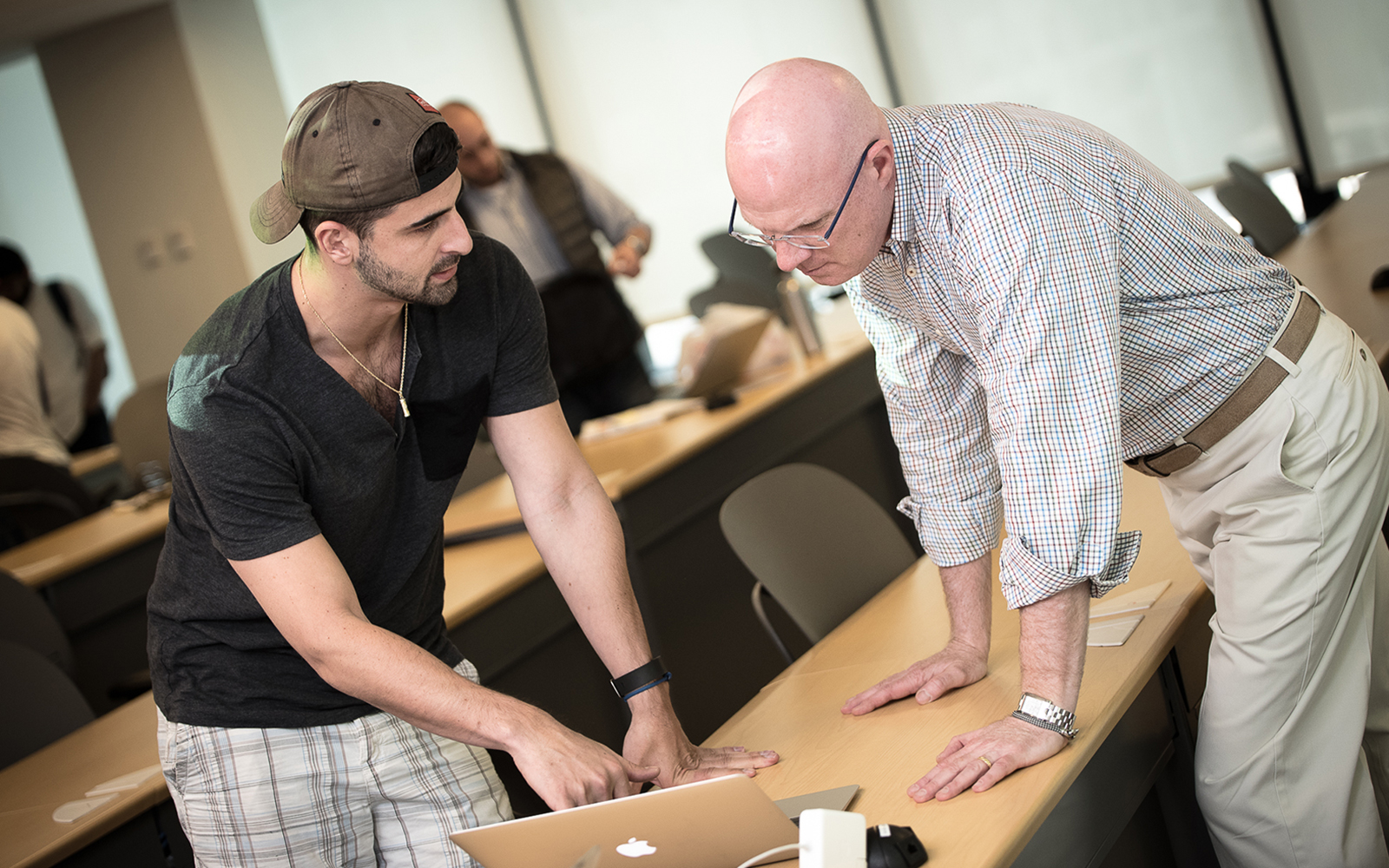
One of the first things people notice about Accounting Professor Mo Hussein is his warm personality. The second, is that he enjoys a little mischief.
“I once told students that my grandfather was a witch doctor,” he said, with a twinkle in his eye. “And some of them believed it!”
Hussein has spent his 38-year career at UConn, where he has taught thousands of students and helped to build the accounting department’s reputation as among the best in the nation. He also served as accounting department head from 1989-90 and from 2003-15, and as interim dean of the School of Business from 2006-07. Continue Reading
Welcome to the Spring 2016 Research Newsletter of the University of Connecticut School of Business. As a top public research institution, our faculty are drawn, in part, by the opportunity to merge their love of teaching with their passion for discovery. This spring, our professors have studied a wide range of topics in the business field. In this issue, we feature a fascinating article about how…
Retired Management Professor John Clair Thompson, 83, passed away this month. He had served on the faculty from 1967-1996, focusing on economics and business environment and policy. Colleagues recall him as kind, honest, caring, intelligent and witty. Family members said he was an avid reader, enjoyed classical music, completed the NYT crossword puzzles in ink. He was also an elegant dresser and a skilled sportsman who played tennis ambidextrously.
Office of the Vice President for Research -A dozen promising technologies are making progress toward the market thanks to Accelerate UConn (AU), the University of Connecticut’s National Science Foundation (NSF) entrepreneurship program. Several high-potential faculty-student teams recently completed rigorous business training provided through the program, culminating with final presentations before their peers, university administrators, and members of the business community.
It isn’t a question of if your company’s cyber-security system will be breached, it is a matter of when.
That’s what retired Air Force Major General Brett T. Williams told more than 150 business executives and graduate students gathered at the Hilton Stamford Hotel and Executive Meeting Center for the UConn School of Business’ 4th Annual Connecticut Risk Management Conference.Continue Reading